How Do Fish Breathe Underwater?
SUMMARY OF THIS ARTICLE
- Fish breathe by taking in oxygen that is dissolved in water, not by breathing air like we do.
- Water flows into a fish’s mouth and over its gills, which are feathery organs full of tiny blood vessels.
- Oxygen passes from the water into the fish’s blood through very thin walls, and carbon dioxide passes out the other way.
- Blood inside the gills flows in the opposite direction to the water, which helps the fish take in far more oxygen.
- Humans cannot breathe underwater because our lungs are built for air, not water, and water holds far less oxygen than air does.
Watch a Fish for One Minute
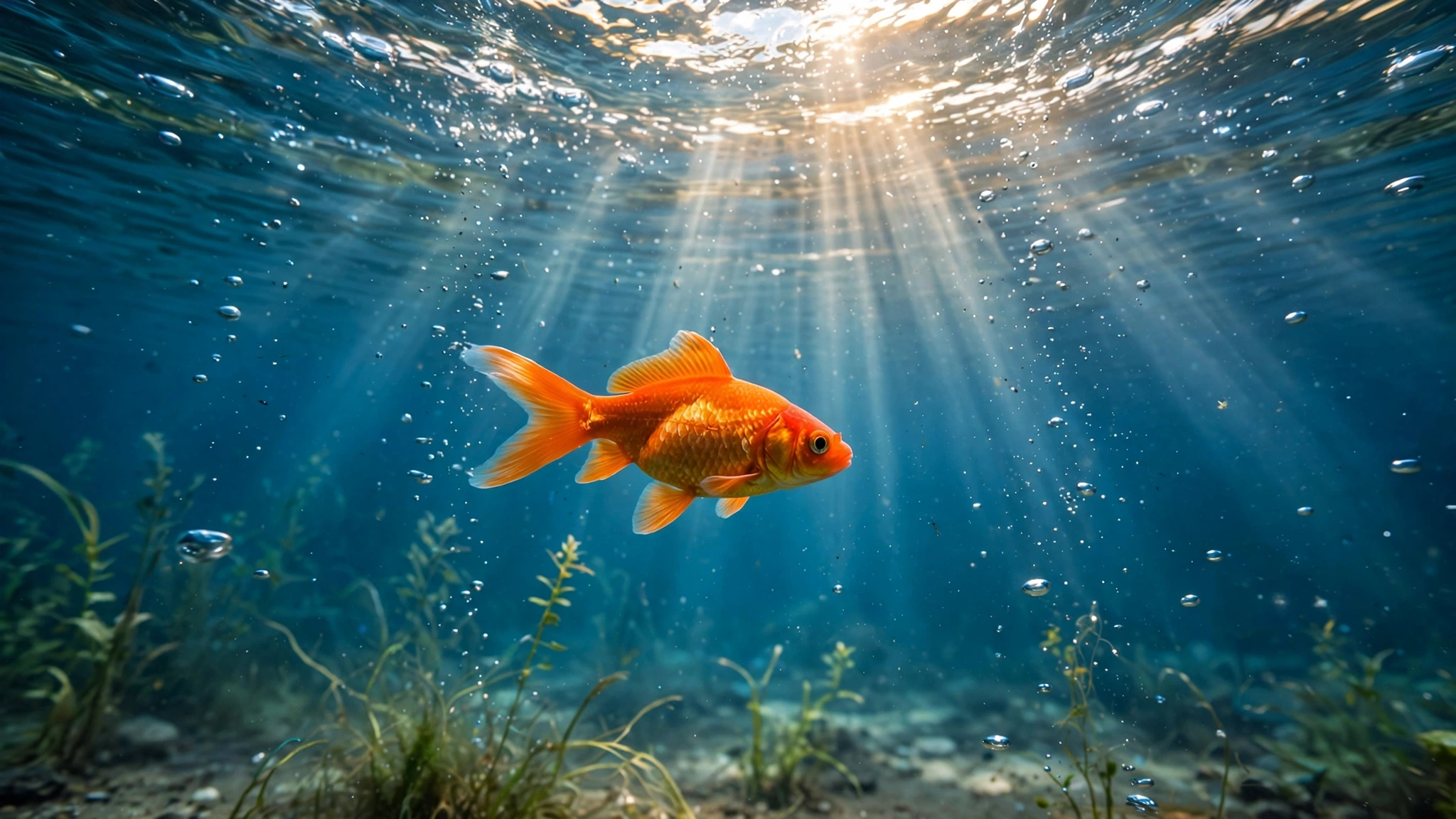
Find a fish and watch it for one minute. It can be a goldfish in a bowl at home, a fish in a tank at a pet shop, or a fish in a pond in the park. Just watch its mouth.
You will see the mouth open and close, open and close, again and again. It never stops. It looks a little bit like the fish is chewing, or talking, or yawning over and over. But the fish is not eating. It is not talking. It is breathing.
That steady opening and closing is the whole secret of life underwater. Every time the mouth opens, water comes in, and hidden in that flow is the oxygen the fish needs to stay alive.
We breathe without thinking about it. Our chest rises and falls, and air comes in and out of our lungs. A fish does the same kind of thing, but with water instead of air. The tool it uses is not a lung. It is a gill.
In this article, we will look at gills up close, see how a fish pulls oxygen out of the water, and meet a few fish that cheat and gulp air from the surface. And we will answer the question every child asks sooner or later: if fish can breathe underwater, why can’t we?
The Short Answer
Fish do not breathe water itself. That is a common mix-up. A fish does not split water into oxygen and hydrogen. It cannot do that, and it does not need to.
Water already holds oxygen inside it. The oxygen is dissolved in the water, which means it is spread through the water in tiny parts you cannot see, just like sugar spread through a cup of tea. You cannot see the sugar once it has dissolved, but it is still there, and you can taste it. In the same way, you cannot see the oxygen in a glass of water, but it is there.
A fish pulls that hidden oxygen out of the water with its gills. Water flows in through the mouth, washes over the gills, and flows out through openings on the sides of the head. As the water passes over the gills, oxygen moves into the fish’s blood, and a waste gas called carbon dioxide moves out of the blood into the water, which carries it away.
That is the whole job in one sentence: water in, oxygen in, waste gas out, water out. It happens all day and all night, for the whole life of the fish.
What Is Dissolved Oxygen?
To understand fish, you first need to understand the water they live in. Real water from a river, a lake, or the sea holds a small amount of oxygen gas mixed into it. Scientists call this dissolved oxygen, and it gets into the water in a few simple ways.
First, oxygen from the air mixes into the water at the surface. Wind and waves help. When the wind blows across a lake, it stirs the top layer of water and pushes air into it, so the moving water picks up more oxygen.
Second, water plants and tiny floating plants called algae make oxygen. They use sunlight to grow, and as they grow they release oxygen into the water, just like trees release oxygen into the air.
Third, cold water holds more oxygen than warm water. A cold mountain stream can hold more dissolved oxygen than a warm, still pond. That is one reason trout and salmon, which need a lot of oxygen, live in cold, fast water.
But here is the hard part for fish. Water holds far, far less oxygen than air does. About one fifth of the air around you is oxygen. Water holds only a tiny amount by comparison. A fish has to work hard to get enough oxygen out of such a thin supply. That is why gills are so good at their job. They have to be.
Meet the Gills
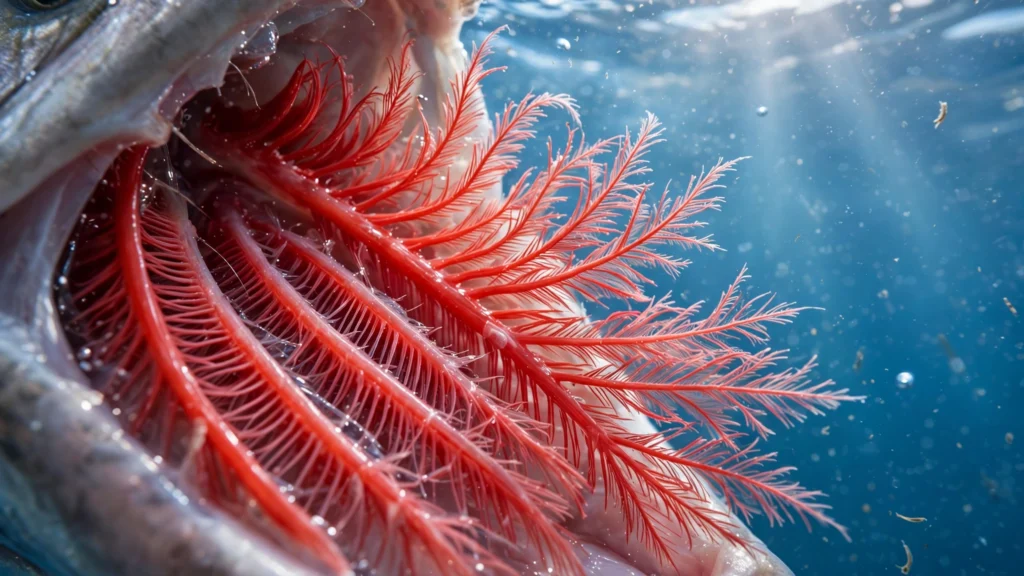
So what does a gill actually look like? Under the gill cover, on each side of the head, sits a set of gills. A fish has four gill arches on each side, and each arch holds many thin, feathery strands.
Those strands are called filaments. They look a bit like the teeth of a fine comb, or like tiny red feathers, and they are red because they are full of blood. If you look very closely, each filament is covered in even tinier flat plates called lamellae. These plates are the real working parts of the gill.
Think of a flat sheet of paper. Fold it many times, and you get a much bigger surface in the same small space. Gills do the same trick. By splitting into filaments, and then into thousands of tiny lamellae, a gill packs a huge surface into a small space behind the fish’s head. All that surface is where oxygen crosses from water into blood.
The walls of the lamellae are very, very thin. They have to be, because oxygen can only pass through a thin wall quickly. The thin wall also lets carbon dioxide pass out of the blood and into the water. One thin wall does two jobs at once, in both directions.
The gills sit under a hard flap called the operculum, or gill cover, on the side of the fish’s head. It opens and closes as the fish breathes, protects the soft gills from dirt and damage, and helps push water out after it has passed over the gills.
How Water Moves Over the Gills
A fish does not just wait for water to drift over its gills. It pumps the water, using its mouth and gill covers like a small pump that runs all the time.
Here is how it works. First, the fish opens its mouth and water flows in. Then the fish closes its mouth and squeezes. The water has only one way to go: back over the gills and out through the openings under the gill covers, which open to let the water out, then close again for the next mouthful.
This is a one-way flow. Water always moves in the same direction: in through the mouth, over the gills, out through the sides. It never flows backwards, so fresh, oxygen-rich water is always arriving at the gills.
You can watch this pump working if you look at a fish in a tank. The mouth opens, the gill covers puff out a little, and the mouth closes again. Open, puff, close. It goes on all day and all night, even while the fish sleeps.
Some fish use a second trick as well. Fast swimmers like tuna and some sharks swim with their mouths open and let the water rush in as they move. This is called ram ventilation, and it saves energy, because the fish does not need to pump. But the fish must keep swimming, or it stops breathing. Most fish, though, can pump water while sitting still, so a goldfish in a bowl can sit in one spot all day and keep breathing.
The Clever Trick: Opposite Directions
Now we come to the cleverest part of the whole system. It is called countercurrent exchange, and it sounds harder than it is.
Inside each tiny lamella, blood flows in thin vessels, and water flows past on the outside. The trick is that the blood and the water flow in opposite directions, like two people walking in opposite directions on a narrow path.
Why does this help? Think about what happens if the two flows go the same way. Fresh water full of oxygen meets fresh blood low in oxygen, and oxygen moves from the water into the blood. That is good. But as they travel along together, the water loses oxygen and the blood gains it. Soon they are about equal, and no more oxygen can move across, because oxygen only moves from a place with more of it to a place with less. Halfway along the gill, the transfer would stop.
Now think about opposite directions. Fresh water full of oxygen meets blood that has already picked up oxygen along most of its journey, but is still a little bit short, so oxygen still moves across. Then, as the water moves along, it meets blood with less and less oxygen, and oxygen keeps moving across, all the way to the end.
In simple words: because the flows go in opposite directions, the water always has a little bit more oxygen than the blood next to it, no matter where you look along the gill. So oxygen keeps moving into the blood from start to finish. Nothing is wasted. Scientists who study fish say that gills can take in a large share of the oxygen in the water that passes over them, often around three quarters or more.
What Happens After the Oxygen Gets In?
Once oxygen crosses into the blood, the job is only half done. The blood has to carry that oxygen to every part of the fish’s body: the muscles that swim, the brain, the gut, and the tail.
A fish’s heart pumps the blood around the body, just like your heart does. It pushes blood first to the gills, where it picks up oxygen. Then the blood flows on to the rest of the body, where cells use the oxygen to release energy from food. That energy powers everything the fish does.
As the cells use oxygen, they make carbon dioxide as a waste product. The blood carries it back to the gills, where it passes out through the thin walls into the water, and the water carries it away. Then the blood, low in oxygen again, goes around the loop once more.
It is a circle, and it never stops. Oxygen in at the gills, energy used in the body, carbon dioxide out at the gills. The same loop runs in your body too, except that your loop starts at the lungs. The idea is the same. Only the tool is different.
Why Fish Cannot Breathe Out of Water
If gills are so good at their job, why does a fish die so quickly out of water? The answer is in the design of the gill itself.
Gills are built for water, not for air. In water, the thin filaments and lamellae float apart, spread out like a fan, so the full surface is open to the flow.
Out of water, there is nothing to hold the filaments apart. They collapse and stick together in a wet clump, like wet hair sticking together when you come out of a shower. When they stick together, most of the surface is hidden, and oxygen cannot reach it. The fish can still open its mouth and move its gill covers, but almost no oxygen gets in.
There is a second problem too. Gills need to stay wet to work, because the thin walls of the lamellae let gases pass through only when they are wet. In air, the delicate gill tissue dries out quickly, and dry tissue cannot pass oxygen well.
So a fish out of water is in real trouble within minutes. Its breathing tool simply does not work in air. It is like trying to use a net to carry water. The tool is perfect for one job and useless for the other. That is why fishermen and pet owners are told to handle fish gently and return them to the water fast.
Why Humans Cannot Breathe Underwater
Now turn the question around. If a fish cannot breathe air, why can we not breathe water? We have lungs, and lungs are wonderful tools. But they are built for air, and air and water are very different. Here is why.
First, water holds far less oxygen than air. Our lungs are made to take oxygen from air, which is rich in it. If we tried to breathe water, our lungs would get only a tiny amount of oxygen from each breath. We would have to move a huge amount of water through our lungs, and our lungs are not built to pump water like that. A fish’s gills are.
Second, water is heavy and thick compared to air. Water is about 800 times denser than air. Try to breathe in a mouthful of water and you will feel it at once. Your chest muscles are not strong enough to pull water in and push it out, over and over, fast enough to live. A fish’s mouth pump is made for water. Your chest is made for air.
Third, your lungs are made of tiny air sacs that must stay full of air to work. If water gets into those sacs, it blocks the way, and oxygen cannot pass into your blood. That is what happens when someone nearly drowns.
So the reason is not that humans are weak. It is that we have the wrong tool for the job. Lungs are perfect for air. Gills are perfect for water. Each tool fits its own world, and neither tool works well in the other world. This is also why scuba divers carry tanks of air: the tank lets a diver take the air world down under the water.
The Fish That Cheat: Air-Breathers
Most fish follow the rules we have talked about. But a few fish cheat, in a good way. They have found a second way to get oxygen, which lets them live in places where other fish would die.
The most famous cheats are the lungfish. A lungfish has gills, but it also has a simple lung, a bit like ours, and it can rise to the surface and gulp air. Some lungfish live in ponds that dry up in the hot season. When the pond dries, the lungfish buries itself in the mud, breathes air, and waits for the rain.
Then there are the bettas, also called Siamese fighting fish, and their cousins the gouramis. These small, bright fish have a special organ called a labyrinth organ, which sits near the gills and works a bit like a lung. A betta can swim to the surface, gulp a mouthful of air, and take oxygen from it. This lets bettas live in warm, still water with very little oxygen dissolved in it, like rice paddies and slow ponds.
These fish are the exceptions, not the rule. Most fish depend on their gills alone. But when the water is warm, still, or drying up, a second way to get oxygen can save a fish’s life.
When the Water Runs Out of Oxygen
Fish need oxygen all the time, but the water does not always have enough. When oxygen runs low, you can often see it happening.
Warm water is the biggest problem. Cold water holds more oxygen than warm water, so on a hot summer day, a shallow pond warms up and the oxygen in it drops. Fish may swim near the surface, where the water holds the most oxygen, and gulp at the surface. If you see fish doing this, the water is short of oxygen.
Still water is another problem, because moving water picks up oxygen from the air and still water does not. At night it gets worse, because plants stop making oxygen when the sun goes down, but they keep using it.
Pollution makes things worse. When too much waste or farm chemicals get into a river or lake, tiny living things feed on it and use up oxygen as they grow. This can leave large areas with almost no oxygen at all. Scientists call these areas dead zones, because most fish cannot live in them.
Fish farmers know this well. They use air pumps to keep oxygen in the water, because a river full of fish is a river with enough oxygen, and a river with no fish may be a river that has lost its oxygen.
Why This Matters
Fish breathing may sound like a small topic, but it touches on big things: clean water, healthy rivers, food, and the climate.
People around the world eat fish, and fish farms raise fish for food. If the water in a fish farm runs low on oxygen, the fish get sick, grow slowly, or die. Farmers watch oxygen levels closely, because oxygen matters as much as food.
Even the salty ocean plays a part in this story. It is home to most of the world’s fish, and its salt, currents, and temperature all affect how much oxygen the water can hold. A fish in the sea must handle salt as well as oxygen, pushing extra salt out through its gills. And spare a thought for the Dead Sea. It is so salty that almost no fish can live in it at all. The Dead Sea is a reminder that fish need the right water, not just any water.
Frequently Asked Questions
Do fish drink water when they breathe?
No, not in the way we drink. A fish takes water into its mouth to breathe, but most of that water flows straight out over the gills. The fish does not swallow it into its stomach. Breathing water goes in the mouth and out the gills.
Can fish drown?
Yes, in a way. A fish drowns when it cannot get enough oxygen from the water, because the water has very little oxygen, the gills are damaged, or the fish is held out of water. The fish has no lungs, but the result is the same: the body runs out of oxygen, and the fish dies.
Do fish sleep, and do they keep breathing while they sleep?
Yes, fish rest, and they keep breathing while they rest. But the mouth pump never fully stops. A sleeping fish still opens and closes its mouth, still moves water over its gills, and still takes in oxygen. Breathing never takes a day off.
Do all fish have the same kind of gills?
No. All fish have gills, but the gills differ in size and shape to fit each fish’s life. Fast fish have big gills. Slow fish have smaller gills. Sharks have gill slits with no cover. Lungfish have gills plus a simple lung. The basic idea is always the same: thin walls, lots of surface, and water flowing over them.
Why do fish come to the surface and gulp air?
There are two main reasons. Some fish, like bettas and lungfish, gulp air on purpose because they have a special organ that can take oxygen from air. Other fish gulp at the surface because the water is low in oxygen, often on a hot day or in a crowded tank. The top layer of water holds the most oxygen, so the fish goes there for a better breath.
Can a fish breathe through its skin?
Some fish can take in a little oxygen through their skin, especially when their skin is wet and thin. Eels and mudskippers do this. But for most fish, the skin is not a main way to breathe. The gills do almost all the work. Skin breathing is a small extra, not a replacement.
More from Zorium Daily
If you liked learning how fish breathe, you may enjoy these other simple science guides from Zorium Daily. Read about why the ocean is salty and learn why sea water tastes so different from river water. Read about why the Dead Sea is so salty and why you float in it, a lake so salty that almost no fish can live there. Read about what causes thunder and lightning, another everyday wonder of nature explained in plain words. And read about why the sky is blue, to see how light and air paint the world above the water.
A Quiet Miracle, Happening All the Time
The next time you see a fish, stop and watch its mouth for a moment. Open, close. Open, close. It looks so small, so ordinary, that it is easy to miss. But inside that small movement is a whole system at work.
A fish does this without thinking, without stopping, from the day it hatches to the day it dies. It does it with an organ so thin and delicate that it would collapse in air, yet so efficient that it can pull life out of water that holds only a tiny amount of oxygen.
We breathe air without thinking. Fish breathe water without thinking. Both of us need the same thing: oxygen, delivered to the blood, carried to the body, used to make energy. We just take different roads to get there. You can find more simple science stories like this one in our Science section.