How Does a Drone Fly?
SUMMARY OF THIS ARTICLE
- A drone flies because its spinning propellers push air down, and the air pushes the drone back up.
- Most small drones have four propellers, each with its own motor, and two spin one way while the other two spin the opposite way.
- The drone steers by changing the speed of each motor: speed up all four to climb, slow them down to come down, and tilt to move forward or sideways.
- A small computer called a flight controller reads the gyroscope and other sensors many times every second to keep the drone steady.
- GPS helps the drone hold its place outdoors and fly back home on its own, while the battery sets how long each flight can last.
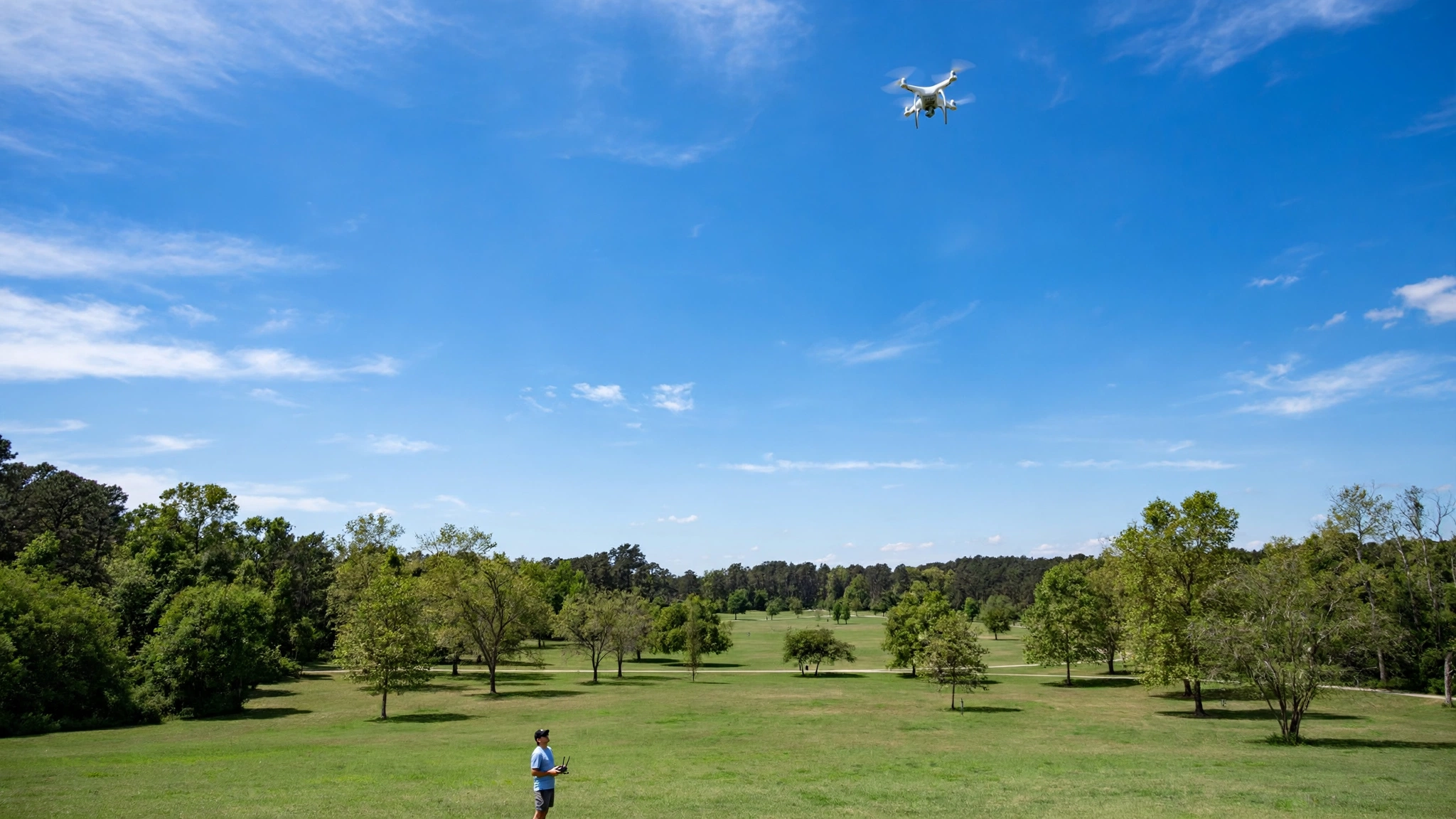
You have probably seen one by now. A small buzzing machine rises from a park lawn, hovers in the air like a strange insect, and then glides away over the trees. It has no wings. It has no pilot sitting inside it. And yet it flies, turns, climbs, and lands as gently as a feather settling on a table. How does it do that?
The answer is simpler than it looks. A drone flies with four spinning blades, four small motors, and one very busy little computer.
The Short Answer, in One Paragraph
A drone flies because its propellers push air downwards, and the air pushes back upwards. Most small drones, called quadcopters, have four propellers, each driven by its own small electric motor. When all four spin fast enough, the upward push becomes stronger than the weight of the drone, and it lifts off the ground. To move, the drone changes the speed of each motor: speed up the back motors a little and the drone tilts forward and flies forward; speed up one pair and slow down the other and it turns in place. A tiny computer on board, the flight controller, reads sensors like the gyroscope many times every second and makes tiny corrections before you can even notice them. Outdoors, GPS helps the drone know exactly where it is and hold its place in the sky.
What Is a Drone, in the Simplest Words?
A drone is a flying machine with no pilot on board. The proper name is an unmanned aerial vehicle, or UAV for short, but almost everyone just says drone. The person who flies it stays on the ground and controls it with a remote controller, or sometimes with a phone.
Most of the drones you see in parks and at weddings are quadcopters. Quad means four, and copter means a machine that flies with spinning blades, like a helicopter. So a quadcopter is a flying machine with four spinning blades. It has a small body in the middle, four arms reaching out like the legs of a table, and a motor and a propeller at the end of each arm.
People use drones to take photos and videos from the sky, to look at rooftops and farm fields, to help rescue teams find people, and to deliver small parcels.
The first thing to understand is that a drone has no wings, and that is fine. A plane needs wings because it moves forward fast, and the air rushing over its wings lifts it up. A drone does not need to move forward at all. Its propellers make their own wind, right where the drone is, and that wind is what lifts it.
The Big Idea: Push Air Down, Go Up
Every drone flies on one simple rule of nature. It is the same rule that lets you swim, row a boat, and jump off the ground. When you push against something, it pushes you back. Stand on the ground and jump. Your legs push down against the floor, and the floor pushes you back up. A drone does the same thing with air. Its propellers push air down, and the air pushes the drone up.
Scientists call this Newton’s third law, after Isaac Newton, who wrote it down more than 300 years ago. The law says that every action has an equal and opposite reaction. Push one way, and something pushes back the other way, just as hard. Just remember the picture: air goes down, drone goes up.
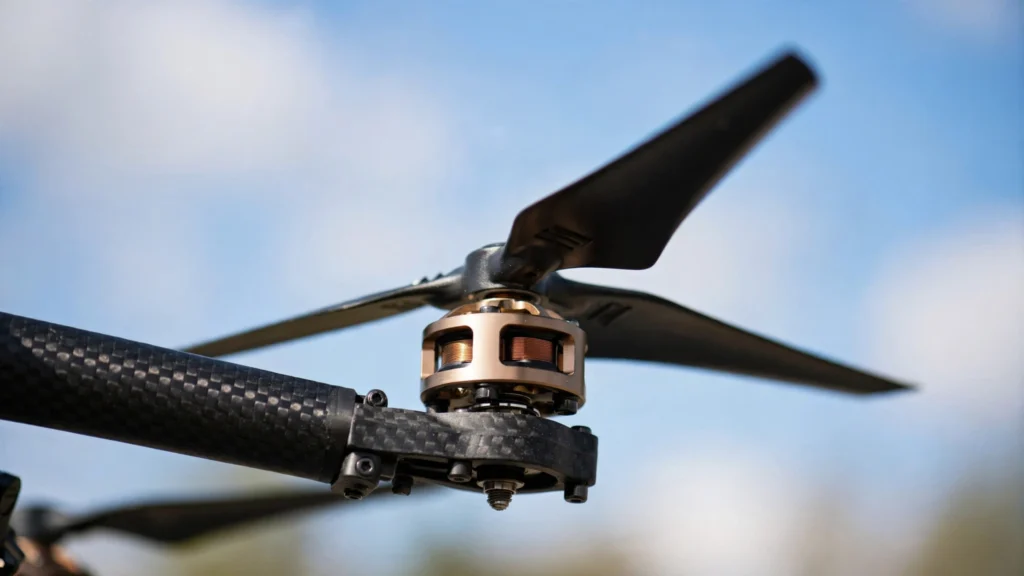
A propeller blade is not flat. It is curved and set at a small angle, a bit like the wing of a plane. As the motor spins it round and round, each blade slices through the air and shoves a little bit of air downwards. One spin moves only a little air, but the blades spin very fast, many times every second, so the little pushes add up to one big push. The faster the blades spin, the stronger the upward push becomes. Spin slowly, and the push is weaker than the drone’s weight, so the drone stays on the ground. Spin faster, and the push grows until it matches the weight, and the drone hovers. Spin faster still, and the drone climbs.
Four Propellers: Why Four, and Why Two Spin the Other Way
Why does a drone need four propellers? Why not one, like a helicopter? The answer is balance. Spinning a propeller is not free. When a motor spins a propeller one way, the propeller tries to twist the drone the other way. If all four propellers spun the same way, the whole drone would spin round and round in the air like a top, and it would be impossible to control.
A helicopter solves this with a small tail rotor. A quadcopter solves it in a smarter way. Two of its propellers spin clockwise, and the other two spin counter-clockwise. The twist from one pair cancels out the twist from the other pair, so the drone body stays still, with no tail rotor needed.
Four propellers also give the drone four separate controls. Each motor can speed up or slow down on its own. That is the whole steering system. A drone has no rudder, no flaps, and no moving wings. It has four fixed propellers, and everything it does — climbing, turning, flying forward, drifting sideways — comes from changing how fast each one spins compared to the others.
What Is Inside a Drone?
A drone looks simple from the outside, but inside its small body there is a tidy team of parts, each with a clear job. The frame is the skeleton, usually made of light plastic or carbon fibre, which is strong but very light. It holds everything together and keeps the weight down, because every extra gram is weight the propellers must lift.
The motors are small electric motors, and they are the muscles of the drone. Most modern drones use brushless motors, which can change speed very fast and last a long time. Each motor sits under a propeller and spins it directly. The propellers are the wings. Each one has two blades, set at an angle, and they are the only part that touches the air.
The battery is the fuel tank. It is a rechargeable lithium battery, a bigger cousin of the battery in your phone, and it powers the motors, the computer, the camera, and the radio. It is also the heaviest single part of a small drone. The flight controller is the brain: a small circuit board with a tiny computer on it. It reads the sensors, listens to your commands from the remote controller, and tells each motor how fast to spin, many times every second.
Then there are the sensors, the drone’s senses. The gyroscope feels when the drone tilts or turns. The accelerometer feels when it speeds up or slows down. The barometer measures air pressure to work out how high the drone is. And the GPS receiver listens to satellites to work out where the drone is on the map. Many drones also carry a camera on a small moving mount called a gimbal, which keeps the camera steady even when the drone tilts.
How a Drone Takes Off, Hovers, and Lands
Let us follow one flight from start to finish. Before take-off, the pilot puts the drone on flat ground, checks the propellers, and switches it on. The drone waits for a GPS signal and checks its battery. Then the pilot pushes the left stick on the remote controller gently upwards. That stick is the throttle, and it tells the flight controller how much lift the pilot wants.
First, the motors start. All four propellers begin to spin, slowly at first, then faster. As the pilot pushes the stick further, all four motors speed up together, and the upward push grows until it is stronger than the weight of the drone. It leaves the ground and rises straight up, because all four motors are pushing equally.
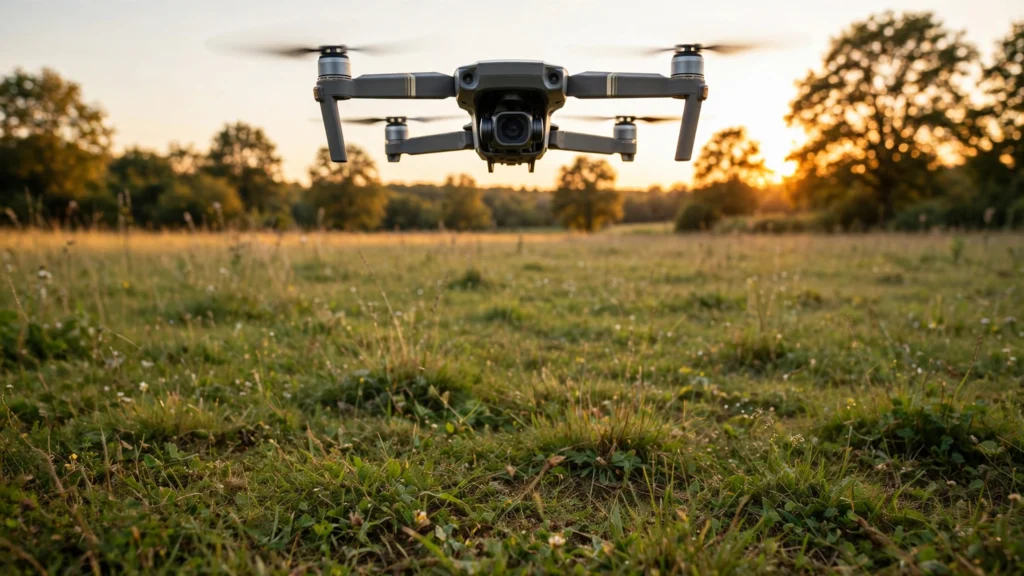
Then comes the hover. The pilot lets the stick settle in the middle, and the flight controller takes over the fine work. It makes the total lift exactly equal to the weight, so the drone hangs in the air, neither rising nor falling. A small gust of wind pushes the drone, and the controller pushes back before you can see the wobble.
To land, the pilot pulls the throttle stick down gently. All four motors slow down together, the lift drops below the weight, and gravity takes over. The drone sinks slowly towards the ground, and the controller keeps it level all the way down, so it lands softly. That is the whole up-and-down story: climb means all four motors faster, come down means all four slower, and hover means all four just right.
How a Drone Moves Forward, Backward, and Sideways
A drone has no propeller pointing forward, so how does it fly forward at all? It does it by tilting. To fly forward, the flight controller slows down the two front motors a tiny bit and speeds up the two back motors a tiny bit. The back of the drone lifts a little higher than the front, so the whole drone tilts nose-down. Now the propellers are no longer pushing straight down. They are pushing down and a little bit backwards, which means the air pushes the drone up and a little bit forwards.
To fly backward, the drone does the opposite: the front motors speed up, the back motors slow down, the nose lifts, and the drone drifts backwards. To slide left, it tilts to the left. To slide right, it tilts to the right. The bigger the tilt, the faster it moves, so a gentle tilt means a slow drift and a steep tilt means a fast dash.
How a Drone Turns in Place
Turning in place is called yaw, and it uses the clever two-way spin we met earlier. Remember that two propellers spin clockwise and two spin counter-clockwise, and their twists cancel each other out. To turn, the flight controller breaks that balance on purpose, just a little. To turn right, it speeds up the two propellers that spin one way and slows down the two that spin the other way, by the same small amount. The total lift stays the same, so the drone does not climb or fall, but the twists no longer cancel. The stronger twist wins, and the drone rotates slowly to the right. To turn left, it does the opposite.
The neat part is that yaw needs no tilt at all. The drone can spin in place while staying perfectly level, which is very handy when a pilot wants to turn the camera towards something without flying away from it.
The Brain: The Flight Controller
No human could do that by hand. Our reactions are too slow, and we have only two sticks on a controller, not four motors to adjust. So the drone carries its own balancer: the flight controller. It is a small circuit board, about the size of a matchbox, with a tiny computer on it. It reads the sensors, works out which way the drone is leaning, and tells each motor what to do. It does this loop — read, think, adjust — dozens or even hundreds of times every second. When a gust of wind tips the drone, the controller feels it, speeds up the right motors, and levels the drone before your eyes can see the wobble.
The controller also listens to you. When you push a stick on the remote, you are not talking to the motors directly. You are telling the controller what you want — go up, go forward, turn left — and the controller works out which motors to speed up and which to slow down.
How a Drone Stays Steady: The Gyroscope and Other Sensors
A drone in the air is like a person standing on a boat. The wind pushes, the air shifts, and the machine must correct itself all the time. Its sensors are what make that possible, and the most important one is the gyroscope. A gyroscope is a small sensor that feels rotation. It can tell when the drone is tilting forward, rolling sideways, or turning around, and how fast. It is the same kind of sensor that lives inside your phone and tells the screen to turn when you turn the phone sideways. Your smartwatch uses a similar sensor to count your steps.
Next to the gyroscope sits the accelerometer. If the gyroscope feels turning, the accelerometer feels speeding up and slowing down. Together, they are called an IMU, which is short for Inertial Measurement Unit. Here is how they work together. A gust of wind tips the front of the drone down. The gyroscope feels the tilt at once and tells the flight controller. The controller speeds up the front motors a fraction and slows down the back ones, and the drone levels out, so fast that to your eyes the drone looks perfectly still.
How GPS Helps a Drone Hold Its Place
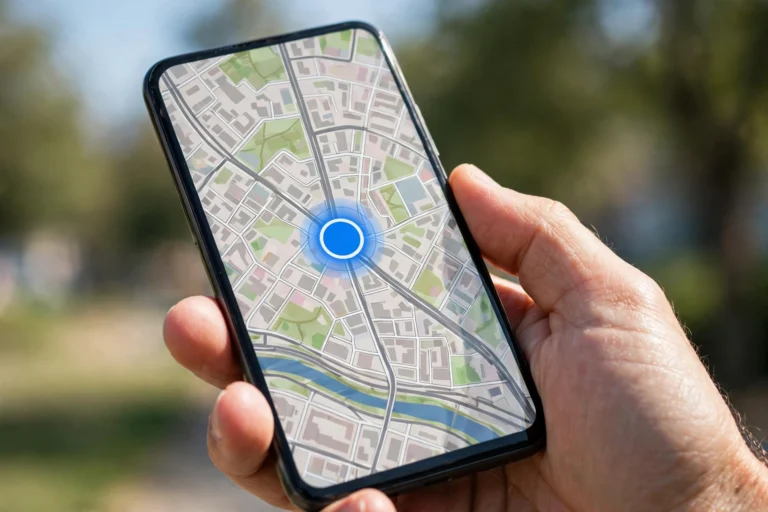
Outdoors, a drone has one more helper, and it lives far above the clouds. GPS, which is short for Global Positioning System, is a set of satellites that circle Earth and send out radio signals all the time. A drone with a GPS receiver listens to those signals and works out exactly where it is on the map, just like your phone does when it shows the little blue dot. If you want the full story, read our simple guide to how GPS knows where you are.
The flight controller checks the GPS position several times a second. If the wind pushes the drone a metre to the left, the controller sees the change and pushes it back to the right. That is how a drone can hover in one place in a breeze. GPS also gives a drone one clever trick: return to home. When the drone takes off, it remembers its starting point. If the battery runs low, or the radio link is lost, the drone can fly itself back and land on its own.
But GPS is not perfect. It needs a clear view of the sky. Indoors, under a thick roof, or between very tall buildings, the signals can be weak or bounce off walls, and the drone may drift. That is why pilots are told to wait for a strong GPS signal before take-off, and to keep the drone where they can see it.
How the Remote Control Talks to the Drone
How does the person on the ground tell the drone what to do? The answer is radio waves, the same invisible waves that carry music to your earbuds and the internet to your phone. Most drones come with a remote controller, a small box with two sticks, some buttons, and often a phone clipped on top to show the camera view. When you push a stick, the controller turns that movement into a radio signal and sends it through the air to the drone.
The link works both ways. The drone sends information back: its height, its battery level, its GPS position, and a live video picture from its camera. That is how the pilot can see what the drone sees, even when the drone is far away. The video comes back over a wireless link too, often over Wi-Fi, and it shows up on the phone screen clipped to the controller.
Some small drones skip the separate controller and let you fly them from a phone app instead, over Wi-Fi or Bluetooth. The radio link has a range, and walls, trees, and hills can weaken it. If the link breaks, a good drone will hover, or fly home on its own, instead of falling. The drone and the controller are also paired, like your phone and your noise-cancelling earbuds, so your controller does not accidentally fly someone else’s drone.
The Battery: Why Drones Cannot Fly All Day
If there is one thing every drone pilot wishes for, it is a longer flight. Most small camera drones fly for less than half an hour on one battery, and smaller ones often fly for less than ten minutes. Why so short? The answer is weight. A drone’s battery must lift itself. A bigger battery holds more power, but it is also heavier, so the motors must work harder to lift it, which uses more power.
Four motors spinning fast use a lot of power. They must fight gravity every second of the flight, with no rest. A plane can glide for a while with its engines quiet, but a quadcopter cannot glide at all. If the motors stop, it falls. Cold weather makes it worse, because batteries do not like the cold, and strong wind shortens a flight too, because the motors must work harder to hold the drone steady.
Frequently Asked Questions
How does a drone stay in the air without wings?
It does not need wings, because its propellers make their own lift. Each spinning blade pushes air down, and the air pushes the drone up. When all four propellers spin fast enough, the upward push beats the weight of the drone, and it rises.
Why do drones have four propellers instead of one?
Because four propellers give balance and control. Two spin one way and two spin the other way, so the twisting forces cancel out and the drone does not spin like a top. Four separate motors also let the flight controller steer by speeding up or slowing down each motor.
How does a drone know where it is?
Outdoors, it listens to GPS satellites, just like your phone. The signals tell it its position on the map, and the flight controller uses that to hold its place in the sky and fly home if needed. Indoors, where GPS cannot reach, it uses its gyroscope, accelerometer, and small cameras that look down at the ground.
How long can a drone fly on one battery?
It depends on the size of the drone. A small toy drone may fly for less than ten minutes. A bigger camera drone often flies for twenty to thirty minutes. Wind, cold weather, and heavy cameras all shorten a flight, because the motors must work harder.
Can a drone fly in the rain or in strong wind?
Most small drones should not fly in rain or strong wind. Rain can damage the motors, the camera, and the electronics, and strong wind can push a light drone away faster than its motors can fight back. A little breeze is fine, but if the trees are bending or the rain is falling, it is better to wait for a calmer day.
Do I need a licence to fly a drone?
It depends on where you live and how big your drone is. In many countries, small toy drones need no licence, but bigger drones must be registered, and the pilot may need to pass a simple test or follow rules about height and distance from people and airports. Always check the local rules before your first flight.
More from Zorium Daily
- How Does a Smartwatch Know Your Heart Rate? — discover how another small gadget uses tiny sensors to understand the world around it.
- How Does GPS Know Where You Are? — find out how satellites help your phone, and your drone, find their place on the map.
- What Is Wi-Fi and How Does It Reach Your Phone? — understand the invisible waves that carry video from a drone back to its pilot.
- What Is Bluetooth and How Does It Work? — learn how short-range wireless links connect the gadgets in your pocket.
The next time you see a drone rise from a park lawn and hang in the sky, you will know what is happening inside it. Four propellers are pushing air down. Four small motors are changing speed many times a second. A tiny computer is reading its sensors, catching every wobble before you can see it. And somewhere far above, satellites are quietly telling it where it is. It looks like magic, but it is not. It is a simple idea, done very fast, very well: push air down, and the sky pushes you up. You can find more simple guides like this one in our Technology section.