
How Does a Bus Company Make Money?
SUMMARY OF THIS ARTICLE
- A bus company makes money by selling rides: each passenger pays a fare, and those small fares add up across hundreds of rides every day.
- Monthly passes and season tickets bring in steady money in advance, even on days when a passenger stays at home.
- School runs, company shuttles, adverts on the side of a bus, and help from the government add extra income on top of fares.
- The biggest costs are fuel, drivers’ pay, repairs, and buying the buses themselves, and they must be paid whether the bus is full or empty.
- Profit is thin, often only a few cents from each dollar of fares, because a bus earns money only when its seats are filled, and for much of the day they are not.
The 7:40 Bus That Never Waits
It is 7:40 on a weekday morning, and a small crowd waits under a bus shelter in light rain. A schoolgirl checks her phone. An office worker holds a coffee and an umbrella. An older man reads the timetable for the third time, just to be sure.
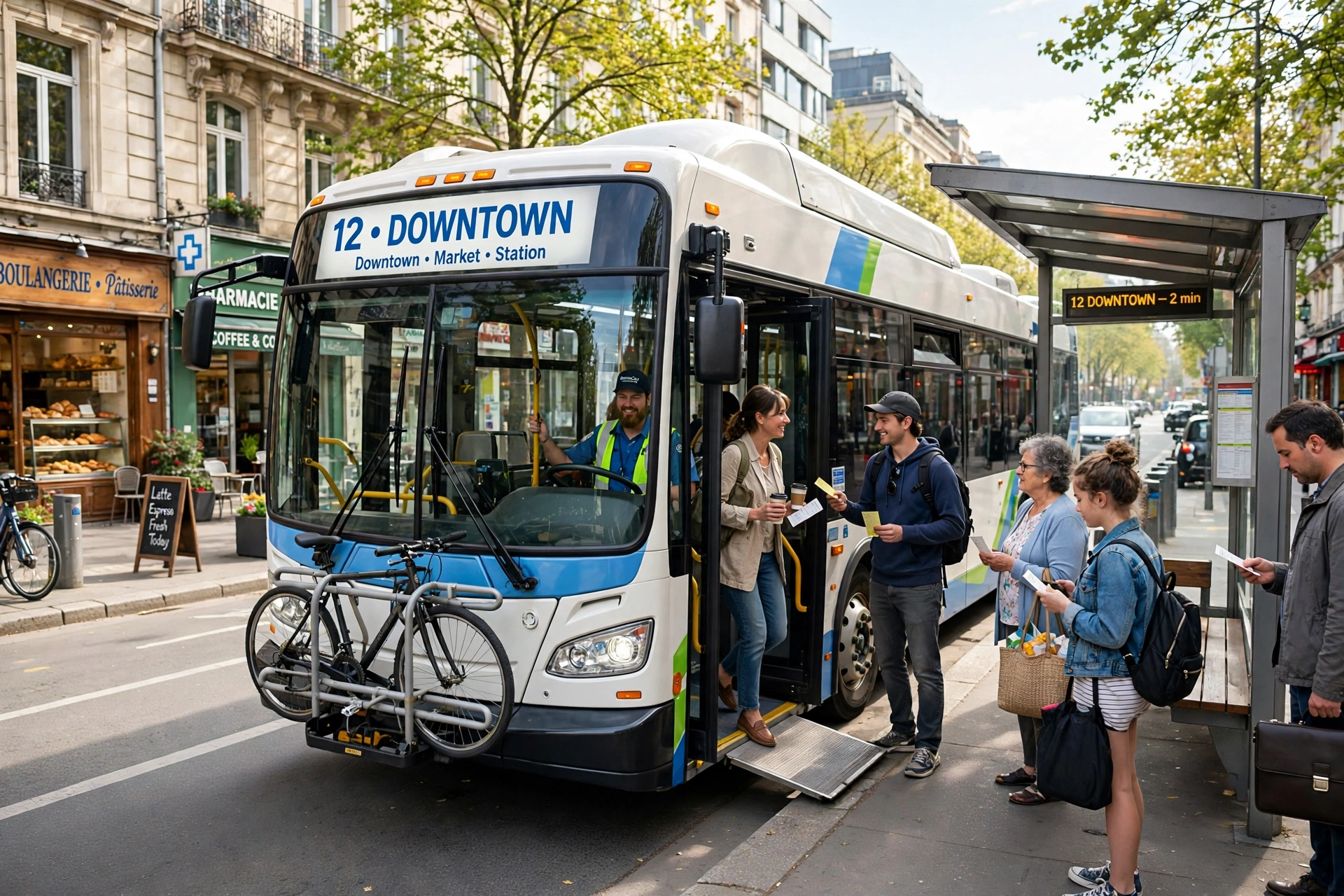
Then the bus rounds the corner, its number glowing above the windscreen. The doors open with a soft hiss. People step up, tap a card or hand over a few coins, and find a seat. Within a minute it is moving again, carrying forty people who all need to be somewhere else.
By the end of the day, that one bus will have carried hundreds of people, and a company with fifty buses can move thousands before nightfall.
It looks like easy money: each rider pays a fare, and the fares pile up. But a bus costs a fortune to buy, it drinks fuel by the gallon, and it needs a driver, a mechanic, insurance, and a place to sleep at night. So how does a bus company actually make money, and why do so many of them say the money is tight? This article follows the fare from your pocket to the company’s bank account, and back out again to the fuel pump, the driver, and the repair shop.
All money figures here are typical examples, not real company accounts. Real costs change a lot from place to place.
The Simple Idea: Selling Seats, Not Buses
Every business runs on the same simple maths: money in must be more than money out. A bus company buys buses, hires drivers, and sells rides. The gap between what it takes in and what it spends is called profit, and profit is what keeps the buses running next month.
But a bus company sells something unusual. It does not sell you a thing you can take home, like a bakery sells a loaf of bread. It sells you a seat for a short time. Once the bus reaches your stop, your seat is sold again to the next person, and then again to the next. One seat on one bus can be sold fifty times in a single day.
That is the whole trick, and the whole problem. An empty seat earns nothing. A full bus earns well. So a bus company lives or dies by one question: how many of its seats are filled, and for how much of the day? Filling seats is the business. Everything else — the routes, the timetables, the ticket prices, the adverts on the side — is a way of filling more seats, more of the time.
Ticket Fares: The Money That Comes In One Ride at a Time
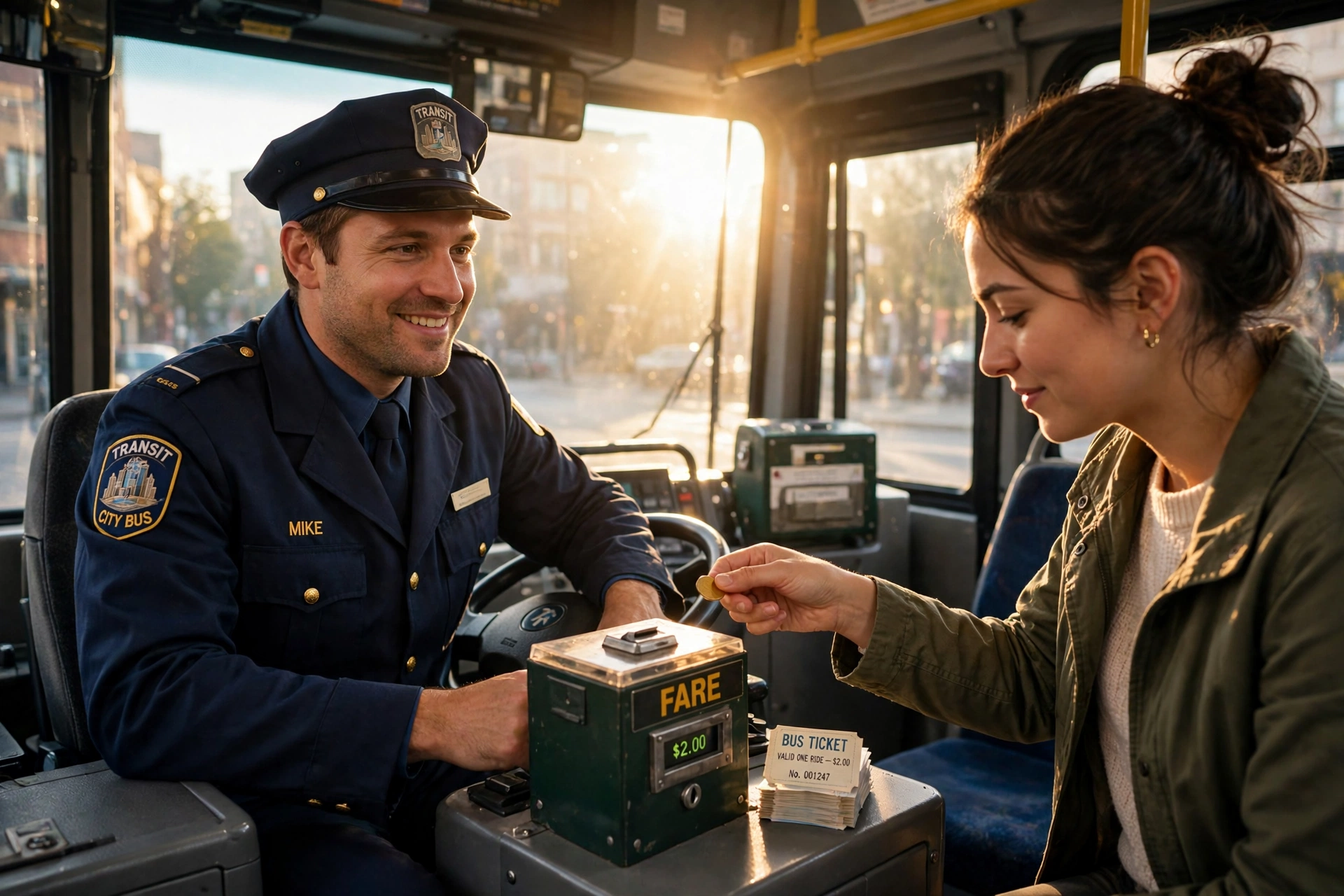
The fare is the first and biggest source of money. A fare is the price of one ride. You pay it when you step on the bus, and in return you get to ride as far as your ticket allows.
Most city buses charge a flat fare: one price no matter how far you travel — 2 dollars, or 2.50, or 3 dollars in a big city. You pay the same whether you ride for two stops or twenty. Flat fares are simple: the driver does not have to ask where you are going, the queue moves fast, and nobody argues about the price.
Some buses charge by distance instead. A short hop costs less, and a long ride across town costs more. This is common on buses between towns, where one passenger might ride for ten minutes and another for two hours. You pay for what you use, but it is slower, because the driver must work out the price for each person.
A single fare looks small, but picture a busy bus with forty seats. If it fills up four times over on one trip to town, that is 160 fares. At 2.50 dollars each, one trip brings in 400 dollars. A bus that makes twenty trips in a day can take in thousands of dollars. Small fares, collected again and again, are how the money adds up — but only when the bus is full. A bus running half empty brings in half the money for the same cost, and one running nearly empty at midday may not even cover its fuel.
Passes and Season Tickets: Money in Advance
Fares paid one ride at a time are the backbone of the business, but passes are its safety net. A pass covers many rides over a set time — a week, a month, or even a whole year. You pay once, and then you ride as often as you like until it runs out.
A monthly pass might cost 60 or 80 dollars — a lot at once, but far cheaper than single tickets for someone who rides twice a day, five days a week. Forty or more rides for the price of about twenty-five single fares is a good deal, and regular riders know it.
For the bus company, passes are gold for a different reason: the money arrives before the rides happen. A gym works the same way — members pay every month whether they visit or not, and that steady flow makes it easy to plan. A bus company with ten thousand monthly pass holders knows, on the first day of the month, that a large part of its income is already in the bank.
Student passes are a special case. Many cities sell students a pass at a lower price, or the school pays for it. Students ride every school day, so thousands of them paying every term add up to a large, steady sum.
Follow One Hundred Dollars Through the Bus
Imagine a bus company takes in 100 dollars in fares in one day. Where does it go? Here is one realistic way it might be divided, using typical figures.
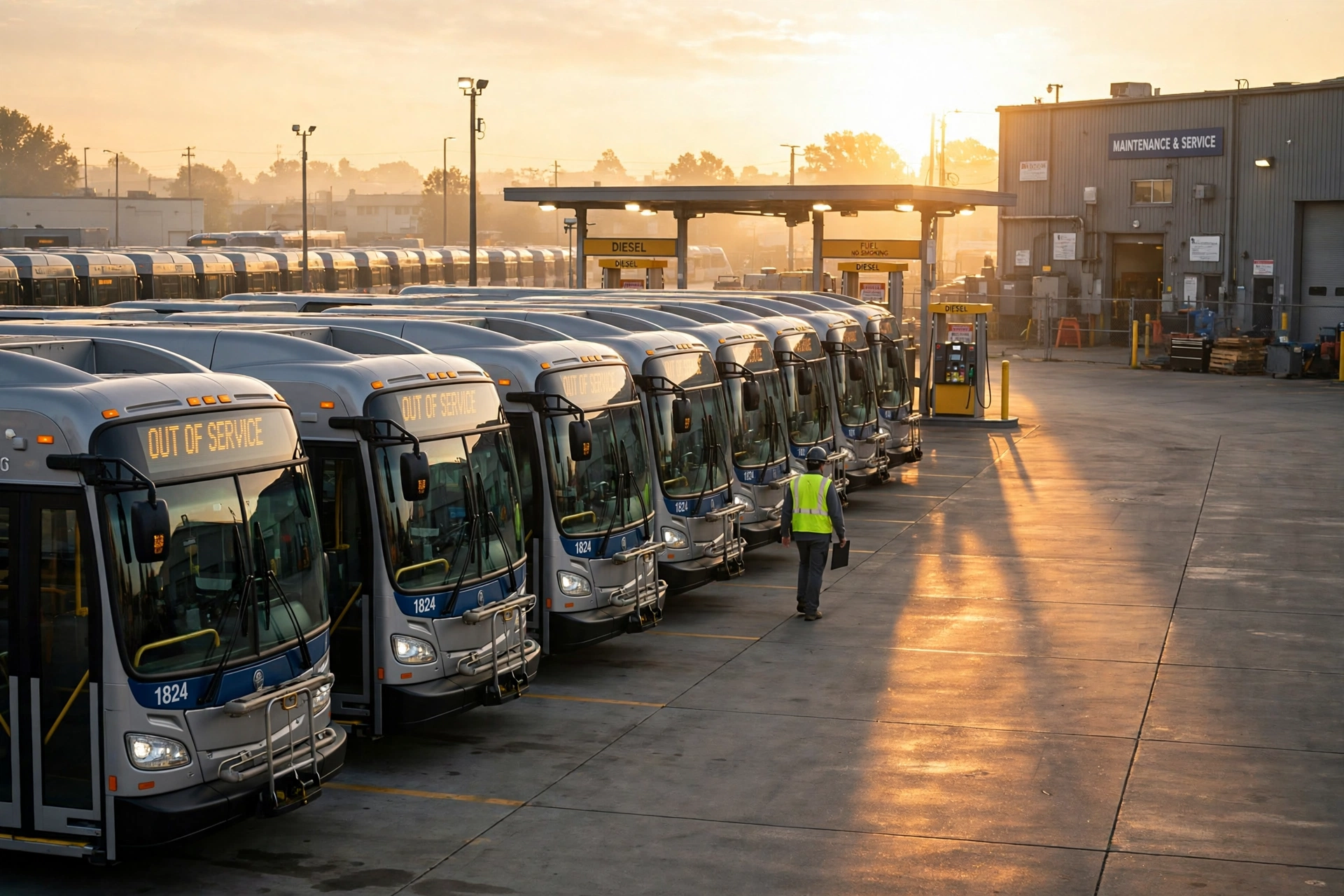
About 25 to 30 dollars goes on drivers’ pay, the biggest cost of all. Drivers work long, split days — an early morning shift, a break in the middle, and then the evening rush. A company with fifty buses may employ a hundred drivers or more, because buses run for eighteen hours a day.
About 20 to 25 dollars goes on fuel. A big city bus is heavy, it stops and starts hundreds of times a day, and it burns a lot of fuel — far more than a car. When fuel prices rise, this slice grows at once, and there is little the company can do about it, because the buses still have to run.
About 10 to 15 dollars goes on repairs and maintenance. Buses work hard: tyres and brakes wear out, engines need oil and new parts, and a bus that breaks down mid-route must be fixed fast.
About 10 dollars goes on buying the buses themselves. A new city bus can cost 300,000 dollars or more, and an electric bus can cost even more. A company does not pay that all at once — it borrows the money and pays it back over years, like a mortgage on a house. But that loan payment comes out of the fares every month.
About 5 to 8 dollars goes on rent, insurance, and the depot — the big yard where buses park at night, get washed, and get fuelled. About 5 dollars goes on everything else: ticket machines, office staff, cleaning, and card fees.
Add those up, and the 100 dollars is nearly gone. What is left, often only 3 to 5 dollars, is the profit.
School Runs and Company Contracts: Rides That Are Paid For in Advance
Not all of a bus company’s money comes from passengers at the bus stop. Some of its steadiest income comes from contracts, where someone pays the company to run a bus whether the seats are full or not.
School runs are the best example. Every school day, thousands of children need to get to school and home again. A school, or the local council, pays a bus company a fixed sum for the term or the year to run those routes. The children ride, the driver is paid, and the company does not have to worry about filling the seats.
Company shuttles work the same way. A big factory, an office park, or a hospital may be hard to reach by public transport, so the employer pays a bus company to run a shuttle between the nearest station and the workplace, morning and evening. Workers ride for free, the employer pays the bill, and the bus company gets regular work when its buses would otherwise sit in the depot.
These contracts are valuable because they fill the quiet gaps and the money is agreed in advance, so the company can plan around it. If fares fall on a rainy week, the contract money still arrives. The catch is that contracts are won by bidding, and the school picks the cheapest good offer. Win the bid, and you have steady work. Lose it, and a chunk of income vanishes overnight.
Advertising on Buses: The Bus as a Moving Billboard
Look at a city bus the next time one passes. Chances are, the side of it is not plain paint. It may carry a huge picture of a new film, a sale at a furniture shop, or a smiling face selling a soft drink. That picture is not decoration. It is rent.
A bus is a moving billboard. It drives through the busiest streets, past thousands of people, every day, and advertisers pay good money to put their message where all those eyes will see it. A full advert covering the whole side of a bus can bring in hundreds of dollars a month. The back of the bus is popular too, because drivers stuck behind it in traffic have nothing else to look at.
Advertising is useful money because it costs the bus company almost nothing to earn. The bus is already driving the route. Sticking a poster on its side does not burn extra fuel or need an extra driver. So nearly all of the advertising money is profit, or close to it. For a big company with hundreds of buses, adverts can bring in a large sum each year — sometimes enough to cover a whole month of fuel.
Government Support: Why Cities Help Pay for Buses
Here is something most passengers never think about: in many places, the fares alone do not cover the cost of running the buses. If fares had to pay for everything, tickets would cost far more, and many routes would close. So the government helps pay.
This help is called a subsidy: money given by the government to keep a service running that would otherwise lose money. Buses get subsidies because a city needs them. Without buses, roads would be clogged with cars, workers could not reach their jobs, and older people and children would be stuck at home.
Subsidies come in several forms. One is a payment for each route. The city says, “Run a bus to this village every hour, and we will pay you a set sum each month.” The village route may never fill its seats, but the payment makes it worth running.
Another form is paying for free or cheap rides. Many cities let older people, children, or people with disabilities ride for free, or at a lower fare. The passenger pays nothing, but the government pays the company for each of those rides.
A third form is help with buying buses. Electric buses are cleaner and quieter, but they cost much more than diesel buses, so governments often pay part of the price to help companies switch.
Subsidies can be a large share of a bus company’s income — in some places, a third or more. That makes them a lifeline, but also a risk: if the government cuts its budget, the company loses money at once, and routes may be cut or fares may rise.
The Biggest Costs, One by One
Making money is only half the story. Here are the biggest costs a bus company faces, one by one.
Fuel comes first for many companies. A city bus may burn 30 to 40 litres of fuel in a day, and a big company with a hundred buses burns thousands of litres every day. When fuel prices jump, the cost jumps with them, and the company cannot simply stop running. Some companies buy fuel in advance at a fixed price, or switch to electric buses, which cost more to buy but less to run.
Drivers’ pay is the largest cost of all. A bus company is really a people business. It needs drivers, and good drivers are hard to find and keep. Driving a bus through city traffic for hours, staying calm with passengers, and keeping to a timetable is skilled work. A company that tries to save money by paying drivers too little soon finds it has no drivers at all, and buses sitting in the depot earn nothing.
Maintenance is the cost nobody sees. A bus works from dawn to midnight, day after day. Brakes, tyres, engines, doors, and lights all wear out. A bus that is not looked after will break down, and a broken bus means angry passengers, missed school runs, and a lost contract.
Buying the buses is the biggest cost of all, but it is spread over years. A new bus may run for twelve or fifteen years before it is replaced, and the company pays for it a little at a time, through loan payments. Older buses cost less to buy but more to repair. New buses cost more to buy but less to repair, and passengers like them more.
Why the Profit Is So Thin
A bus company takes in money one small fare at a time, and it spends money on fuel, drivers, repairs, buses, and a depot — costs that must be paid whether the bus is full or empty. That is why the profit is so thin.
Here is a simple monthly example. Suppose a medium bus company runs twenty buses and takes in 200,000 dollars in a month from fares, passes, contracts, and adverts. Drivers’ pay might be 60,000 dollars. Fuel might be 45,000 dollars. Repairs and parts might be 25,000 dollars. Loan payments for the buses might be 25,000 dollars. Rent, insurance, and the depot might be 20,000 dollars. Office staff, ticket machines, and cleaning might be 15,000 dollars.
Add those up: 60,000 + 45,000 + 25,000 + 25,000 + 20,000 + 15,000 = 190,000 dollars. The company took in 200,000 dollars and spent 190,000 dollars, leaving 10,000 dollars of profit, or about 5 percent. From that, it may still need to pay tax, or save for a new bus.
Notice how fragile that is. If fuel prices rise by just 10 percent, profit falls to 5,500 dollars. If a few drivers fall ill and the company must pay overtime, profit falls again. One bad month can wipe out the whole year’s gain.
Peak Hours and Quiet Hours: The Empty-Seat Problem
A bus company’s day has a shape, and that shape is its biggest headache. The morning and evening rush hours are packed, but the middle of the day is quiet, and so is the late evening.
Picture the 8 a.m. bus. It is full, people are standing in the aisle, and some are left at the stop because there is no room. Now picture the same bus at 11 a.m. There may be only six or seven people on board. The driver is paid the same. The fuel burns the same. But the fares coming in are a fraction of the morning’s.
This is the empty-seat problem, and it is the heart of the bus business. A bus earns money only when its seats are filled, but it must run all day, because passengers need a bus at 11 a.m. just as much as at 8 a.m. A company cannot simply park its buses at midday, because the drivers are needed again at 4 p.m., and the timetable promises a bus every twenty minutes.
A restaurant faces the same swing: Friday night is gold, Monday morning is quiet, and the rent must be paid either way. Bus companies handle it in a few ways. Some run smaller buses at quiet times, so a half-empty small bus costs less than a half-empty big one. Some run fewer buses at midday. Some offer cheap off-peak tickets to tempt shoppers and older people to ride when the buses are quiet. Every filled seat at midday is almost pure gain, because the bus is running anyway.
City Buses and Tour Coaches: Two Very Different Businesses
Not all buses do the same job. A city bus and a tour coach may look alike, but they earn their money in very different ways.
A city bus runs the same route, day after day, stopping every few hundred metres. It picks up many people, each paying a small fare, and it depends on volume — hundreds of rides a day. Its income is spread across thousands of small payments, plus passes, contracts, and subsidies, and in many cities it cannot survive without government help.
A tour coach is a different animal. It is hired for a whole trip — a school outing, a football team travelling to an away match, a wedding party, or a group of tourists visiting a city. The customer pays one price for the whole coach, often hundreds of dollars, and it may carry fifty people at once. There are no single fares, no bus stops, and no subsidies. The coach company earns its money from private hire, and it must find enough bookings to keep its coaches busy.
Tour coaches have their own rhythm. Summer is busy, with school trips and holidays. Winter is quiet. A coach that sits in the yard for a week earns nothing but still costs money in loan payments and insurance, so coach companies often take other work in the quiet months: airport transfers, company outings, or day trips.
Frequently Asked Questions
How does a bus company make most of its money?
Most of its money comes from fares — the small payments each passenger makes for a ride. Monthly passes, school runs, company shuttles, adverts, and government subsidies add important extra income.
Why are bus fares so high if the bus is full?
Because the fare must cover far more than fuel: the driver, repairs, insurance, the depot, and the loan on the bus itself. A full bus earns well, but the same bus runs half empty for much of the day, and those quiet hours must be paid for too.
What is a season ticket, and why do bus companies like them?
A season ticket, or monthly pass, covers unlimited rides for a week, a month, or a year. Companies like them because the money arrives in advance, which makes it easy to plan, and because pass holders become regular riders.
Why do bus companies get money from the government?
Because fares alone often do not cover the cost of running buses, and a city needs buses. The government pays for quiet routes, free rides for older people and children, and cleaner buses.
Why do some bus routes get cancelled?
A route is usually cancelled when too few people ride it, so the fares do not come close to covering the cost. The company may also lose its subsidy for that route, or driver and fuel costs may have risen too high.
What is the difference between a city bus and a tour coach?
A city bus runs the same route every day, stopping often, and earns money from many small fares. A tour coach is hired for one trip at a time, such as a school outing or a wedding, and earns money from one large payment.
More from Zorium Daily
- How Does a Coffee Shop Make Money?
- How Does a Bakery Make Money?
- How Does a Gym Make Money?
- How Does a Supermarket Make Money?
The next time you step onto a bus, look at it with new eyes. The fare you pay, the pass in your pocket, the advert on the side, the schoolchildren in the back seats — all of it is part of one careful balancing act. A bus company must fill enough seats, often enough, to pay for fuel, drivers, repairs, and the bus itself, and still have a few cents left over. It is a business that works, day after day, one ride at a time.