What Is Gravity and Why Do Things Fall Down?
SUMMARY OF THIS ARTICLE
- Gravity is the invisible pull between things that have mass, and Earth’s huge mass pulls everything near it down toward the centre of the planet.
- Things fall down because Earth pulls them, and “down” always means toward the middle of the Earth, no matter where you stand on it.
- Isaac Newton worked out that the same pull that drops an apple also holds the Moon in its path, and he published his law of universal gravitation in 1687.
- Albert Einstein later showed that heavy things bend the shape of space itself, like a bowling ball sinking into a soft mattress.
- The Moon is always falling toward Earth, but it moves sideways so fast that it keeps missing the ground, and that endless falling-and-missing is what an orbit is.
The Apple That Would Not Stay Up
Drop a spoon on the kitchen floor, and it clatters down and stays there. Toss a ball into the air, and it goes up for a second, then comes straight back down. Jump as high as you can, and for one happy moment you are off the ground, then you land again, right where you started.
Nothing about this surprises us, because it happens every single day. But stop and think about it for a moment. Why down? Why does everything fall the same way, every time, everywhere on Earth? Why does nothing ever fall up?
A young man in a garden once asked it while watching an apple drop from a tree, and his answer changed how the world understands the sky. The answer is a force you cannot see, cannot touch, and cannot switch off. It holds your feet to the ground, keeps the Moon circling the Earth, and keeps the planets circling the Sun. It is called gravity. It has been pulling on everything, everywhere, since the beginning of the universe, and it never takes a day off.
What Is Gravity, in Plain Words?
Gravity is a pull. That is the simplest way to say it. Every single thing that has mass pulls on every other thing that has mass. Mass is just a fancy word for how much stuff is in something. A rock has mass. A feather has mass. You have mass. The Earth has a very great deal of mass.
The pull works in both directions. The Earth pulls you down, and you pull the Earth up, just a tiny, tiny bit. The Earth is so enormous compared with you that its pull is the one you notice. Your pull on the Earth is so small that it makes no difference at all.
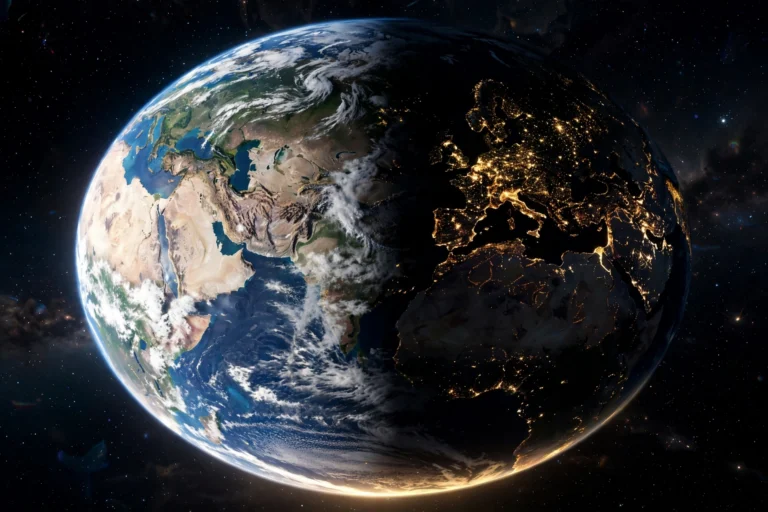
What makes gravity special is that it reaches across empty space, with no rope or string. The Sun pulls on the Earth from about 150 million kilometres away, and that pull keeps our planet circling the Sun instead of flying off in a straight line. You cannot see this pull, but you can see what it does, every time something falls.
Here is a good way to picture it. Hold a magnet near a paper clip, and the clip jumps to it without anyone touching it. Gravity works a little like that, except it is not magnetism, and it works on everything, not just metal. It is always on, everywhere, all the time. You are being pulled toward the centre of the Earth right now, as you read these words.
Why Things Fall Down, and Always Down
When you let go of something, it falls toward the ground. The reason is simple: the Earth is pulling it. The ground stops it from going any further, but the pull is still there, pressing the object against the floor, the table, or your hand.
But what does “down” actually mean? Stand on a beach in Australia and drop a stone. It falls toward your feet. Stand on a beach in England and drop a stone. It falls toward your feet too. Yet the people in Australia stand on the opposite side of the planet from the people in England. How can “down” point in two opposite directions at once?
The answer is that “down” does not mean the same direction for everyone. Down means toward the middle of the Earth. The Earth is a ball, and gravity pulls everything toward the centre of that ball. So a person in Australia and a person in England are both being pulled toward the same point, deep inside the planet, and from each person’s point of view, that direction feels like “down”. It is a neat trick of living on a round world, and it is why people on the other side of the Earth do not fall off. There is no edge to fall off. There is only the centre, pulling everyone in.
Drop a cup, and it falls toward the centre until the floor gets in the way. That is all “falling down” really is.
Stand anywhere on Earth and the same rule holds. A ball dropped in Tokyo, in London, or in Sydney always falls toward the ground under the feet of the person who dropped it, because the centre of the Earth is always straight down from wherever you happen to stand.
Why a Heavy Rock and a Light Feather Fall Together
Most people guess that heavy things fall faster than light things. Drop a stone and a feather from the same height, and the stone hits the ground first, every time. So the stone must fall faster, right?
Not quite. The stone wins that race for a different reason: the air gets in the way. A feather is light and wide, so the air pushes against it and slows it down, like a parachute. The stone is small and heavy, so the air barely slows it at all. Take the air away, and the race ends in a tie.
A scientist called Galileo worked this out more than four hundred years ago. He said that without air in the way, all things fall at the same speed, no matter how heavy they are. For a long time nobody could prove it properly. Then, in 1971, an astronaut called David Scott proved it on the Moon.
The Moon has almost no air at all. Standing on its dusty surface during the Apollo 15 mission, Scott held out a hammer in one hand and a feather in the other, and let go of both at the same time. There was no air to slow the feather down. Both fell at exactly the same speed and hit the ground together. Millions of people watched it live on television. Galileo had been right all along.
On Earth, gravity speeds up a falling object by about 9.8 metres per second every second, and that number is the same for a stone, a feather, a spoon, or a piano. The only reason the feather loses on Earth is the air. Gravity treats everything the same.
The Apple Story: A Famous Legend
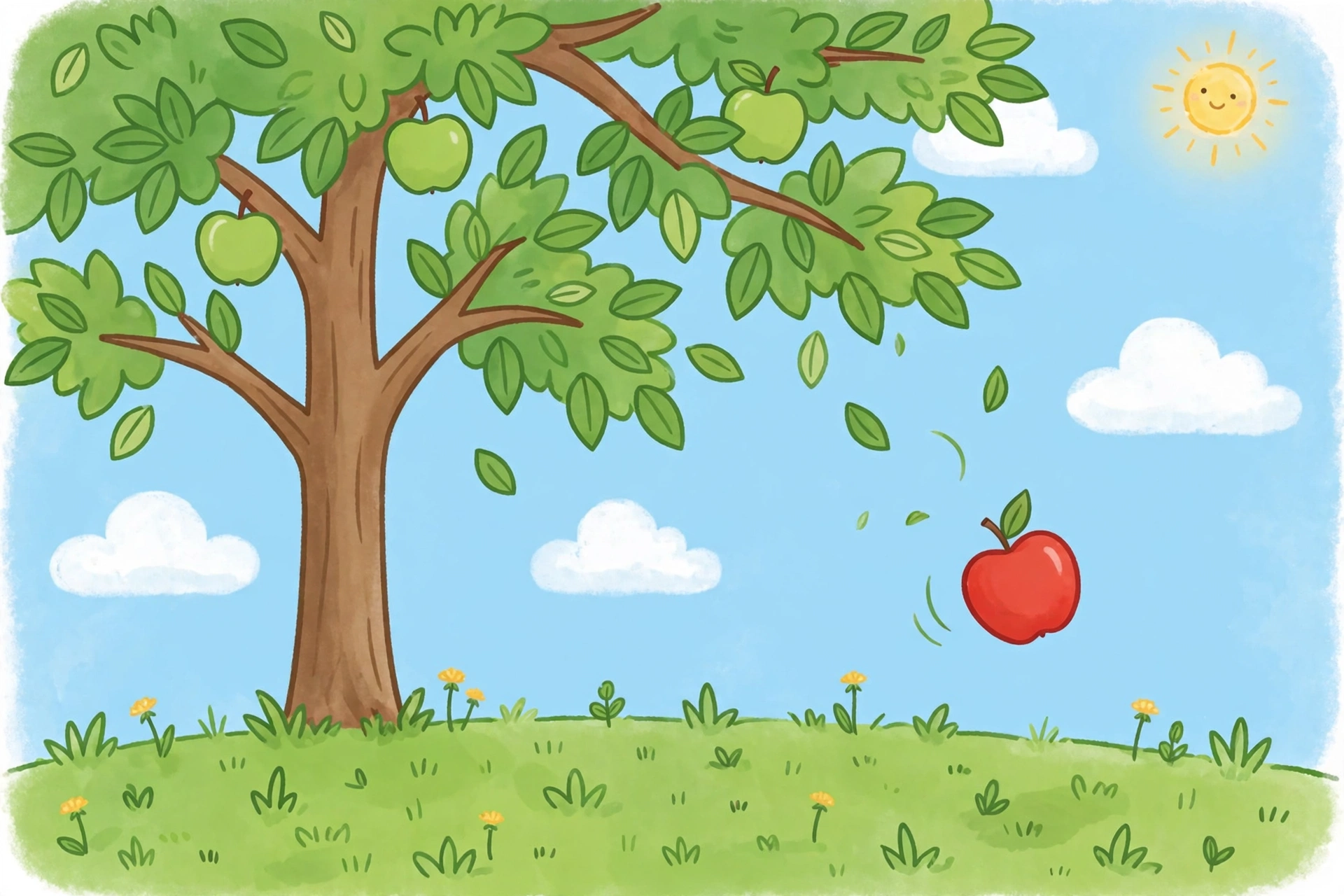
You have probably heard the story of Isaac Newton and the apple. A young Newton sits under a tree. An apple falls and hits him on the head. In a flash, he understands gravity. It is a wonderful story, told in schools all over the world. But most of it is not true.
Newton himself told the story later in life, to a friend called William Stukeley. He said he was sitting in the garden of his family home at Woolsthorpe in England, in the year 1666, when he watched an apple fall from a tree. It did not hit him on the head. It simply fell to the ground, as apples do. But watching it fall started him thinking: why does the apple always fall straight down? Why never sideways, or up into the sky?
Newton was only 23, and his university had closed because of the plague, so he had gone home to wait it out. The falling apple was not the whole discovery. It was the spark. The real work came later, when he sat down and worked out the maths.
What Newton realised was far bigger than one apple. The force pulling the apple down might be the very same force holding the Moon in the sky. People thought the heavens and the Earth played by different rules. Newton said no: one rule covers both.
In 1687, more than twenty years after watching that apple, Newton published his great book, the Principia, setting out his law of universal gravitation. The word “universal” is the key. His law said every object pulls on every other object, and the pull depends on two things: how much mass the objects have, and how far apart they are. More mass means a stronger pull. More distance means a weaker pull. Double the distance, and the pull becomes four times weaker. That one rule could explain falling apples, the tides, the Moon, and the planets, all at once.
Einstein’s Big Idea: Heavy Things Bend Space
Newton’s law worked beautifully for more than two hundred years, but it left one question unanswered. How does gravity reach across empty space? Newton himself admitted he did not know. He could describe what gravity did, but not how it did it.
Then, in 1915, Albert Einstein gave the world a new picture. It still feels strange today, but it explains things Newton’s picture could not. Einstein said gravity is not really a pulling force at all. Heavy things bend the shape of space itself, and other things simply roll along the bend.
Picture a soft mattress, stretched flat, with a heavy bowling ball in the middle. The mattress sinks around the ball, making a dip. Roll a small marble across it, and the marble curves toward the bowling ball, because the surface under it is curved. It may even circle the ball for a while before falling in.
Einstein said space works like that mattress. The Sun is the bowling ball, bending the space around it, and the Earth rolls along that bend, circling the Sun year after year. You are not really being pulled down by an invisible rope. You are sliding down the dip the Earth makes in space.
This picture also explains things Newton could not, like why light bends near heavy things, and why time runs a little slower where gravity is stronger. Scientists have tested Einstein’s ideas again and again, and so far his strange picture has passed every test. Newton’s law is still used every day, because it is simpler and it works perfectly for most jobs, like sending rockets to the Moon. Einstein’s picture is the deeper truth underneath it.
Why the Moon Does Not Fall to Earth
Here is a puzzle. If gravity pulls everything down, why does the Moon not fall out of the sky and crash into the Earth? The Moon is a huge rock, and the Earth’s pull on it is strong. So why does it stay up there, night after night, year after year?
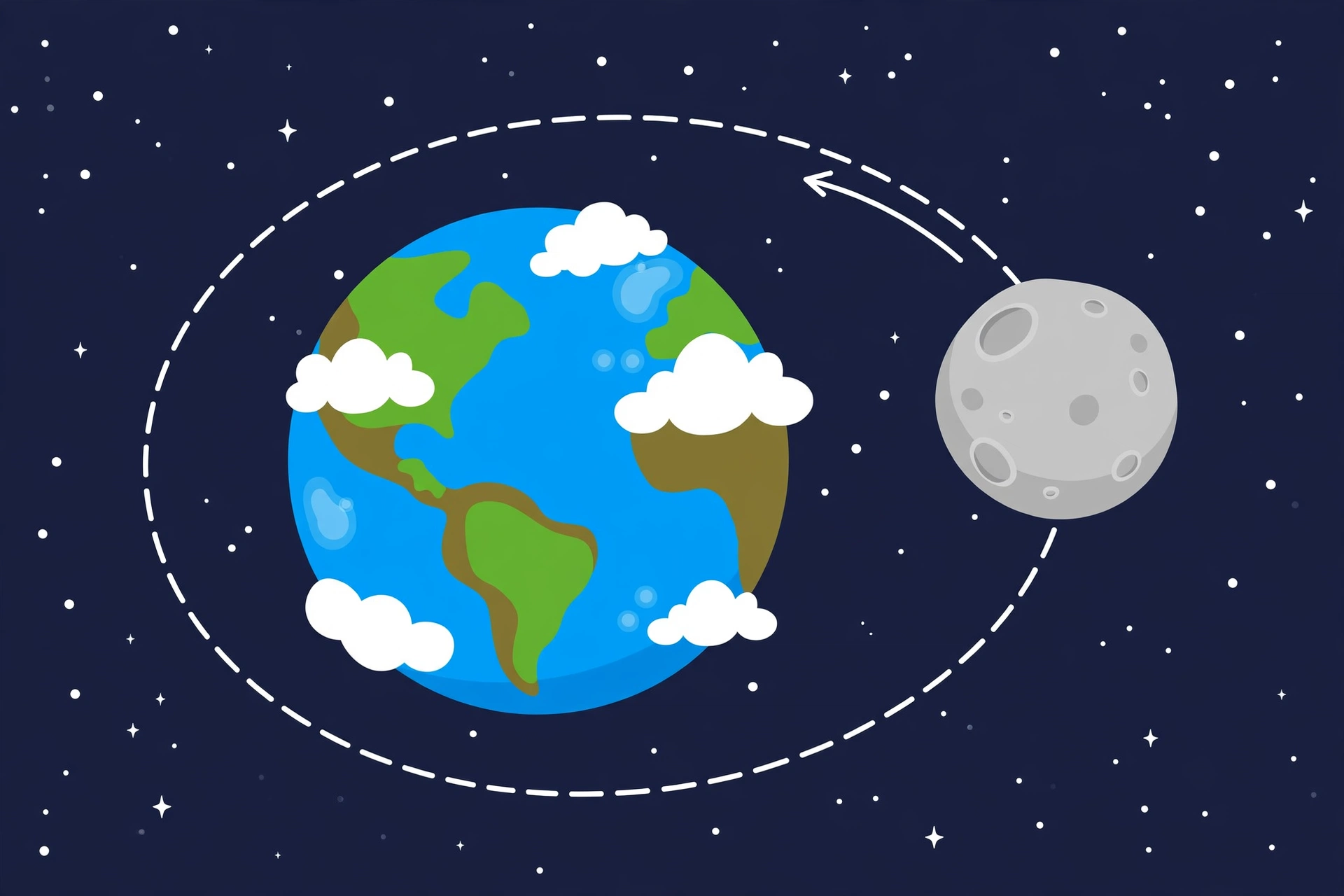
The answer is that the Moon is falling. It has been falling toward the Earth for billions of years. It just keeps missing.
Imagine throwing a ball. Drop it, and it falls straight down. Throw it forward, and it lands a little way away. Throw it fast enough, and it would curve down so slowly that the ground would curve away underneath it at the same rate. The ball would keep falling, but never land. It would circle the whole Earth.
That is what the Moon is doing. It moves sideways at about 3,700 kilometres per hour, fast enough that as it falls toward Earth, the ground curves away beneath it. It falls and falls, but never gets closer. Scientists call this an orbit: falling that never ends. The same idea holds for the satellites above our heads, which is how your phone finds where you are, as explained in how GPS knows where you are.
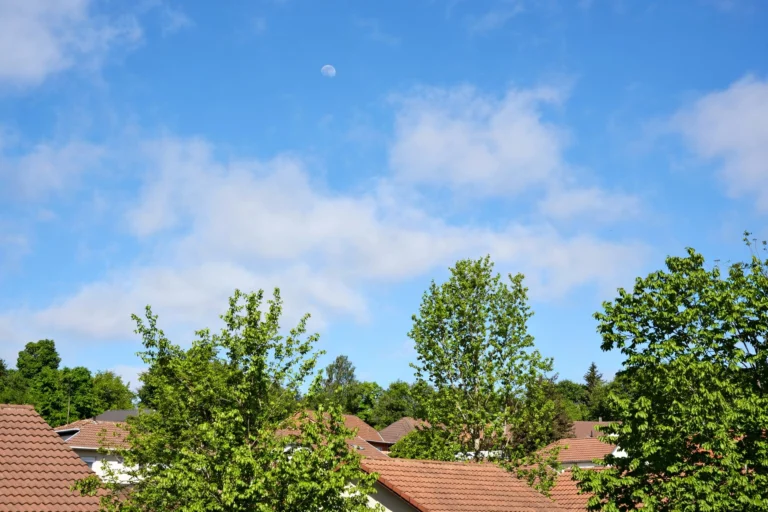
You can sometimes see the Moon in the daytime sky too, pale against the blue, as explained in why we can sometimes see the Moon during the day. It looks calm and still, but it is really racing sideways through space, falling forever and missing forever. If it ever slowed down, it would spiral in and crash. If it sped up, it would fly away. That balance is gravity at work.
Gravity on the Moon vs Earth
Jump on Earth, and you go up a little way, perhaps half a metre, and come straight back down. Jump on the Moon, and you would shoot up much higher and float down slowly. Astronauts there bounced along the surface in slow, springy hops.
The reason is simple: the Moon’s gravity is about one-sixth as strong as Earth’s. On Earth, a falling object speeds up by about 9.8 metres per second every second. On the Moon, that number is only about 1.62. If you weigh 60 kilograms on Earth, you would weigh only about 10 kilograms on the Moon, though your body itself has not changed at all. Your mass stays the same. Your weight, the pull of gravity on your mass, drops to a sixth.
Why is the Moon’s pull so much weaker? Because gravity depends on mass, and the Moon has only about one eighty-first of Earth’s mass. It is much smaller too, with a radius of about 1,737 kilometres against Earth’s 6,371. Less mass means a weaker pull, and that is the whole story.
This weaker gravity changes everything on the Moon. There is almost no air there, partly because the Moon’s gravity is too weak to hold a thick atmosphere. That is why the sky on the Moon looks black even in the daytime, while ours looks blue. Our blue sky comes from sunlight scattering in thick air, as explained in why is the sky blue.
Tides: The Moon Pulls the Sea
Gravity does not only make things fall. It also moves the sea. Every day, all around the world, the ocean rises and falls, and the Moon is the main reason.
The Moon’s gravity pulls hardest on the side of the Earth facing it, because that side is closest. The water there gets pulled toward the Moon, making a bulge, a kind of hill of water. A second bulge forms on the far side too. As the Earth turns under these two bulges, most coastal places get two high tides and two low tides, roughly every 24 hours and 50 minutes.
The Sun also pulls on the oceans, but less strongly, even though it is far bigger than the Moon, because it is so much further away. When the Sun, Moon, and Earth line up, around the new Moon and the full Moon, their pulls add together, and the tides run higher. People call these spring tides. When the Sun and Moon pull at right angles, the tides run lower, and people call these neap tides.
Next time you stand on a beach and watch the water creep up the sand, remember you are watching gravity at work. The Moon, hundreds of thousands of kilometres away, is tugging on the sea, and the sea is answering. Fishermen have known about the tides for thousands of years, long before anyone understood why they happen.
Why Astronauts Float
Ask a child why astronauts float, and the answer you often get is: “Because there is no gravity in space.” It sounds sensible. But it is wrong.
There is plenty of gravity in space. The International Space Station flies about 400 kilometres above the Earth, and up there gravity is still about 90 percent as strong as on the ground. So why do the astronauts inside it float around as if gravity had been switched off?
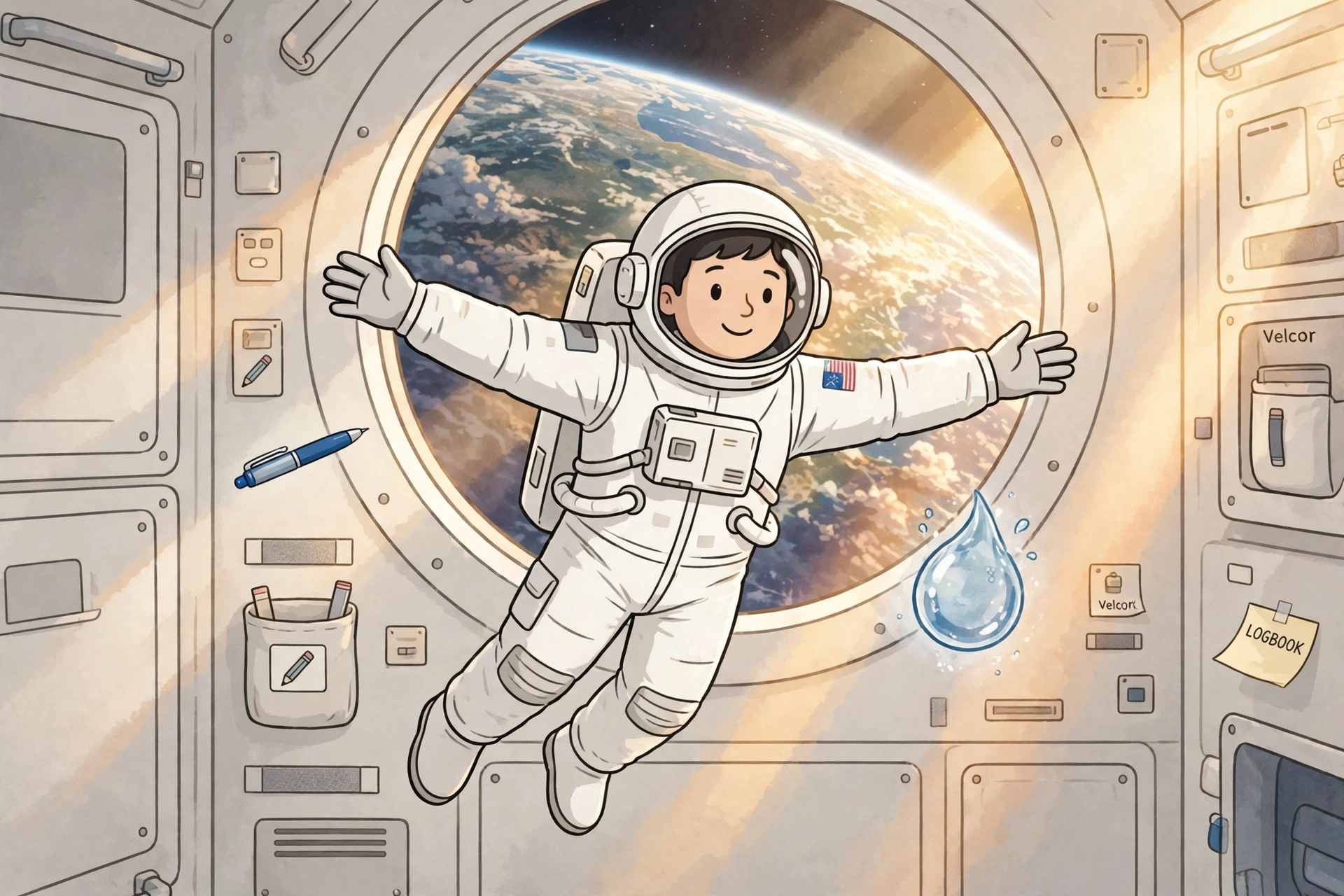
The answer is that they are falling. The space station falls toward the Earth all the time, just like the Moon, and misses all the time, because it is moving sideways so fast, about 28,000 kilometres per hour. The astronauts inside fall at exactly the same speed as the station around them, so nothing pulls them down to the floor. They float because everything around them is falling together.
Think of a lift in a tall building. If the cable snapped, everyone inside would float for a few seconds, because they would be falling at the same speed as the lift. The space station is like a lift that never hits the ground, because it keeps missing the Earth as it falls around it. Scientists call this weightlessness, or free fall. It is not the absence of gravity. It is gravity doing its job so perfectly that you cannot feel it.
That is also why a pen let go inside the station does not drop to the floor. It just hangs in the air. A drop of water floats as a perfect round ball, wobbling gently, until someone catches it. Living like that takes practice, and astronauts’ muscles get weaker because they are not fighting gravity all day. When they come home after months in space, they have to build their strength back up.
Gravity in Your Everyday Life
Gravity is so ordinary that we forget it is there, but it shapes almost everything you do. When you pour water from a jug, gravity pulls it down into the glass. When rain falls, gravity pulls each drop to the ground. When you sit in a chair, gravity holds you in it. Climb a hill, and you fight gravity with every step. Walk down the other side, and gravity does half the work for you.
It even shapes your body. Your heart pumps blood up to your brain, fighting gravity all day. Your bones are strong because they carry your weight against it, year after year. Without gravity to push against, the body slowly forgets how to be strong.
And gravity shapes the world itself. It pulled dust and gas together billions of years ago to make the Sun and the planets. It holds the air around the Earth so we can breathe. Rain falls because of gravity, and so does snow, and so do the leaves in autumn. The rain that falls with a storm is gravity’s work, as you can read in what causes thunder and lightning. Even the simple act of standing up in the morning is a small victory over a force that never rests.
The next time you drop something, pause for a second. That little fall is the same force that holds the Moon in the sky and bends the path of light from distant stars. You live inside it, like a fish lives inside water, and you only notice it when something goes wrong.
Frequently Asked Questions
What is gravity in simple words?
Gravity is the invisible pull between things that have mass. Earth’s huge mass pulls everything near it down toward the centre of the planet, and that pull is what makes things fall.
Why do things fall down and not up?
Things fall down because Earth pulls them toward its centre. “Down” means toward the middle of the Earth, so no matter where you stand on the planet, down is always the direction of the ground under your feet.
Did an apple really fall on Newton’s head?
No, that part is a legend. Newton told a friend that watching an apple fall in his garden in 1666 started him thinking, but the apple fell to the ground, not onto his head. His law came from years of work and was published in 1687.
Why does the Moon not fall to Earth?
The Moon is falling toward Earth all the time, but it is also moving sideways so fast that it keeps missing the ground. That endless falling-and-missing is called an orbit.
How strong is gravity on the Moon compared with Earth?
Gravity on the Moon is about one-sixth as strong as on Earth. A falling object speeds up by about 1.62 metres per second every second on the Moon, against about 9.8 on Earth.
Why do astronauts float in space?
Astronauts float because they are in free fall. The space station falls toward Earth all the time but keeps missing it, and the astronauts fall at the same speed as the station, so nothing pulls them down to the floor.
More from Zorium Daily
- Why Is the Sky Blue?
- Why Is the Sky Dark at Night?
- Why Can We Sometimes See the Moon During the Day?
- How Does GPS Know Where You Are?
Gravity is the quiet force behind almost everything you see. It drops the apple, holds the Moon, pulls the tides, and keeps your feet on the ground. You cannot see it, but you can feel it in every step you take. The next time something slips from your hand and falls, you will know exactly why.