How Do Rainbows Form? Explained Simply
SUMMARY OF THIS ARTICLE
- A rainbow forms when sunlight shines through raindrops in the air: the light bends as it enters each drop, splits into colours, bounces off the back of the drop, and bends again as it leaves.
- You can only see a rainbow when the Sun is behind you and low in the sky, while rain falls in front of you — that is why rainbows show up most often in the morning or late afternoon.
- The bow looks like an arc, but it is really part of a full circle. You only see the top half because the ground gets in the way of the rest.
- In a rainbow, red is always on the outside edge and violet on the inside edge, and the top of the bow sits about 42 degrees above the point directly opposite the Sun.
- A rainbow has no end to reach. It is not an object sitting in a field — it moves when you move, because it is made of light reaching your eyes from millions of raindrops at once.
The Question Everyone Asks After the Rain
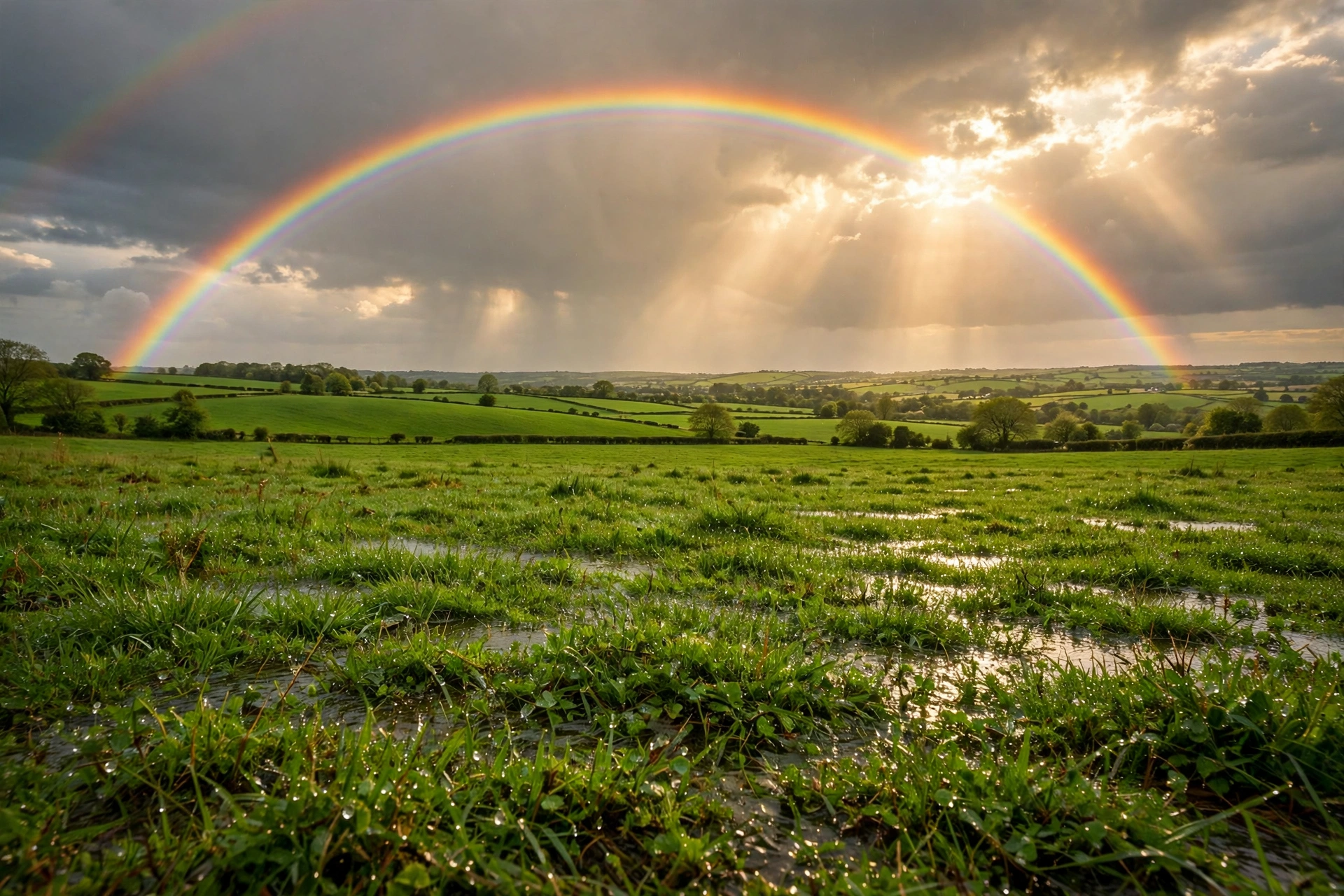
Rain stops, the clouds break, and sunlight spills across the wet grass — and there it is, a great band of colour hanging in the sky, as if someone painted it while you were not looking. Red on top, then orange, yellow, green, blue, and violet at the bottom. You point. Someone nearby points too. For a minute, everyone forgets the wet shoes and the ruined picnic.
Rainbows have that effect on people: they show up without warning, last a few minutes, and fade away as quietly as they came. Children chase them. Grown-ups stop the car to look at them. Old stories say a pot of gold is buried where the rainbow touches the ground.
But what is a rainbow, really? It is not paint in the sky, not a bridge, and not a solid thing you could ever touch. It is light doing a small trick inside raindrops — and you do not need to be a scientist to follow it. You need three things: sunlight, rain, and your own two eyes standing in the right place.
The Short Answer: Sunlight, Rain, and Your Eyes
Here is the whole story in one paragraph. Sunlight looks white, but it is really a mix of many colours packed together. When that white light hits a raindrop, it bends as it enters the water, and the bend splits the light into its separate colours, just like a prism does. The light then bounces off the back of the drop, like a ball bouncing off a wall, and bends a second time as it leaves. Millions of raindrops do this at the same moment, each one sending a tiny bit of coloured light toward your eyes. Your brain puts all those tiny bits together, and you see a rainbow.
Three things have to line up. First, it has to be raining, or at least raindrops must still be hanging in the air in front of you. Second, the Sun has to be shining behind you, low enough in the sky to throw its light over your shoulder. Third, you have to be standing in the right spot, looking toward the rain with your back to the Sun. Take away any one of the three, and there is no rainbow.
That is why you never see a rainbow at noon on a cloudless day, or when the Sun is in front of your face. The rainbow lives opposite the Sun, and it only appears when rain and sunshine share the sky. Rain without sun gives you grey skies; sun without rain gives you a blue sky. Put the two together, with you standing between them, and you get one of the prettiest sights in nature. If you have ever wondered why the sky is blue on those bright days after the rain, the answer is a close cousin of the rainbow’s story — both are about sunlight playing with tiny things in the air.
Step One: Sunlight Walks Into a Raindrop
Follow a single beam of sunlight as it meets a single raindrop. A raindrop is small — about the size of a pinhead — but for a beam of light, it is a whole world to travel through.
Sunlight travels straight through the air until it hits the curved front surface of the raindrop — and then something changes. Light moves slower in water than it does in air, so the moment the beam crosses from air into water, it bends. Scientists call this bending refraction. You have seen refraction yourself, even if you never knew its name. Push a spoon into a glass of water and look at it from the side: the spoon looks bent at the waterline. It is not bent at all. The light coming from the spoon bends as it leaves the water, and your eyes get fooled. The same bending happens when sunlight steps into a raindrop.
The bend matters because it is not the same for every colour. White sunlight is not one colour. It is a crowd of colours travelling together, all mixed up so tightly that your eyes read them as plain white. But each colour in that crowd bends by a slightly different amount when it enters the water. Violet bends the most. Red bends the least. Orange, yellow, green, and blue fall in between, in that order.
Think of friends running from smooth pavement onto sand: the ones who hit the sand first slow down first, and the neat line spreads into a fan. Light does the same at the edge of a raindrop — the colours enter together and start to spread apart.
Step Two: White Light Splits Into Colours
The splitting of white light into colours has a name too: dispersion — the same effect you get from a glass prism, the triangle-shaped piece of glass science teachers hold up in front of a lamp to throw a little rainbow onto the wall. Isaac Newton, the English scientist, showed this in the 1660s with a prism and a beam of sunlight. Before Newton, many people thought the prism itself added the colour to the light, as if the glass were painting it. Newton showed that the colours were already inside the white light all along. The prism only pulled them apart so you could see them.
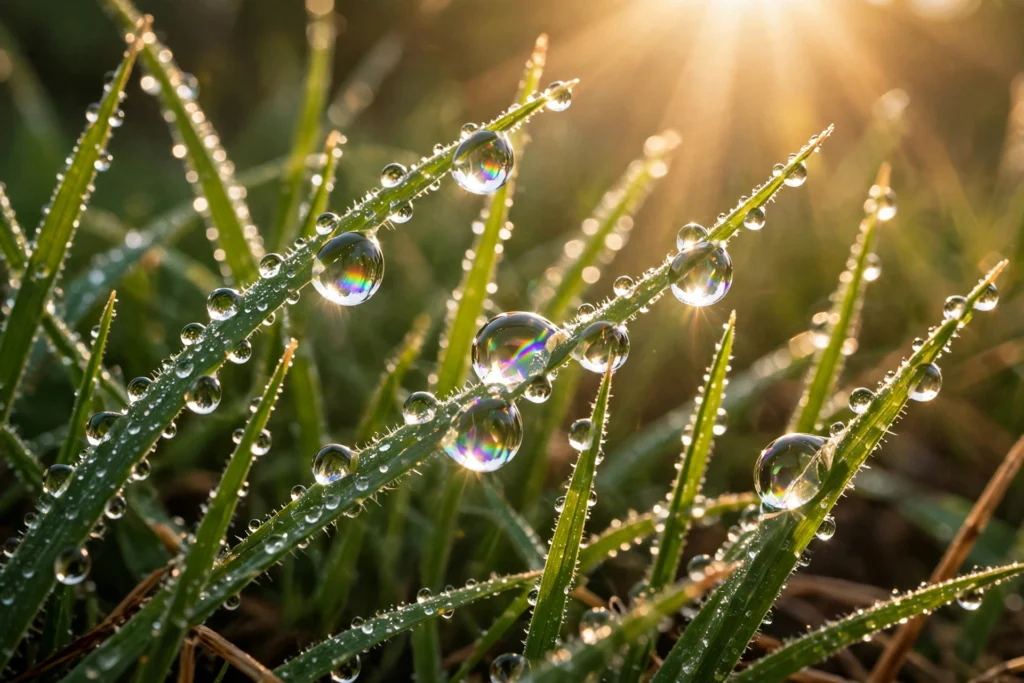
A raindrop is a tiny natural prism. It is not a perfect prism — it is round, not triangular — but it does the same job. Each colour of light moves at a slightly different speed through water, and that difference is what pulls the colours apart. Violet light is slowed down and bent the most. Red light is slowed down and bent the least. By the time the light has crossed the drop, the colours have fanned out into a small spread, like the colours of a tiny fan opening up.
Picture white light as a rope made of seven coloured threads twisted together: red, orange, yellow, green, blue, indigo, and violet — remember them with Richard Of York Gave Battle In Vain. While the rope is twisted tight, you see only white. Once the light bends into the drop, the threads untwist and separate, spreading wide enough for your eye to see each one on its own.
Step Three: The Light Bounces Back and Bends Again
Now the light is inside the raindrop, fanned out into its colours. It travels across the drop and reaches the curved back wall. What happens next is the second half of the trick: some of the light bounces off the inside of that back wall and heads back the way it came, toward the front of the drop.
You have seen this bounce before: look at the surface of a swimming pool from underneath, and it looks like a mirror. The inside of a raindrop works the same way — when the light hits the back of the drop, much of it bounces instead of passing out.
When the light reaches the front surface again, it leaves the water and steps back into the air. Light moves faster in air than in water, so it bends a second time as it exits — and this second bend spreads the colours out even more. Violet bends most again, red bends least again, and the fan of colours opens a little wider.
So one raindrop does three things to a beam of sunlight: bends it on the way in, bounces it off the back, and bends it again on the way out. Bend, bounce, bend. Every raindrop in a shower is doing this at the same time, millions of them, each sending its own tiny fan of coloured light in all directions. Most of it never reaches you — it flies off elsewhere. But a little bit of it, from the drops sitting at just the right angle from your eyes, comes straight to you. And that little bit is the rainbow.
Why the Bow Is a Circle (and Why You Only See Half)
Here is a fact that surprises almost everyone: a rainbow is not really an arc. It is a full circle.
The coloured light that reaches your eyes comes from raindrops sitting at a particular angle — about 42 degrees away from the point directly opposite the Sun. Every drop at that angle sends you its colours. Those drops are not lined up in a row. They are spread out in a great ring all around the point opposite the Sun, like a circle drawn on the sky with you at the middle of it.
If you could float in the air, high above the ground, you would see the whole thing: a perfect ring of colour. Pilots in aeroplanes sometimes see it, and so do people looking down from a high mountain into a rain shower below.
But most of us are standing on the ground, and the ground gets in the way. The bottom half of the circle would fall below the horizon, where there are no raindrops floating in the air for the light to bounce through. So we see only the top half of the ring — the arc. The lower the Sun, the higher and fuller the arc. When the Sun is just above the horizon, you can see almost a half-circle; as it climbs, the arc sinks and flattens until it slips below the horizon and vanishes.
That is why you never see a rainbow at noon. At midday the Sun is high overhead, the point opposite the Sun is far below the horizon, and the whole circle hides under the ground. Morning and evening, when the Sun is low, are the rainbow’s hours.
Why the Sun Must Be Behind You
If you want to see a rainbow, turn your back to the Sun. A rainbow always appears in the part of the sky directly opposite the Sun, and your shadow points toward it. If the Sun is shining in your face, the rainbow is behind your back — turn right around and the Sun is behind you again, which is the whole point.
This is also why rainbows are morning and evening things. The best time to look is when the Sun is low — in the first couple of hours after sunrise, or the last couple of hours before sunset. Then the Sun is low enough for the top of the bow to rise high in the sky where you can see it. The lower the Sun, the taller the bow. Just after sunrise or just before sunset, when the Sun is barely above the horizon, a rainbow can stretch across the sky in a huge, tall arc.
There is a simple rule for it. Rainbows appear when the Sun is lower than 42 degrees above the horizon. That number comes from the angle inside the raindrop: the coloured light leaves each drop at about 42 degrees from the direction the sunlight came in. Red light comes out at about 42 degrees, violet at about 40 degrees. If the Sun climbs higher than 42 degrees, the whole bow drops below the horizon and disappears. On a summer day, the Sun passes 42 degrees by late morning, so the rainbow hours are short. In winter, when the Sun stays low all day, you get more chances — our guide to why we have four seasons explains that low winter Sun in plain words.
The other thing you need is rain in front of you while the Sun shines from behind, which happens most often as a shower passes. The rain does not even have to be falling on you — often the best rainbows appear when the rain is falling a little way off, over the next field, while you stand in sunshine.
Why the Colours Always Line Up the Same Way
Look at any rainbow and you will see the same order of colours every time: red on the outside edge, at the top of the arc, then orange, yellow, green, blue, indigo, and violet on the inside edge, at the bottom. No rainbow has ever shown up with the colours scrambled. The reason goes back to that bend inside the raindrop.
Red light bends the least when it enters and leaves the drop, so it comes out at the widest angle — about 42 degrees from the direction opposite the Sun. Violet light bends the most, so it comes out at the narrowest angle — about 40 degrees. That two-degree difference is small, but it is enough to separate the colours into bands across the sky.
Each colour you see comes from a different set of raindrops. The red band comes from drops sitting a little higher in the sky, at that 42-degree angle from your eyes. The violet band comes from drops sitting a little lower, at 40 degrees. The other colours fall in between. Your eye takes the light from all those different drops at once and reads it as one smooth band of colour.
This is also why a rainbow looks slightly different to every person watching it. Your rainbow is made from the drops sitting at 42 degrees from your eyes; the person ten steps away sees light from a different set of drops. Step sideways, and your rainbow shifts with you. It is not one object hanging in the sky for everyone to share — it is a personal show, put on by the light for whoever happens to be looking.
Double Rainbows: Twice the Bounce
Sometimes, if you are lucky, a second, fainter rainbow appears above the first one — a double rainbow, one of the prettiest sights the sky can offer.
A double rainbow happens when the sunlight bounces twice inside the raindrop instead of once: in, off the back wall, off the front wall from the inside, and then out. That extra bounce costs the light some strength, so the second bow is fainter and wider, and its colours come out at about 51 degrees instead of 42, sitting above and outside the main bow like a pale echo of it.
The extra bounce also flips the order of the colours. In the main bow, red is on the outside and violet on the inside. In the second bow, it is the other way round: violet is on the outside and red on the inside. Look closely at a double rainbow and you can see the reversal with your own eyes. The two bows face each other, red to red, like two arches leaning together.
Double rainbows are rarer than single ones, because the light has to survive two bounces and still be bright enough to see. But they are not as rare as people think. If you see a bright rainbow, take a second look above it. The second bow is often there, faint and shy, waiting for someone to notice it.
Why You Can Never Reach the End
Every child has tried it, or wanted to: run to the end of the rainbow and find the gold. The old stories say a pot of gold is buried where the rainbow touches the ground, guarded by a leprechaun in the Irish version. It is a lovely story, and it is also a good way to learn what a rainbow really is.
You cannot reach the end of a rainbow, because there is no end. A rainbow is not a thing sitting in a field. It has no place, no distance, and no size. It is an effect made of light, and the light that makes it depends entirely on where you are standing.
Think about it this way. Your rainbow is made of the raindrops sitting at about 42 degrees from your eyes. If you run toward the bow, you change the angle. The drops that were making your rainbow are no longer at 42 degrees from you, so they stop sending you their colours. A new set of drops, further along, takes their place at the right angle. The rainbow moves with you, always staying the same distance away in the sky, always just out of reach.
So no, there is no pot of gold at the end of the rainbow. There is something better: a piece of sky that rearranges itself for every single person who looks at it, and a reminder that some of the most beautiful things in the world are not objects at all. They are moments, made of light, that exist only while you are looking.

Frequently Asked Questions
What is a rainbow?
A rainbow is a band of colour that appears when sunlight shines through raindrops. The light bends as it enters each drop, splits into colours, bounces off the back, and bends again as it leaves. Millions of drops do this at once, and the coloured light that reaches your eyes adds up to the arc you see. A rainbow is not a solid object — it is light, shaped by water and by where you stand.
Why do rainbows only appear after rain?
Because raindrops are the main ingredient — without drops of water in the air, sunlight has nothing to bend and split through. Rainbows show up when a shower is passing and the Sun breaks through at the same time: the rain provides the drops, the Sun provides the light, and you provide the eyes. The same trick works with other fine mists too, like waterfall spray or a garden hose.
Why do you have to have the Sun behind you to see a rainbow?
A rainbow always appears in the part of the sky directly opposite the Sun: the light travels from the Sun, past you, into the drops ahead of you, and bounces back to your eyes. If the Sun is in front of your face, the rainbow is behind your back. Turn around, put the Sun behind you, and the bow will be waiting in front of you, in the direction your shadow points.
Why are rainbows curved?
A rainbow is really part of a full circle: the light that reaches your eyes comes from drops sitting at about 42 degrees from your eyes, in every direction around the point opposite the Sun. From the ground, the bottom half of the ring hides below the horizon, so you only see the top half — the arc. From an aeroplane, you can sometimes see the whole circle.
What causes a double rainbow?
A double rainbow happens when sunlight bounces twice inside the raindrop instead of once. The extra bounce makes a second, fainter bow above the first one, further out at about 51 degrees, and it flips the colours: violet on the outside, red on the inside. The second bow is fainter because some light is lost with each bounce.
Can you touch a rainbow or reach the end of it?
No. A rainbow has no place, no distance, and no end to reach. It is made of light coming to your eyes from raindrops at a certain angle, and that angle moves when you move, so the bow stays ahead of you, always out of reach. Two people in different places see two different rainbows, made from two different sets of drops. There is no pot of gold at the end — there is no end at all.
More from Zorium Daily
- Why Is the Sky Blue?
- Why Do We Have Four Seasons?
- Why Do Leaves Change Colour in Autumn?
- Why Can We Sometimes See the Moon During the Day?
The next time the rain stops and the Sun comes out, step outside and turn your back to the light. Look toward the rain, and see if the sky has put on its show for you. Autumn is a fine time to try it, when the showers pass often and the leaves change colour all around you. If the rainbow is there, enjoy it while it lasts — the drops will fall, the clouds will move on, and the colours will fade back into plain white sunlight. But now you know what you are looking at: sunlight, split into colours by millions of tiny raindrops, bent and bounced and delivered straight to your eyes, at exactly 42 degrees. It is one of the oldest shows on Earth, and it is free, every time it rains.