How Do Fireflies Make Light Without Heat? The Science of Cold Light
SUMMARY OF THIS ARTICLE
- Fireflies make light through a chemical reaction called bioluminescence, in special cells in their lower abdomen.
- The reaction uses a molecule called luciferin, an enzyme called luciferase, oxygen, and energy from ATP, and it releases light instead of heat.
- Fireflies control their flashing by controlling oxygen flow to those light cells, which lets them send precise signals.
- Different species flash in different patterns and colours, mainly to find mates, and also to warn predators that they taste bad.
- Fireflies are declining in many places because of light pollution, habitat loss, and pesticides, but simple choices can help them.
Introduction: A Lantern That Does Not Burn
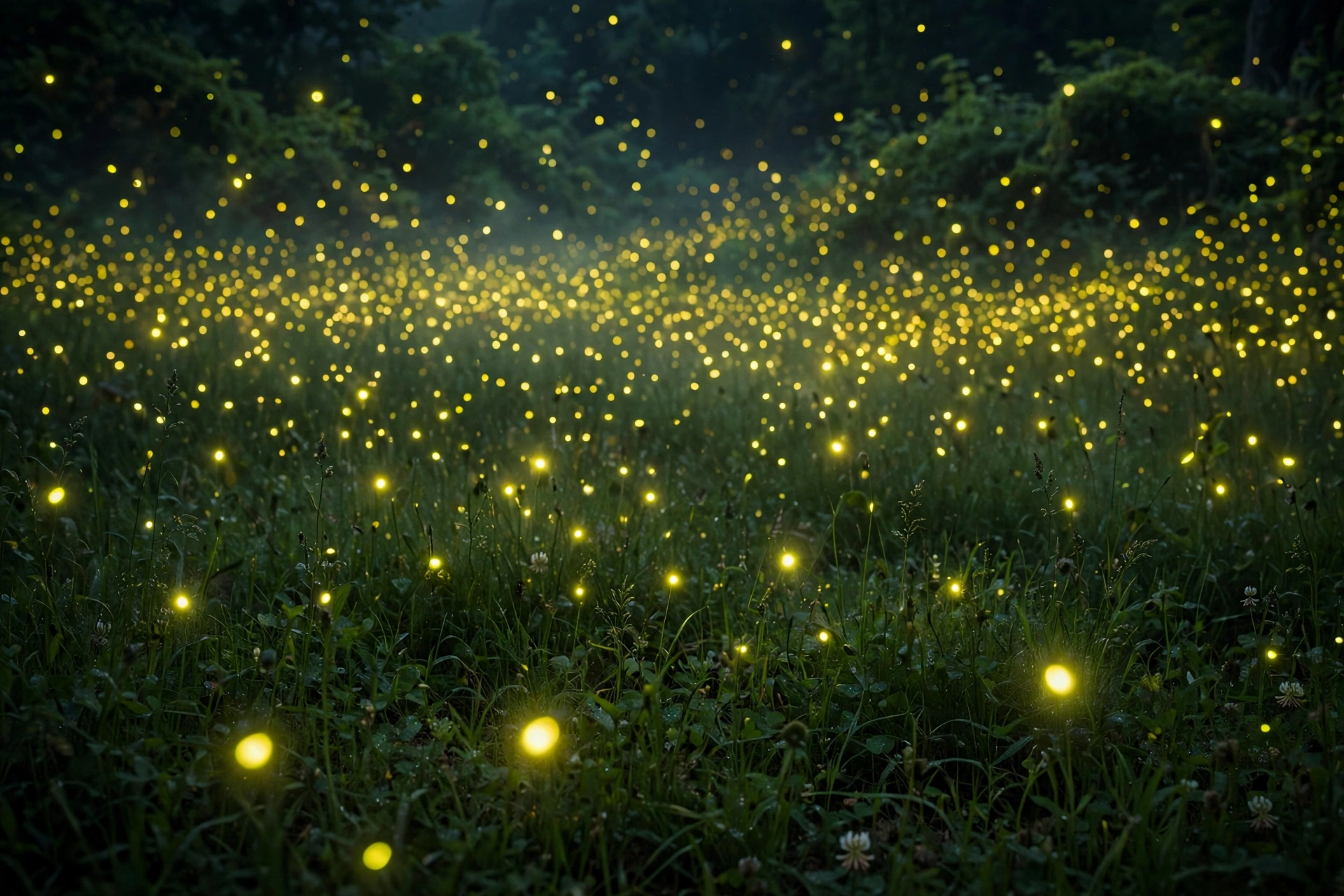
On a warm summer night, in a field, a garden, or beside a quiet stream, you may see small yellow-green lights blinking in the dark. They rise, hover, flash, and vanish, then flash again a little further away. There is no wire, no bulb, and no flame. The light comes from a living insect, about the size of a small fingernail, and it feels like magic. It is not magic, though. It is chemistry, and it is one of the most beautiful examples of chemistry in nature.
The question is simple, and it is the kind of question a child asks first: how do fireflies make light without heat? If you touch a normal light bulb after it has been on for a while, it is hot. If you hold a candle, the flame is hot. Even the sun, our greatest source of light, is unimaginably hot. A firefly, by contrast, glows without burning itself, without heating the air around it, and without wasting most of its energy as heat. Scientists call this kind of light “cold light”, and the process that makes it is called bioluminescence. “Bio” means life, and “luminescence” means the production of light. Put together, bioluminescence means light made by a living thing.
This article explains, in simple language, how fireflies make light without heat, what happens inside their bodies, how they turn their light on and off, why they glow at all, and why other creatures glow too. It also looks at how scientists use firefly chemistry in medicine and research, why fireflies are disappearing in many places, and what ordinary people can do to help them, without catching or harming them.
You do not need to know chemistry to follow it. If you have ever seen a firefly, wondered about a glow stick, or asked why a light bulb gets hot, you already have everything you need to understand the story.
What Is Bioluminescence?
Bioluminescence is light made by a living organism through a chemical reaction inside its body. It is different from the light made by the sun, a fire, or an electric bulb, because it does not need extreme heat or an electric current. It needs the right chemicals, in the right place, at the right time.
Fireflies are not the only animals that glow. Many deep-sea fish, jellyfish, squid, and tiny plankton glow in the dark ocean, where sunlight never reaches. Some fungi glow softly on rotting wood in forests. Some bacteria glow in the sea, and some worms and millipedes glow on land. Scientists have found bioluminescence in many different groups of living things, and it has evolved independently many times, which means different creatures found their own way to the same trick.
For fireflies, bioluminescence is not a side effect. It is a central part of their life. Adult fireflies use it to find mates. Their larvae, which look like small worms and are sometimes called glowworms, use it to warn predators. In some species, females that cannot fly sit on the ground and glow steadily, like little lamps, while males fly above them and look for the answering light.
It is important to be clear about what fireflies are. Despite their name, fireflies are not flies. They are beetles, members of the family Lampyridae, and there are more than 2,000 known species around the world. They live on every continent except Antarctica, in fields, forests, marshes, and gardens, wherever there is moisture, darkness, and food for their larvae. Not every species glows as an adult. Some species are active in the daytime and do not use light at all, while others glow only as larvae. The flashing fireflies we love to watch on summer nights are the ones that have kept, and perfected, the art of cold light.
Inside the Firefly: The Light Organ
A firefly’s light comes from a special organ in its lower abdomen, near the tip of its body. If you look closely at a firefly in daylight, you can often see the pale, yellowish segments at the end of its abdomen. Those segments contain the light organ, a collection of tiny cells called photocytes, which are the cells that make light.
The light organ is a remarkable piece of engineering. It is supplied with air tubes, called tracheae, which bring oxygen directly to the photocytes. It is also supplied with nerves, which control the organ, and with a layer of cells that reflect light outward, a bit like the shiny backing inside a torch, so that as much light as possible shines out instead of being lost inside the body. The underside of the organ is transparent, so the light can escape easily.
Photocytes are packed with the chemicals needed for the reaction. The two most important are luciferin and luciferase. Luciferin is the molecule that actually produces light when it changes form. Luciferase is an enzyme, a kind of helper molecule, that speeds up the reaction and makes it happen at body temperature. The names are easy to confuse, but there is a simple way to remember them. Luciferin ends in “-in”, like many chemical substances, and luciferase ends in “-ase”, like many enzymes. The firefly carries both, ready to use, in its photocytes.
There are other ingredients too. The reaction needs oxygen from the air, energy in the form of a molecule called ATP, which is the energy currency of almost all living cells, and small amounts of other helpers, including magnesium ions. When all of these are present together, and when the firefly decides to flash, the reaction runs, and light is released.
The Chemical Reaction, Step by Step
The firefly light reaction happens in a few steps, and each step is simple on its own. Together, they turn chemical energy into light energy, with almost no heat.
First, luciferin combines with ATP, using energy stored in ATP, to form an activated version of luciferin. Think of this as charging a battery, or cocking a spring. The molecule is now ready, but it has not yet made light.
Second, oxygen is allowed into the photocytes. This is the key control step, and it is the step the firefly controls when it flashes. Without oxygen, the reaction pauses. With oxygen, it proceeds.
Third, luciferase helps oxygen react with the activated luciferin. This reaction creates a new molecule in an excited state, which means it holds extra energy, like a ball held high above the ground. It cannot stay in that state for long.
Fourth, the excited molecule relaxes back to a stable state, and as it does, it releases its extra energy. In a firefly, that energy comes out almost entirely as light, in the yellow-green part of the spectrum that our eyes see very well in the dark. The molecule left behind is called oxyluciferin, and it can be recycled, in part, back into luciferin, so the firefly can flash again.
The whole process is extremely efficient. A normal incandescent light bulb turns most of its energy into heat and only a small fraction into light, which is why it gets hot. A firefly turns almost all of the energy in this reaction into light, and very little into heat. That is why the light is called cold light. It is not literally at freezing temperature, and the firefly’s body is still warm from being alive, but the light itself does not add heat the way a bulb or a flame does.
There is a familiar comparison that helps here. A glow stick works in a similar way, by a chemical reaction that makes light without heat, but a glow stick cannot turn itself off and on, cannot control its pattern, and cannot recycle its chemicals. A firefly can do all of those things, because it is alive, and because its nervous system controls the reaction.
How Fireflies Turn the Light On and Off
A firefly does not glow all the time. It flashes, and the flashing is the whole point. If it glowed steadily, like a lamp left on, it would waste energy, attract predators for longer, and, most importantly, it would not be able to send messages. Flashing is a language, and like any language, it needs pauses, rhythm, and timing.
For a long time, scientists debated exactly how fireflies control their flashing. The current understanding is that the firefly controls the supply of oxygen to its photocytes. The light organ is surrounded by tiny air tubes, and the firefly can change how much oxygen reaches the photocytes, in part by using a signalling molecule called nitric oxide. When nitric oxide is released, it allows oxygen to flow into the photocytes, and the reaction runs, so the firefly flashes. When nitric oxide stops, oxygen flow is reduced, the reaction pauses, and the light goes out.
Nerves also play a role, telling the light organ when to flash, and the whole system can respond very quickly, in fractions of a second. That speed matters, because a firefly’s flash pattern may be only a few flashes long, separated by precise pauses, and a mate must recognise that pattern among many other flashing insects in the same field.
Think of it like a traffic light controlled by a switch. The chemicals are always ready, like electricity waiting in a wire. The switch is oxygen. When the firefly opens the switch, oxygen flows, the reaction runs, and light appears. When it closes the switch, oxygen stops, the reaction pauses, and darkness returns. Because the switch can be opened and closed quickly, the firefly can produce short flashes, long glows, double flashes, and complex rhythms, all with the same chemistry.
This control is also why a firefly can flash while flying. Flying takes a lot of energy and a lot of oxygen, and the firefly’s body must balance the oxygen needs of its flight muscles with the oxygen needs of its light organ. The fact that it can do both, while also navigating, avoiding predators, and looking for a mate, is a small miracle of biology.
Why Different Fireflies Flash Differently
Not all fireflies flash the same way. Some flash once, then pause. Some flash twice quickly. Some draw a J-shape as they fly. Some glow steadily. Some flash yellow, some green, and a few flash orange or reddish.
These differences are not random. Each species has its own flash pattern, like a signature, which helps males and females of the same species find each other in the dark. In a field where several species live together, a female must tell whether the male above her is the right species. The pattern is a combination of how many flashes in a group, how long each flash lasts, how long the pause is, whether the male flashes while flying in a particular path, and what colour the light is. The female answers with a flash of her own after a precise delay, often a fraction of a second, guiding the male closer, step by step.
Colour is controlled by small differences in the luciferase enzyme. A slightly different luciferase can shift light from green to yellow, or to orange. There is also a darker side to this language. Some predatory fireflies mimic the flash patterns of other species, luring males towards them, not to mate, but to eat them. This is called aggressive mimicry, and it shows how powerful a signal can be.
Why Do Fireflies Glow at All?
The main reason adult fireflies glow is to find mates, as described above. But glowing has other uses too, and those uses change across the firefly’s life.
Firefly larvae live in soil, leaf litter, and damp places, and they eat snails, slugs, and other small creatures. Larvae of many species glow steadily, and scientists believe this glow is a warning. Fireflies, both as larvae and as adults, contain chemicals that taste bad to many predators, and in some cases are mildly toxic. The glow says, in effect, “Do not eat me, I taste bad, and I may make you sick.” Predators that try once and dislike the taste learn to avoid glowing insects in future. This is the same idea as the bright colours of a poison dart frog, or the black and yellow stripes of a wasp, except that the firefly’s warning works at night, when colour cannot be seen, so it uses light instead.
Adult fireflies may also use light to warn predators, and some species flash when disturbed, as if to say they are not good food. In a few species, adults do not feed at all, living only long enough to mate and lay eggs, so their light is their only adult job, apart from mating itself.
It is worth asking why fireflies evolved light at all, when most insects manage perfectly well without it. The answer is that light works well in the dark, in places where sound and smell are less reliable, or where many species live together and need a clear, private channel. A flash can be seen from a distance, it can be timed precisely, and it can be species-specific, all without making noise that might attract a predator that hunts by sound. For a small beetle active at dusk and at night, light is an elegant solution.
Why Is the Light Cold? The Difference From a Bulb
To understand cold light, it helps to compare a firefly with a normal light bulb, and with a fire.
An old-style incandescent bulb makes light by heating a thin wire, called a filament, until it glows white-hot. Most of the electricity goes into heating the wire, and only a small part, often less than ten percent, comes out as visible light. The rest is heat, which is why the bulb feels hot and why it wastes energy. A modern LED bulb is much better, because it makes light by a different process, and wastes less energy as heat, but it still needs electricity, and it still warms up a little.
A fire makes light by burning fuel at high temperature. The flame is hot because burning releases a lot of energy as heat, and only a part of that energy becomes light. If you put your hand near a flame, you feel the heat at once.
A firefly makes light by a chemical reaction that is designed to release its energy as light, not as heat. The excited molecule in the reaction has a choice, in a sense, about how to release its extra energy. It can release it as heat, by vibrating, or as light, by emitting a photon, a tiny packet of light. In the firefly reaction, the structure of the molecule and the conditions in the photocyte strongly favour light. Almost all of the energy goes into photons, and very little goes into heat. Scientists describe this as high quantum efficiency, which simply means that most of the reaction’s energy becomes light.
This efficiency matters for the firefly. If its light reaction produced a lot of heat, the firefly would overheat, waste energy, and possibly damage its own cells. By making cold light, it can signal for hours, night after night, using only a small amount of energy, while staying cool enough to fly, mate, and survive.
It also matters for us. When scientists studied firefly light, they learned lessons about efficient light production that have inspired research into better lighting, better medical imaging, and better ways to detect tiny amounts of chemicals in the body. Nature solved the problem of cold light long before humans did, and we are still learning from its solution.
Other Creatures That Glow
Fireflies are the most familiar glowing animals on land, but they are only a small part of a larger glowing world. In the deep ocean, anglerfish dangle glowing lures, jellyfish pulse with blue and green light, and tiny plankton flash when waves break. On land, some fungi glow softly on rotting wood, and some glowworms glow in caves and forests. Each uses its own version of the same basic idea, a light-making molecule and a helper enzyme, though the exact molecules differ. In the ocean, light can attract prey, confuse predators, or help animals find mates in the dark, just as firefly light helps with mating and warning on land.
How Scientists Use Firefly Chemistry
Firefly chemistry is also useful in laboratories. Scientists can attach the gene for luciferase to another gene they want to study. When that other gene is switched on, the cell also makes luciferase, and if luciferin is added, the cell glows. By measuring the glow, scientists can tell whether a gene is active and how active it is, without killing the cell. This is used in research on cancer, infections, and new medicines.
A similar idea tests for ATP, the energy molecule. Because the firefly reaction needs ATP, the amount of light can show how much ATP is in a sample, which is used to test whether food or surfaces are clean, since living cells contain ATP. Scientists are also studying luciferase for medical imaging, to follow tumours or infections inside a living body by their glow. This is mainly a research tool, not a routine treatment, and firefly chemistry alone has not cured diseases. But it shows how studying a small beetle can lead to tools that help medicine and science.
Why Fireflies Are Disappearing
In many parts of the world, people report seeing fewer fireflies than they did as children, and surveys in North America, Europe, and Asia suggest many species are declining, although the exact picture varies by species and place, and not every species has been studied in detail.
There are three main reasons, and they often act together. The first is light pollution. A bright streetlight, garden light, or porch light can wash out a firefly’s flash, making it harder for males and females to find each other, so mating fails. The second is habitat loss. Fireflies need damp, dark, undisturbed places for their larvae, which live for one or two years in soil and leaf litter, and open, grassy places for adults to flash. When wetlands are drained, fields are paved, lawns are mowed very short, and leaf litter is removed, both homes disappear. The third is pesticides, which can kill fireflies directly, or kill the snails and slugs their larvae eat. Climate change may also play a role, but scientists are still studying how large that effect is compared with light pollution, habitat loss, and pesticides.
How to Help Fireflies, Without Harming Them
Helping fireflies does not require special equipment or money. It requires darkness, patience, and a willingness to leave some parts of a garden a little wild.
Turn off outdoor lights when you do not need them, and use motion sensors, timers, or shielded lights that point down when you do need light. If you want to watch fireflies, use a red torch, or no torch at all, because red light interferes less with their signals, and your eyes will adjust after a few minutes.
Leave some leaf litter, tall grass, and damp corners in your garden, especially near trees, hedges, or water. Do not mow everything short and often. A patch of longer grass and leaves left over winter can be a home for firefly larvae.
Avoid pesticides on lawns and gardens, especially broad-spectrum insecticides. Fireflies eat snails and slugs, so a garden with a few snails is food for them, not a problem. Do not catch fireflies and keep them in jars, even for a short time, because they cannot mate or feed, and may die from heat, lack of air, or stress. Watching them in the wild, without touching them, is kinder and more rewarding.
Frequently Asked Questions
How do fireflies make light without heat?
Fireflies make light through a chemical reaction called bioluminescence, in special cells called photocytes in their lower abdomen. A molecule called luciferin reacts with oxygen, helped by an enzyme called luciferase and energy from ATP, and releases its energy as light, not heat. Because almost all of the energy becomes light, the glow is cold, unlike a bulb or a flame, which waste most of their energy as heat.
Why do fireflies flash instead of glowing all the time?
Flashing is a language. Each species has its own pattern of flashes and pauses, which helps males and females of the same species find each other in the dark. A female answers a male’s flash after a precise delay, guiding him closer. Flashing also saves energy, and it lets a firefly send a clear, recognisable signal, rather than a steady light that could be confused with other lights.
Do all fireflies glow?
No. Fireflies are beetles, and there are more than 2,000 species. Some species glow only as larvae, some glow as adults, and some are active in daytime and do not use light at all. The flashing fireflies we see on summer nights are the species that use light for mating, while other species use smell or other signals instead.
Can I touch a firefly? Will its light burn me?
No, a firefly’s light will not burn you, because it is cold light, with very little heat. However, it is best not to catch or handle fireflies, because handling can harm them, stress them, and prevent them from mating. Watch them in the wild, without touching them, and you will see their natural behaviour, and they will have a better chance of surviving.
Why are there fewer fireflies than there used to be?
In many places, fireflies are declining because of light pollution, which interferes with their flashing signals, habitat loss, which removes the damp, dark places their larvae need, and pesticides, which kill fireflies or their food. Turning off unnecessary outdoor lights, leaving leaf litter and tall grass, and avoiding pesticides can help fireflies in gardens and parks.
Closing: A Small Light With a Big Story
So, how do fireflies make light without heat? They do it with chemistry, not with fire. A molecule called luciferin, an enzyme called luciferase, oxygen, and energy from ATP come together in special cells, and the energy is released as light, not as heat. The firefly controls that reaction by controlling oxygen, so it can flash in precise patterns, send messages in the dark, find a mate, and warn predators that it tastes bad.
That small light tells a much larger story. It tells us about evolution, about how different creatures have found the same trick in different places, from deep oceans to dark forests. It tells us about science, because firefly chemistry is now used in laboratories to study genes, to test for contamination, and to image living cells. And it tells us about our own world, because the decline of fireflies is a sign that our nights are becoming too bright, our fields too tidy, and our soils too sprayed, for a small beetle that needs darkness, dampness, and quiet to live.
The next time you see a firefly, on a warm night, in a dark field, take a moment to watch it, without a torch, without a jar, without trying to catch it. Watch its flash, its pause, its answer, and its flight. You are watching cold light, made by chemistry, used as language, and perfected over millions of years. It is a small light, but it is one of the most beautiful lights in nature, and it is worth keeping dark nights dark, so that it can keep shining.