Why Does Ice Float on Water? Explained Simply
SUMMARY OF THIS ARTICLE
- Ice floats because it is lighter than the same amount of water, which is strange and rare.
- When water freezes, its tiny parts spread out into an open shape, so ice takes up more space.
- That open shape makes ice less dense, and less dense things float on denser things.
- If ice sank, lakes would freeze from the bottom up and most lake animals could not survive winter.
- Floating ice also helps keep the Earth cool, because white ice bounces sunlight back into space.
Drop an Ice Cube in a Glass and Watch
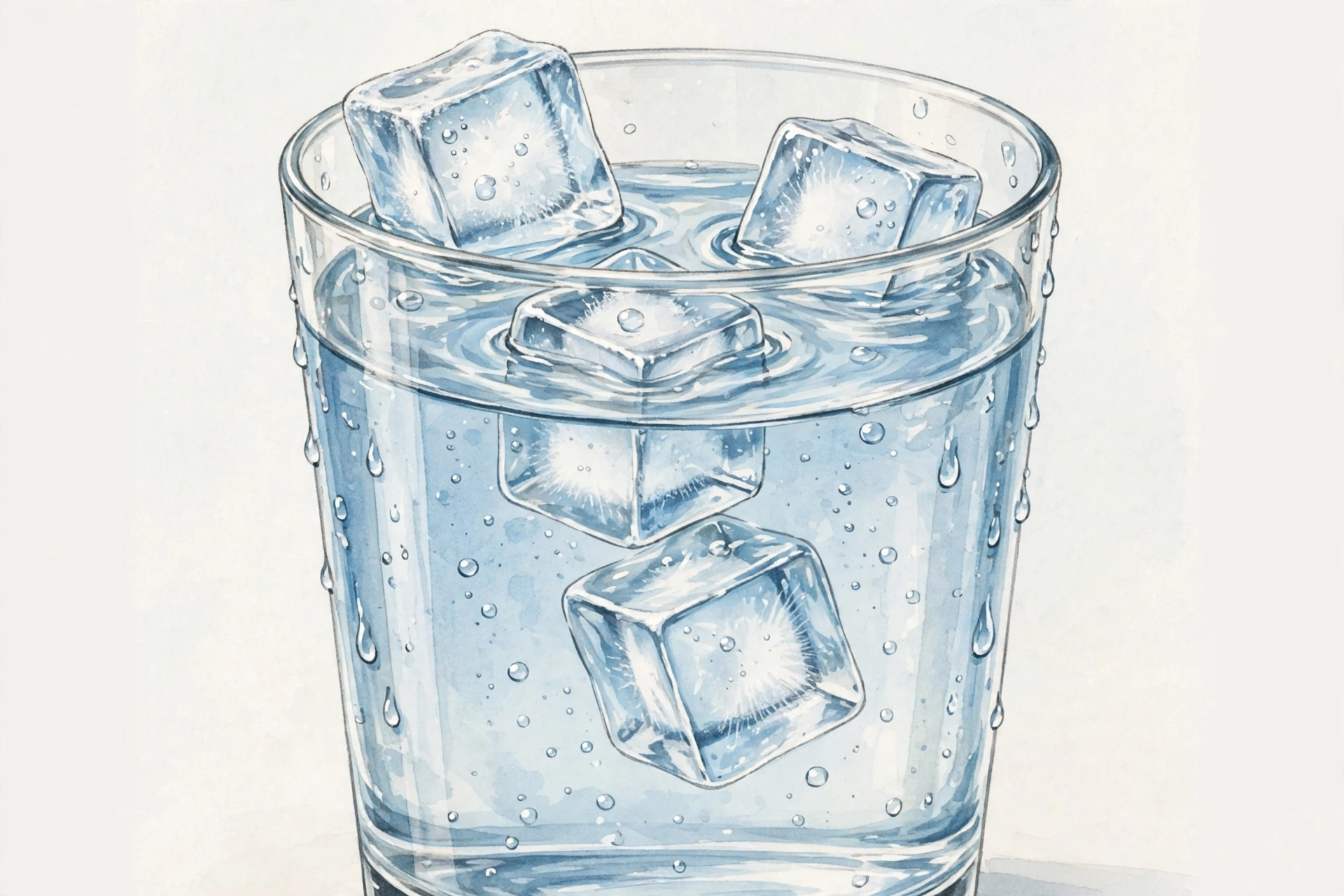
You have probably done this a hundred times without thinking. You drop an ice cube into a glass of water, and it floats. It bobs up and down. Most of it sits under the water, with just a little bit poking out on top, like a tiny white iceberg.
It feels normal. But it is actually very strange.
Think of it like this. Take almost any other solid thing — a stone, a piece of metal, a lump of wax — and drop it into its own melted liquid. The solid sinks. A frozen lump of candle wax sinks in melted wax. A solid piece of iron sinks in melted iron. That is the normal rule: solids are heavier than their own liquids, so they sink.
Water breaks the rule. Solid water — that is what ice is — floats on liquid water. It is one of the few things in the world that does this. And it turns out that this small oddity is one of the reasons life on Earth works at all.
So why does it happen? The answer lives in the tiny parts that make up water. We need to zoom right in, smaller than your eye can see, and look at what water is made of.
What Water Is Made Of
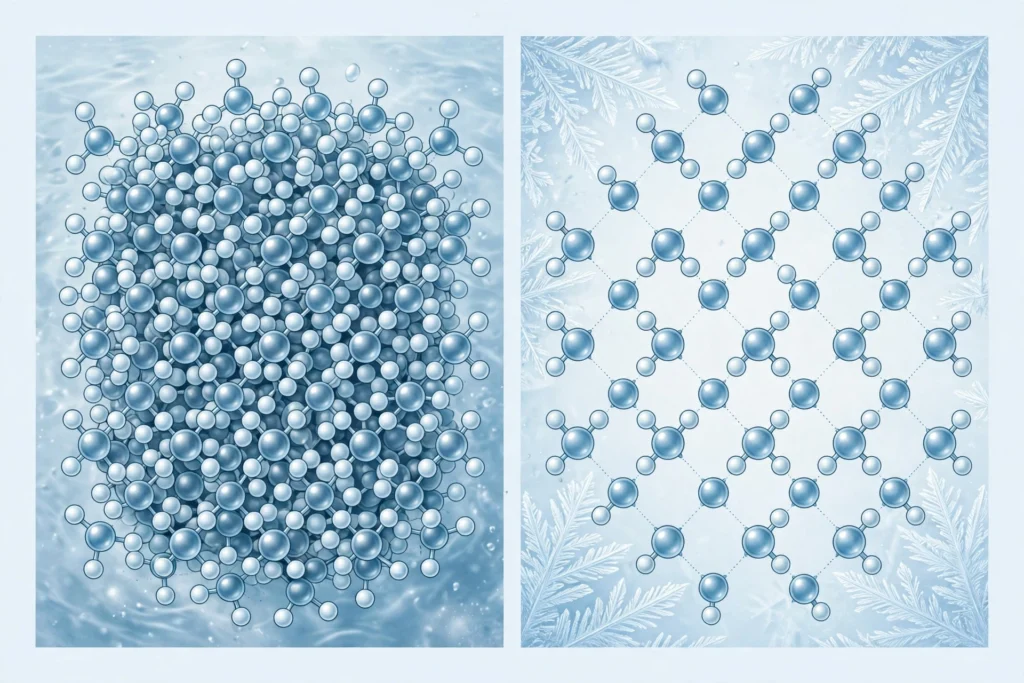
Everything around you is made of tiny parts called molecules. A molecule is the smallest bit of something that is still that thing. A water molecule is made of two tiny bits of hydrogen and one bit of oxygen, stuck together. You can picture it a bit like a tiny Mickey Mouse head: the big oxygen in the middle, two small hydrogen ears on top. Water molecules are always moving, sliding past each other, bumping and jostling like people in a busy market.
In liquid water, the molecules are close together, but they can still move around. They are like a crowd of people standing shoulder to shoulder, able to shuffle and slide past each other. That is why water flows and pours.
Now, here is the key part. Water molecules like to hold hands with each other. Not real hands, of course. They have a tiny pull towards each other, a weak little grip called a hydrogen bond. In warm water, the molecules move too fast and too wildly to hold hands for long. They grab and let go, grab and let go, like children playing a fast game of tag.
But as water gets colder, the molecules slow down. They move less wildly. And those little hand-holds start to last longer. The molecules begin to line up. And when water gets cold enough to freeze, something special happens: the molecules lock into a neat, open pattern, a bit like a honeycomb, with lots of empty space in between.
That empty space is the whole secret. Ice takes up more room than the same water did as a liquid. Same molecules, more space. And more space for the same weight means lighter. That is why ice floats.
The Word That Explains It: Density
There is a useful word here: density. Density means how much stuff is packed into a certain amount of space. A heavy thing packed tight has high density. A light thing with lots of air in it has low density.
Here is an easy way to feel density. Pick up a small rock and a sponge of the same size. The rock is heavy. The sponge is light. The rock is denser. It has more stuff packed into the same space.
Now picture a jug of water and a jug of ice, both exactly the same size. The ice jug weighs less. The water molecules in the ice have spread out into that open honeycomb shape, so fewer molecules fit in the jug. Less stuff in the same space means lower density. And in water, lower density things float. A cork floats because it is less dense than water. A stone sinks because it is denser. Ice floats because frozen water is a little bit less dense than liquid water.
How much less? Only about 9 per cent less. That is not much. And that is why most of an ice cube — or an iceberg — sits under the water, with just a small bit above. Roughly nine-tenths of an iceberg is hidden under the sea. Sailors have known this for a long time, and it is why icebergs are so dangerous to ships. What you see is only the tip. The rest is a huge hidden lump below.
Water Is a Bit of a Rebel
Most liquids shrink as they get colder. The molecules slow down and pack closer together, so the liquid takes up less space and gets denser. Then it freezes, and the solid is even denser, so it sinks. That is the normal story.
Water does something different, and it does it right at the end. As water cools from warm to cold, it shrinks like everything else — until it reaches about 4 degrees Celsius. That is just above freezing. At that point, water is at its densest, its heaviest for its size.
Then, as it cools the last little bit from 4 degrees down to 0 degrees, it starts to expand again. Expand means to get bigger, to take up more space. The molecules begin to lock into that open crystal pattern, pushing each other a little farther apart. So water at 0 degrees is actually a tiny bit less dense than water at 4 degrees. It is a strange little U-turn, and it happens nowhere else in quite the same way.
You can see this in a bottle if you are not careful. Fill a glass bottle right to the top with water, put the lid on tight, and leave it in the freezer. The water will freeze, expand, and crack the bottle. The ice needs more room than the water did, and the glass cannot stretch. That is why you should never leave a full bottle of water in the freezer overnight. It is also why pipes can burst in winter when the water inside them freezes and pushes outwards.
This odd behaviour of water has a name among scientists: the anomalous expansion of water. Anomalous is a fancy word for strange or unusual. But you do not need the fancy word. Just remember: water shrinks as it cools, then changes its mind at the very last moment and grows again as it freezes.
Why Fish Are Grateful for Floating Ice
Now, here is where this little science fact becomes a matter of life and death — for fish, at least.
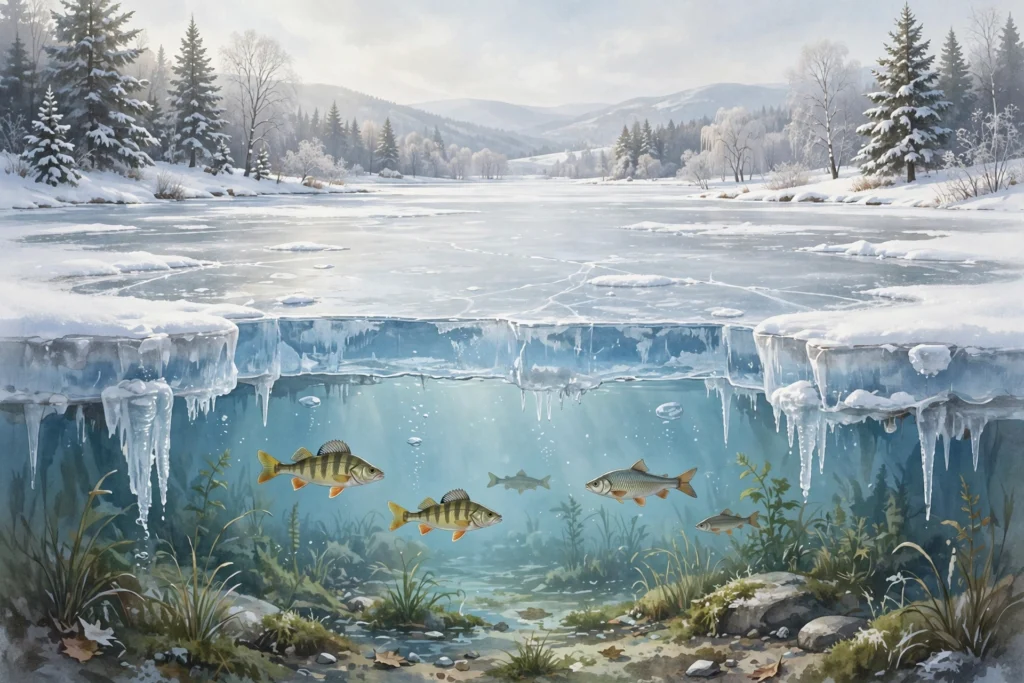
Picture a lake in winter, somewhere cold like Canada or northern Europe. The air is freezing. Snow falls. The top of the lake turns to ice. Because ice floats, that ice sits on top like a lid. Under the lid, the water stays liquid. And the coldest water, the water near freezing, stays near the top, just under the ice. The slightly warmer, denser water sinks to the bottom, where it stays around 4 degrees. Fish, frogs, and other animals swim down there, slow and sleepy, waiting out the winter.
Now picture the opposite. Imagine if ice sank. The top of the lake would freeze, the ice would sink to the bottom, and more ice would form on top, then sink too. The lake would freeze from the bottom up, like a freezer filling with ice cubes. Before long, the whole lake would be solid. Every fish, every frog, every tiny water creature would be trapped in ice. Come spring, there would be nothing left alive.
That is not a made-up story. It is what would happen on a planet where ice sank. Lakes and ponds would be deadly in winter. Life in fresh water would be far harder, maybe impossible in cold places. The fact that ice floats is one of the quiet reasons lakes stay alive through winter, year after year.
It works the same way in the sea, too. Sea ice floats on the ocean. Under it, the water stays liquid, and animals like seals, whales, and fish carry on living. Polar bears walk on the floating ice and hunt through holes in it. If sea ice sank, the whole picture of life at the poles would fall apart.
There is a similar idea behind why things float in very salty water. The Dead Sea, for example, is so salty that people float in it without even trying. You can read more about that strange water in our piece on why the Dead Sea is so salty and why you float in it. Salt and ice are different stories, but both show the same rule at work: when something is less dense than the water around it, it floats.
Icebergs: The Tip Is Only the Start
You have heard the phrase “the tip of the iceberg.” It means the small part of a problem that you can see, while a much bigger part hides underneath. It comes straight from this science.
An iceberg is a huge lump of ice that has broken off a glacier, which is a giant river of ice on land, and drifted into the sea. Because ice is only a little less dense than seawater, about nine-tenths of the iceberg sits below the surface. What you see above the water is just the top. The rest is a giant hidden mass, wider and heavier than it looks.
That is why ships treat icebergs with so much respect. In 1912, the Titanic hit an iceberg in the North Atlantic and sank. The part the crew could see was not the part that tore the ship open. The damage came from the hidden ice below the water. To this day, ships and planes watch the seas near the poles and warn each other about icebergs, because the danger is mostly invisible.
Icebergs are beautiful, too. They come in blue and white, with caves and arches carved by waves. Some are the size of small towns. When they melt, they slowly release fresh water into the sea. And because they float, they drift with the currents, sometimes for years, before they melt away.
Floating Ice Helps Cool the Earth
Here is a bigger picture, one that reaches far beyond your glass of water. The ice at the North and South Poles floats on the sea, and it does a job for the whole planet: it keeps the Earth cool.
White ice is very good at bouncing sunlight back into space. Scientists call this the albedo effect. Albedo is just a fancy word for how much light a surface reflects. Fresh snow and ice reflect most of the sunlight that hits them, like a white shirt on a hot day. Dark ocean water, on the other hand, soaks up sunlight and warms up, like a black shirt in the sun.
When sea ice melts, white ice is replaced by dark water. The dark water soaks up more heat, which warms the sea, which melts more ice. It is a loop, and it worries scientists who study the climate. The floating ice at the poles is not just pretty scenery. It is part of the Earth’s cooling system.
This is also why people who study the weather watch Arctic sea ice so closely. Each summer, some of it melts. Each winter, much of it freezes again. The balance between freezing and melting tells us a lot about how warm the planet is getting. A glass of water with an ice cube is a small thing. The polar ice is the same science, on a giant scale.
Try It Yourself at Home
The best way to believe this is to see it with your own eyes. You do not need a lab. Your kitchen will do.
First, the classic test. Fill a glass with water, drop in an ice cube, and watch. It floats, with most of it under the water. Push it down with a spoon and let go. It pops straight back up. That is buoyancy, the push-up force of water on something less dense than itself. The water pushes the ice up because the ice is lighter than the water it pushes aside.
Second, try the bottle test — carefully. Take a small plastic bottle, fill it with water, but leave a little space at the top, and put it in the freezer. Come back in a few hours. The water has frozen and expanded. If you filled it too full, the bottle may have bulged or cracked. That is the ice needing more room.
Third, try a fun one with salt water. Dissolve a lot of salt in a glass of warm water, let it cool, and drop in an ice cube. It floats even higher than in fresh water, because salty water is denser than fresh water. The denser the water, the more it pushes the ice up. This is the same reason it is easier to float in the sea than in a swimming pool, and easier still in the Dead Sea.
Fourth, watch a drink. Pour a cold drink, add ice, and watch the cubes slowly shrink as they melt. Notice that the water level barely changes as the ice melts. That is because the ice was already pushing aside an amount of water equal to its own weight. When it melts, it just fills the space it was already taking up. It is a neat little bit of physics hiding in your glass.
If you have children at home, these little tests are a lovely way to show them science without a textbook. No big words needed. Just water, ice, and a bit of watching.
The Same Idea Shows Up Everywhere
Once you understand density, you start seeing it all over the place. Hot air rises because it is less dense than cold air — that is how a hot air balloon floats up into the sky. Oil floats on water because oil is less dense than water, which is why oil spills spread across the sea in a thin layer. A beach ball floats, a pebble sinks. A wooden boat floats because the wood and the air inside it together are less dense than water, even though wood feels solid and heavy in your hand.
Cooking uses the same idea. Cream rises to the top of milk because fat is less dense than the rest of the milk. Soup stock has fat floating on top for the same reason. Even the clouds above your head are part of the story: warm, damp air rises because it is lighter than the cool air around it, then cools and forms clouds.
One more place you can see it is in your own home in winter. If you have ever looked at a pond on a frosty morning and seen ducks walking on the ice while fish swim below, you have seen the whole story in one picture. The ice is a roof, not a floor. Under that roof, life carries on, slow and quiet, waiting for spring. It is a small miracle, and it happens because of a tiny gap between molecules that you cannot even see.
Water’s little trick — getting bigger as it freezes — is unusual, but the rule it follows is not. Less dense things float. More dense things sink. Ice floats because freezing makes water less dense. That is the whole answer, in one short line. Everything else is just that line playing out in lakes, oceans, glasses, and the sky.
Frequently Asked Questions
Why does ice float instead of sinking?
Ice floats because it is less dense than liquid water. When water freezes, its molecules lock into an open, spread-out pattern with empty space between them. The same amount of water takes up more space as ice, so it weighs less for its size. Less dense things float on denser things, so ice floats.
How much of an iceberg is above the water?
Only about one-tenth. Roughly 90 per cent of an iceberg sits below the surface, hidden under the water. That is because ice is only about 9 per cent less dense than seawater. The small part you see is called the tip, and the huge part you cannot see is what makes icebergs dangerous to ships.
What would happen if ice sank?
Lakes and ponds would freeze from the bottom up in winter. The ice would pile up on the bottom, and before long the whole lake could turn solid. Fish, frogs, and other water animals would have nowhere liquid to survive the winter. Life in cold lakes would be far harder, and many lakes would lose their animals every winter.
Does ice float in salt water too?
Yes, and it floats even higher. Salt water is denser than fresh water, because the salt adds extra stuff to the water. The denser the water, the more it pushes up on the ice. That is why it is easier to float in the sea than in a pool, and why ice cubes bob higher in salty water.
Why does a bottle of water crack in the freezer?
Because water expands when it freezes. The ice needs about 9 per cent more space than the liquid water did. If the bottle is full and sealed, the growing ice has nowhere to go, so it pushes hard against the bottle until the bottle cracks or bursts. Always leave space at the top of a bottle before freezing it.
Does the water level rise when ice melts in a glass?
Barely at all. A floating ice cube already pushes aside water equal to its own weight. When it melts, the melted water just fills that same space. So the level in your glass stays almost the same. Melting sea ice also does not raise sea levels much, but melting ice from land, like glaciers, does add new water to the sea.
A Little Wonder in Your Glass
Here is the thing I keep coming back to. The world runs on small rules, and this is one of the loveliest. A glass of water, a cube of ice, and a rule so simple a child can see it: light things float, heavy things sink. But behind that simple rule sits a hidden dance of tiny molecules, a strange U-turn at 4 degrees, and a gift that keeps fish alive under winter ice.
So next time you hear the clink of ice in a glass, or see a frozen pond on a cold morning, remember what is really happening. That ice is floating because water did something almost nothing else does — it grew bigger as it froze. And because of that small oddity, lakes stay alive, ships watch the seas with care, and the white caps at the poles help keep our planet cool. Not bad for a cube of frozen water.