Who Invented the Telephone?
SUMMARY OF THIS ARTICLE
- Alexander Graham Bell is usually named as the inventor of the telephone, and he holds the first United States telephone patent.
- Bell received US patent 174,465 on 7 March 1876, after filing his application on 14 February 1876.
- On the same day, 14 February 1876, another inventor, Elisha Gray, filed a similar claim, only hours after Bell.
- The first clear spoken sentence over a telephone was heard on 10 March 1876: “Mr. Watson, come here, I want to see you.”
- Other inventors, including Antonio Meucci and Philipp Reis, built earlier voice devices, so the telephone was the work of many hands, not one man alone.
A Question With a Surprising Answer
Pick up your phone. Tap a name. A few seconds later, you hear the voice of a friend who lives on the other side of the world. It feels normal. Most of us do it every day without thinking about it at all.
But think how strange it really is. A voice travels through wires and across oceans, and arrives in the ear of a person thousands of miles away. Less than 150 years ago, that idea sounded like magic. Today, we would feel lost without it.
So who made it happen?
If you ask a class of school children, most will say the same name: Alexander Graham Bell. He is the name in the school books and on the first telephone patent. In one sense, that answer is right. But the full story is much more interesting. It is about a race to the patent office, a man who could not afford ten dollars, a German teacher with a strange machine, and a sentence spoken by accident that changed the world.
A World Before the Telephone
To understand why the telephone mattered so much, you need to picture the world before it existed. In the 1870s, if you wanted to talk to someone far away, you had two choices. You could write a letter, or you could send a telegram.
A letter was slow. It travelled by horse, by ship, or by train, and a letter from New York to London could take more than a week. If the news was urgent, a letter was useless.
A telegram was faster, but it was not a conversation. You went to a telegraph office and wrote down your message. An operator tapped it out in dots and dashes, a code called Morse code, and it travelled along a wire to another office. It was clever, and it changed business and news forever. But you could not hear a voice. You could not laugh with someone.
People of that time already knew how to measure hours and days with clocks and calendars. If you want to know how people managed before modern clocks, you can read about telling time long before phones and watches. But voices could not travel at all.
The Boy Who Listened Differently
Alexander Graham Bell was born in Edinburgh, in Scotland, on 3 March 1847. His family was unusual, and that shaped everything he did later. His father and grandfather taught people how to speak clearly. And in Bell’s own home, sound was a daily struggle.
His mother was deaf. She could not hear her own son’s voice. His wife, Mabel, whom he married later, was also deaf, having lost her hearing as a small child after a serious illness. Bell grew up close to people who could not hear, and he spent much of his life trying to help deaf people speak and listen.
As a young man, Bell worked as a teacher of deaf children. He taught them to feel sound through their hands and throats, and he tried to find ways to show sound as a picture. This was not a side job for him. It was his life’s work.
That work led him to a strange idea. If sound could be turned into something you could see, could it also be turned into something that could travel along a wire? Could a voice become electricity, travel far away, and then become a voice again? At first, it was just a question. Then it became an experiment. Then it became an obsession.
Bell moved to Boston, in the United States, and set up a small workshop with a young assistant named Thomas Watson. Watson was a clever mechanic, good with tools and good at building things with his hands. Bell was the thinker. Watson was the builder.
The Problem Bell Was Really Trying to Solve
Here is the funny part. Bell was not trying to invent the telephone at all, at least not at first. He was trying to build a better telegraph.
The telegraph companies had a problem. One wire, one message. That was slow and wasteful. What if one wire could carry many messages at once, like many instruments playing different notes in the same room? This idea was called the harmonic telegraph. Each message would travel on its own musical note, and the receiver would pick out each note separately.
Bell worked hard on this. He built metal reeds, like the parts inside a musical instrument, each shaking at its own speed when a current passed through it. It did not make him rich. But it taught him something important: sound could be turned into a changing electric current, and that current could travel along a wire.
One of those men was Elisha Gray, an inventor from Chicago who ran his own company and had already built many telegraph devices. Another was an Italian immigrant in New York named Antonio Meucci.
Antonio Meucci and the Ten Dollars
Antonio Meucci was born in Italy in 1808. He moved to the United States in 1850. He was a clever man with many ideas, but he was never rich, and he worked on stage machinery, candles, and all kinds of small inventions to make a living.
Many years later, in 2002, the United States House of Representatives passed a resolution recognising Meucci’s work on the telephone. It did not change Bell’s patent, but it said Meucci’s work should be remembered. He had built a working voice device years before Bell’s patent. He simply did not have the money to protect it.
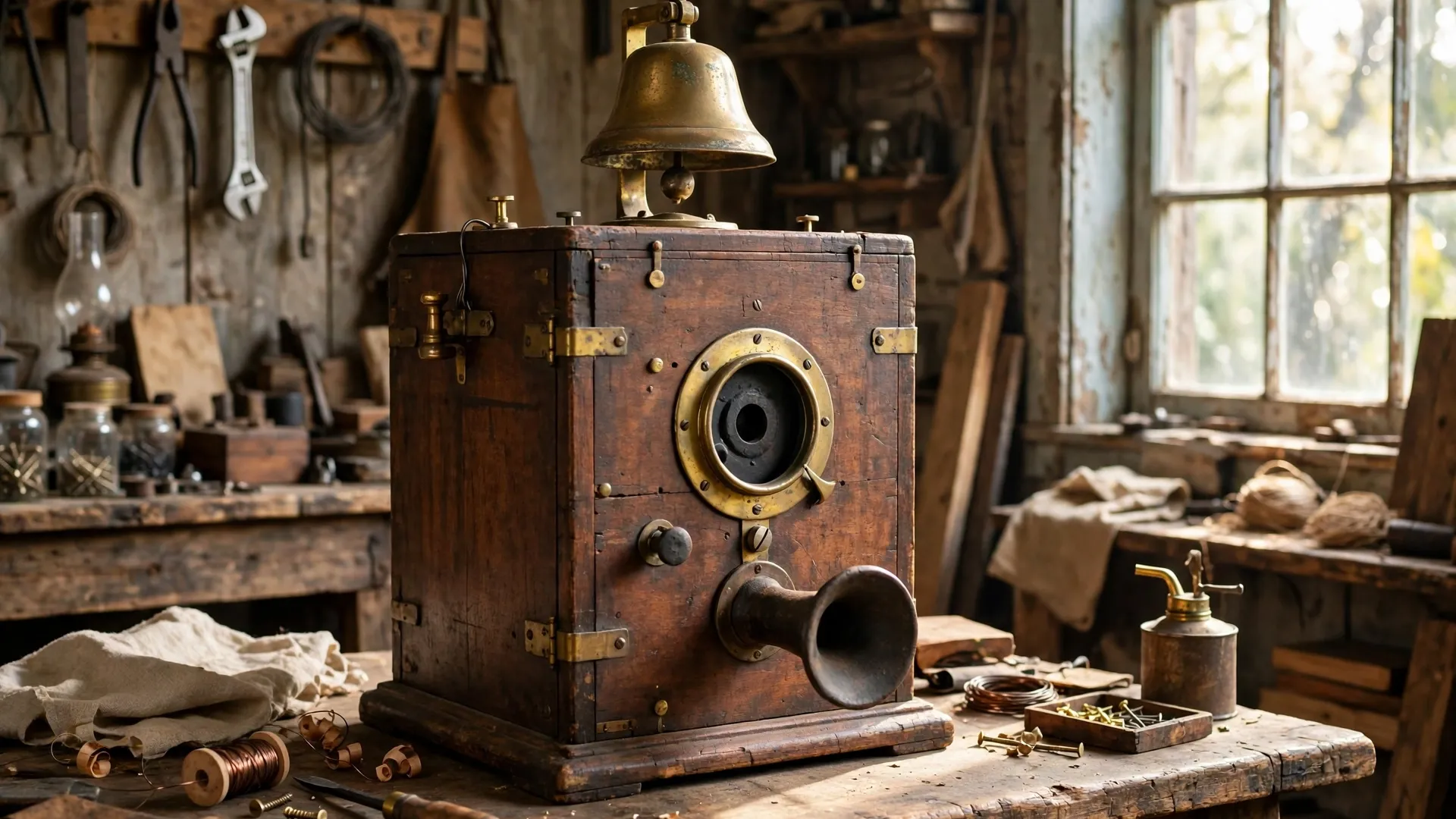
In the 1850s, Meucci built a device in his own home that could carry a voice from one room to another through a wire. He called it the teletrofono. His wife was often ill and spent much of her time in a room upstairs, so he wanted a way to talk to her from his workshop below.
In 1871, Meucci filed a paper with the United States Patent Office. It was called a caveat, a kind of warning that said, “I am working on this idea. Please remember that I was here first.” A caveat cost ten dollars and lasted for one year. After that, you had to pay ten dollars again to renew it.
Meucci renewed it in 1872. He renewed it again in 1873. But in 1874, he could not pay. Ten dollars does not sound like much money today. For Meucci, a poor man with a sick wife and many debts, it was too much. His caveat expired on 28 December 1874, and his claim to the telephone was lost.
Philipp Reis and the Machine That Almost Talked
Before Meucci, and before Bell, there was another man: Philipp Reis, a German schoolteacher.
Reis was a self-taught inventor. In 1861, fifteen years before Bell’s patent, he built a device he called the Telephon. It was a strange machine made of wood, wire, and a sausage skin stretched over a small opening. When someone spoke into it, the skin shook, and that shaking changed the electric current in a wire. At the other end, the machine shook in the same way, and sound came out.
Reis showed his machine to other scientists in Frankfurt in October 1861. It could carry music quite well. It could carry some words, but not clearly. A sentence would come out broken and hard to understand. Reis knew his machine was not good enough. He kept working on it, but he died young, in 1874, at the age of 40.
Reis never built a machine that could carry clear speech, but he showed that a voice could travel through a wire at all, and he gave the device its name: telephone, from Greek words meaning “far sound.” So by the time Bell and Gray entered the race, the idea was already in the air. Several men had touched it. None of them had finished it.
The Race of 14 February 1876
Then came the most famous day in the whole story: 14 February 1876. It was Valentine’s Day, but there was nothing romantic about what happened at the United States Patent Office in Washington, D.C.
That morning, two lawyers arrived at the patent office with papers about the telephone. The first was Bell’s lawyer, Marcellus Bailey. He filed a full patent application for Bell’s telephone, called “Improvement in Telegraphy.” The office logged it as the fifth filing of the day.
A few hours later, a second lawyer arrived. His name was William Baldwin. He worked for Elisha Gray. He filed a caveat, not a full application, but a warning that Gray was working on a similar device. The office logged it as the 39th filing of the day. Gray believed he had the better design: a liquid transmitter, where a metal rod dipped in acid water changed the electric current as a voice shook it.
Two men. Same day. Same idea. A few hours apart.
For more than a hundred years, people have argued about that day. Some say Bell was lucky. Some say his lawyer was simply faster. Some say the patent examiner, Zenas Fisk Wilber, showed Bell’s lawyer the contents of Gray’s secret caveat before the decision was made. Years later, Wilber signed a paper saying he had done exactly that, and that Bell had given him a hundred-dollar bill. Other historians say that paper is not reliable, and that the two men worked on their ideas separately. The truth is hard to pin down. No single document settles it. What we know for sure is this: Bell’s application was filed first, and Gray’s was a caveat, not a full patent. On those two facts alone, the Patent Office chose Bell. The argument has never fully ended, but the decision has never been reversed.
That small gap in time decided everything. Bell had filed a full application, and Gray had filed only a caveat. Under the rules of the time, a full application beat a caveat. Bell’s paper was also filed first. So the Patent Office gave Bell the priority.
The Patent: 7 March 1876
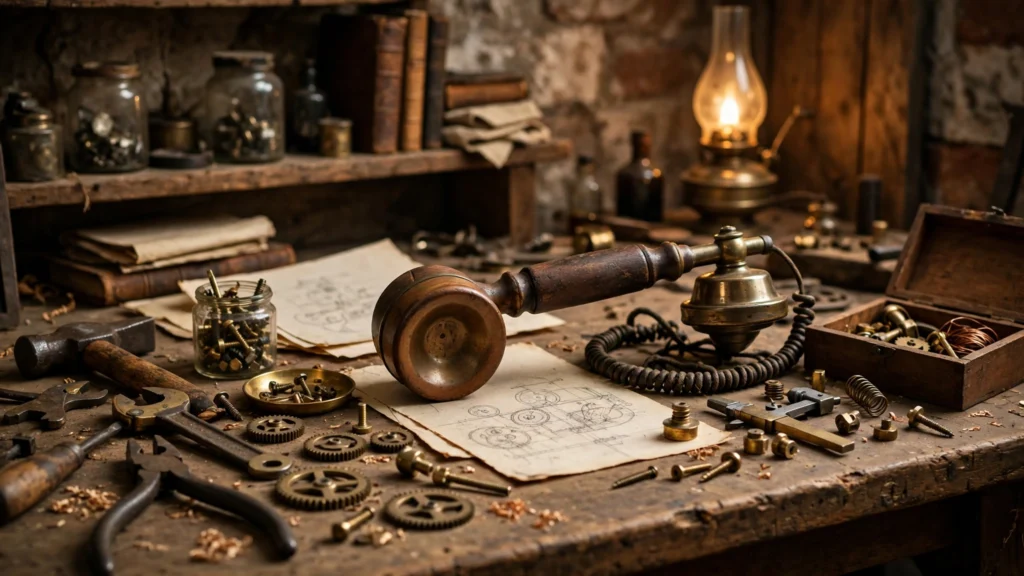
On 7 March 1876, less than a month after the filing, Bell was awarded United States patent number 174,465, titled “Improvement in Telegraphy.” It covered a device for sending vocal sounds through a wire.
People sometimes call it the most valuable patent in American history, because it covered not just one machine but the whole idea of sending a voice by electricity. For the next seventeen years, anyone who wanted to build a telephone in America had to deal with Bell’s company.
But here is a detail many people miss. When Bell got the patent, he did not yet have a working telephone that could carry a clear sentence. The patent described the idea. The machine itself was still not ready. A patent is not the same as a finished invention. It is a legal claim. Bell had claimed the idea. Now he had to prove it could work in real life.
“Mr. Watson, Come Here”
Three days later, on 10 March 1876, it worked.
Bell and Watson were working in their workshop in Boston, in different rooms connected by a wire. Bell was testing a new transmitter. According to his own notes, he spilled some battery acid on his clothes. It burned, and he called out for help.
“Mr. Watson, come here, I want to see you.”
Watson, in the next room, heard the words through the telephone receiver. They were clear. Not broken, not a whisper, but a real sentence, spoken by a real voice. It was the first time a full, clear sentence had ever travelled through a wire like that. Watson ran into Bell’s room. Both men knew what had just happened. A human voice had travelled through electricity and arrived whole on the other side.
The Court Battles
Winning the patent was only the start. Keeping it was a long fight.
Over the next ten years, Bell and his company faced hundreds of court cases. Other inventors said Bell had stolen their ideas. Elisha Gray fought Bell in court. The Western Union telegraph company, the biggest communications company in America, fought Bell too. It had its own telephone, built from Gray’s designs, and it did not want to pay Bell.
The cases were long, costly, and bitter. In the end, Bell’s side won. In 1879, Western Union agreed to settle. It gave up its telephone business and agreed to pay Bell’s company a share of its income.
The final test came in 1888. The case went all the way to the United States Supreme Court, the highest court in the country. The court ruled in Bell’s favour, by a narrow vote. Bell’s patent stood.
From a Curiosity to a Business
In the early days, many people did not understand the telephone at all. They thought it was a toy. One famous story says that Bell offered to sell his patent to Western Union, the telegraph giant, for one hundred thousand dollars. The company looked at the offer and said no. Its leaders thought the telephone would never be more than a novelty.
They were wrong, and they knew it soon enough.
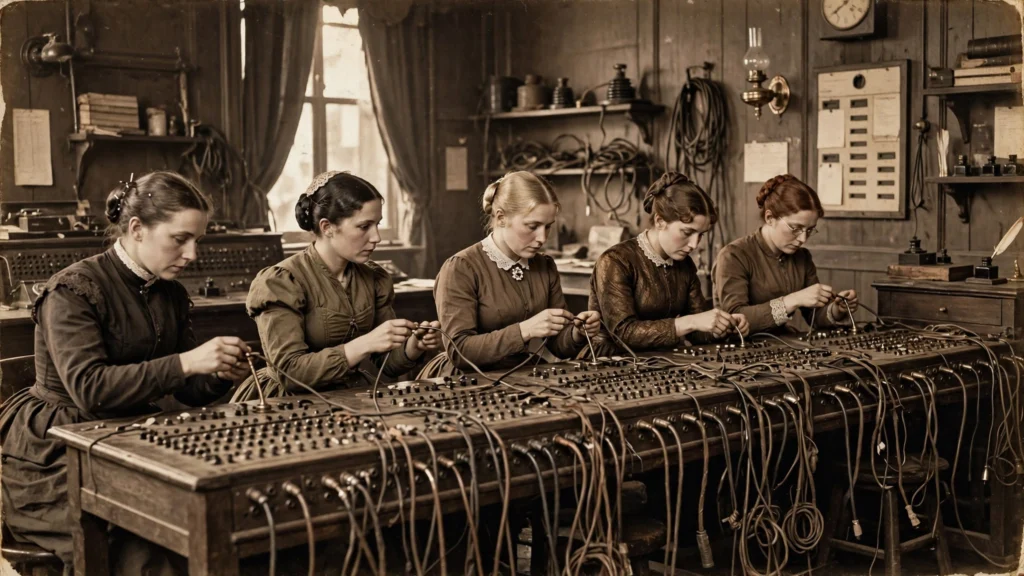
In 1877, Bell started the Bell Telephone Company. In 1878, the first telephone exchange opened in New Haven, in Connecticut. An exchange was a central office where wires from many homes met, and an operator, usually a young woman, would connect one caller to another by plugging cords into a board. The first exchange had only 21 customers. But it was the start of a network.
The network grew fast. By the end of the 1870s, there were telephones in many American cities. People used the phone to order goods, to call a doctor, to check on a sick relative. Business owners used it to place orders and to talk to customers. It saved time, and it saved lives when a doctor could be reached in minutes instead of hours.
The telephone was no longer a curiosity. It was part of daily life.
How the Telephone Changed the World
It is hard to overstate what the telephone did. Before it, news travelled at the speed of a letter or a telegram. After it, news travelled at the speed of speech.
Think about a simple example. A farmer’s wife falls ill in the evening. Before the telephone, her husband would have to ride on horseback to fetch a doctor, perhaps in the dark, perhaps for miles. With a telephone, he could call the doctor in a minute.
Think about family. A son who moved to a new city for work could call his parents on a Sunday evening and hear their voices. The telephone shrank distance.
It also changed the way we think about time. People began to expect fast answers. A message that once took a week now took a second. That expectation is still with us. Today, we get annoyed if a text takes a minute to arrive. The telephone started that habit.
It is no accident that the telephone arrived in the same century as railways, time zones, and the modern calendar. The world was becoming connected. Trains moved people faster. The telegraph moved news faster. The telephone moved voices. Each invention made the next one more useful. If you want to see how the world learned to share one clock time, read about time zones. If you want to see how the calendar got its shape, read about 12 months in a year, and about leap years.
The same is true of roads. Long before the telephone, people built the first roads so that messages and goods could move faster across land. The telephone was the next step in the same old human wish: to reach someone far away, quickly. And it kept changing. Rotary dials replaced operators. Then came push buttons. Then came cordless phones, mobile phones, and finally the small computers we carry in our pockets today. Each step made the phone smaller, faster, and easier to use. But the basic idea is still the same one Bell patented in 1876: turn a voice into electricity, send it far away, and turn it back into a voice.
So Who Really Invented the Telephone?
Now we come back to the question we started with. Who invented the telephone?
The short answer is still Alexander Graham Bell. He filed the first full patent, won the court cases, and built the first telephone company. His name is on patent 174,465, granted on 7 March 1876. That is a fact, and it will not change.
But the honest answer is longer. Bell did not work alone. He stood on the work of others. Philipp Reis showed that a voice could travel through a wire. Antonio Meucci built a voice device in his own home years earlier, and only lost his claim because he could not pay ten dollars. Elisha Gray filed his own claim on the very same day, only hours later.
Invention is rarely the work of one person in one moment. It is more like a relay race. One person runs part of the way and passes the baton. Bell ran the final part, and he crossed the finish line first. But the race had many runners.
It simply means we should remember the others too. Meucci, who built a telephone for his sick wife and lost it for want of ten dollars. Reis, the German teacher who showed the world it was possible. Gray, who arrived at the patent office only hours too late. Their names are less famous, but without them, the story would be much poorer.
The telephone is one of the greatest inventions in human history. It began with a teacher of deaf children, a workshop in Boston, a spilled bottle of acid, and a simple sentence: “Mr. Watson, come here, I want to see you.” More stories from the past live in our History section.
Frequently Asked Questions
Who invented the telephone?
Alexander Graham Bell is credited with inventing the telephone. He received United States patent 174,465 on 7 March 1876. But Antonio Meucci, Philipp Reis, and Elisha Gray also made important contributions before and around the same time.
When was the telephone invented?
Bell filed his patent application on 14 February 1876. The patent was granted on 7 March 1876. The first clear spoken sentence over a telephone was heard on 10 March 1876. Earlier devices by Meucci and Reis existed in the 1850s and 1860s, but they could not carry clear speech.
What was the first sentence spoken on a telephone?
The first clear sentence was “Mr. Watson, come here, I want to see you.” Bell spoke it to his assistant, Thomas Watson, in another room in Boston on 10 March 1876, after spilling battery acid on his clothes and calling for help.
Who was Elisha Gray?
Elisha Gray was an American inventor from Chicago. On 14 February 1876, the same day Bell filed his patent application, Gray filed a caveat for a similar telephone device, only hours later. His design used a liquid transmitter. Because Bell filed a full application first, the Patent Office gave Bell the priority.
Did Antonio Meucci invent the telephone before Bell?
Meucci built a voice device called the teletrofono in his home in the 1850s, and he filed a patent caveat for it in 1871. He renewed it in 1872 and 1873, but he could not pay the ten-dollar fee in 1874, so it expired. In 2002, the United States House of Representatives passed a resolution recognising his work.
Why is Bell’s patent 174,465 so famous?
Patent 174,465, granted on 7 March 1876, is often called the most valuable patent in American history. It covered not just one machine but the whole idea of sending a voice through a wire by electricity. For seventeen years, it gave Bell’s company control over the telephone business in the United States.
More from Zorium Daily
- How Did People Tell Time Before Clocks Were Invented?
- Who Built the First Roads in the World?
- Why Do We Have Seven Days in a Week?
- Why Do We Have Time Zones?
The next time your phone rings, take one second to think about it. A voice is about to cross the room, the town, or the whole world, and land in your ear. That was once impossible. Then a teacher of deaf children, a mechanic named Watson, an Italian immigrant who could not afford ten dollars, a German schoolteacher, and a Chicago inventor all reached for the same idea. One of them got the patent. All of them helped make the modern world.