
Why Do Onions Make Your Eyes Water?
SUMMARY OF THIS ARTICLE
- Onions make your eyes water because cutting them lets out a gas. That gas is like a light tear gas from the onion.
- An onion takes in sulfur from the soil. Sulfur is a kind of mineral. It sits in the onion in safe forms.
- When you cut an onion, you break its tiny cells. Cells are the tiny building blocks that make up living things.
- Tiny helpers in the onion, called enzymes, mix the sulfur parts. They make the gas. The gas floats up to your eyes.
- Your eyes make tears to wash the gas out. That is why you cry. Cooked onions do not make you cry, because heat stops the tiny helpers.
- You can cry less if you chill the onion, use a sharp knife, or cut near a fan.
Introduction: Tears in the Kitchen
You are in the kitchen. You want to cook a nice meal. You pick up an onion. You cut it. Soon your eyes start to sting. Then tears come. You are not sad. You are not hurt. But your eyes water all the same.
This happens to almost all of us. It happens to cooks at home. It happens to cooks in big kitchens too. It has happened for a very long time. People have asked for years: why do onions make your eyes water?
The short answer is this. An onion makes a gas when you cut it. The gas floats up into the air. It gets into your eyes. Your eyes do not like it. So they make tears to wash it away.
But why does an onion make this gas at all? What is in the onion? Why does a cooked onion not make you cry? And can you stop the tears? This article will tell you all of this in very simple words. You do not need to know hard science words. If a hard word comes up, we will explain it in plain words right away.
What Is Inside an Onion?
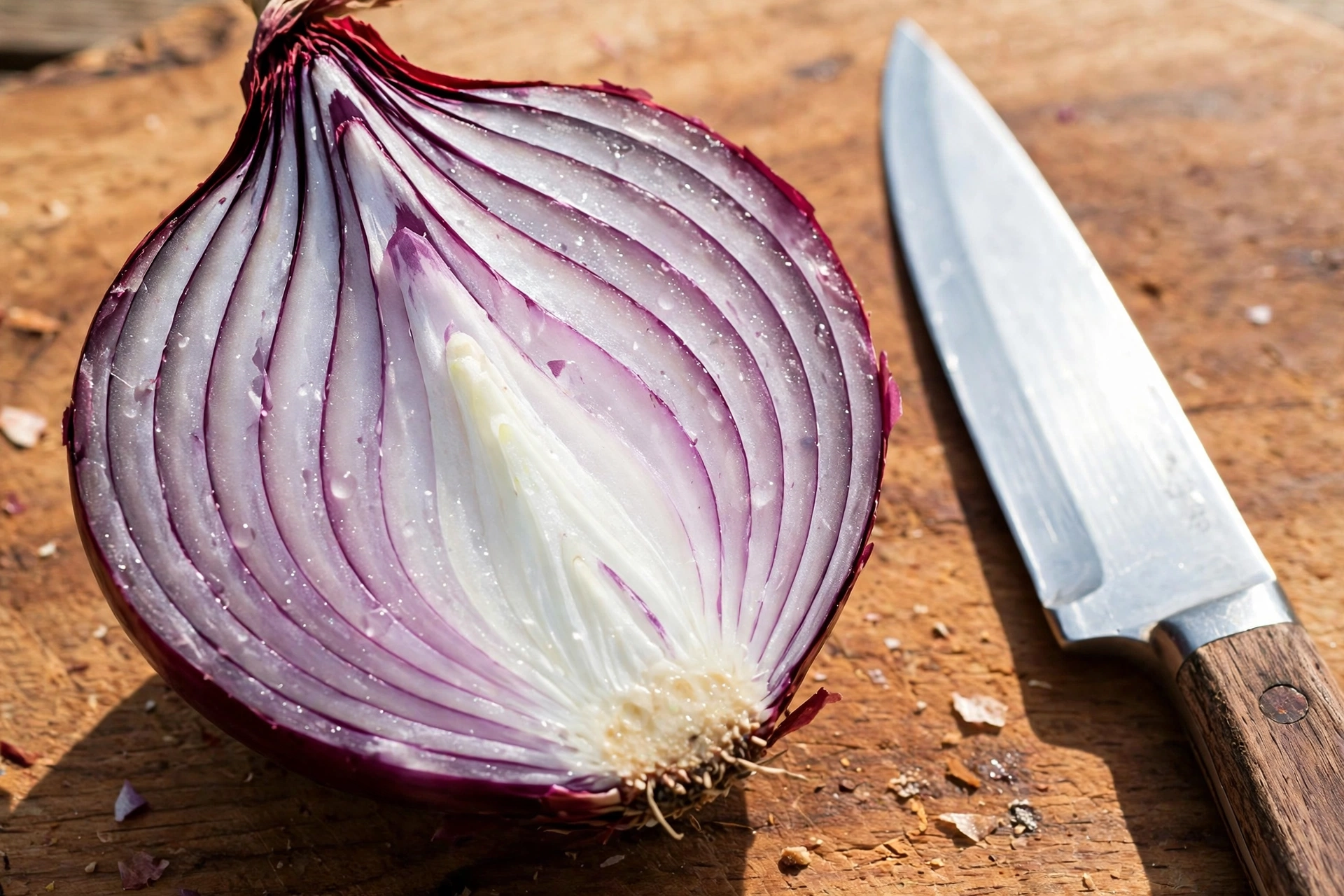
An onion is a plant. It grows under the ground. It has layers. If you peel an onion, you see thin, shiny layers, one inside the other. Each layer is made of tiny cells. Cells are the tiny building blocks of all living things. You cannot see one cell with just your eyes. But there are millions of them in an onion.
Inside those cells, the onion keeps many things. One of them is sulfur. Sulfur is a kind of mineral. It is in the soil where the onion grows. The onion takes sulfur up from the soil through its roots. Then it keeps the sulfur in its cells.
Sulfur is not bad. In fact, your body needs a small amount of sulfur too. It is in some foods, like eggs and garlic. In an onion, sulfur sits in safe forms. It is like a set of parts that are kept apart. As long as the onion is whole, the parts do not mix. So a whole onion does not make you cry.
Think of it like this. Imagine you have two kinds of paint. One is in a red tube. One is in a blue tube. As long as the tubes are closed, nothing happens. But if you open both tubes and mix the paints, you get a new color. An onion is a bit like that. The parts are kept apart in different cells. When you cut the onion, you break the cells. Then the parts can mix.
What Happens When You Cut an Onion?
When you cut an onion, your knife breaks thousands of tiny cells. This is the key moment. The walls of the cells break open. The things inside the cells spill out and mix.
Now we meet two hard words. The first is enzymes. Enzymes are tiny helpers in living things. They help chemical changes happen fast. Think of them as tiny workers. They do not get used up. They just help things mix and change.
The second hard word is the name of the gas. Scientists call it syn-propanethial-S-oxide. That is a very long name. You do not need to say it. We will call it the tear gas from the onion. It is a gas that can make your eyes water. It is not the same as the tear gas used by police. It is much weaker. But it works in a like way. It stings the eyes.
Here is what happens, step by step.
First, you cut the onion. The knife breaks the cells. Sulfur parts spill out.
Second, the tiny helpers, the enzymes, start to work. They mix the sulfur parts. They change them into new forms.
Third, those new forms turn into a gas. The gas is light. It floats up into the air.
Fourth, the gas reaches your eyes. It touches the front of your eye. The front of your eye is very soft and very sensitive. Sensitive means it feels things fast. It does not like the gas.
Fifth, your eyes send a signal to your brain. Your brain says: wash this out! Then your tear glands make tears. Tear glands are tiny parts near your eyes that make tears. The tears wash the gas away.
That is why you cry. Your eyes are not sad. They are doing their job. They are cleaning themselves.
Why Do Your Eyes Make Tears?
Tears are not just water. They are a mix of water, salt, and oils. They keep your eyes wet and clean all day. When dust gets in your eye, you blink. Blinking spreads tears over your eye. That washes the dust out.
The onion gas works in the same way. It is like dust, but it is a gas. It stings. So your eyes make extra tears. You blink more. The tears wash the gas away. This is a good thing. It keeps your eyes safe.
Some people cry more than others. That is normal. Some eyes are more sensitive. Some people cut onions in a small room with no air flow. Then more gas stays near their face. So they cry more. Some people cut onions fast and close to their face. That also makes more tears.
Your nose may run too. That is because your eyes and nose are linked. Tears can flow from your eyes into your nose through tiny tubes. So when your eyes water, your nose may run as well. That is normal. It is not a cold. It is just the tears moving.
Why Do Cooked Onions Not Make You Cry?
Have you ever cooked onions in a pan? You may have seen that they do not make you cry. Why is that?
The answer is heat. Heat stops the tiny helpers. Enzymes, those tiny workers, do not work well when they get hot. They change shape. They stop working. Scientists say they are denatured. That is a hard word. It just means the helper is broken by heat and cannot work anymore.
When you cook an onion, the heat breaks the helpers before they can make much gas. Also, the gas itself can leave the onion when it gets hot. It floats away in the steam. By the time you eat the onion, there is no gas left to sting your eyes.
That is why raw onion in a salad can make your eyes water when you cut it, but cooked onion in soup does not. The heat has done its job.
The same idea helps with other tips. If you can slow the helpers down, you can make less gas. Cold slows them down too. That is why chilling an onion can help. We will talk about tips soon.
Why Do Some Onions Make You Cry More?
Not all onions are the same. Some make you cry a lot. Some make you cry only a little. Why?
One reason is the amount of sulfur. Onions that grow in soil with a lot of sulfur take in more sulfur. Then they can make more gas. Onions that grow in soil with less sulfur make less gas.
Another reason is how fresh the onion is. A fresh, strong onion has more active helpers. An old, soft onion may have less. It may make you cry less. But it may also taste less good.
Another reason is the type of onion. Yellow onions and white onions often make people cry a lot. Red onions can also make people cry. Sweet onions, like Vidalia onions, often make people cry less. They have less sulfur. They taste sweeter. They are milder. Mild means soft and not strong.
Size matters too. A big onion has more cells. When you cut it, more cells break. So more gas can come out. A small onion makes less gas.
How you cut matters most of all. A dull knife, a knife that is not sharp, crushes the onion. It breaks more cells in a messy way. That makes more gas. A sharp knife cuts clean. It breaks fewer cells. So it makes less gas. We will come back to this in the tips.
What About Garlic and Shallots?
Garlic and shallots are cousins of the onion. They are in the same plant family. They also have sulfur. But they do not make most people cry as much. Why?
Garlic has sulfur too. But garlic does not make the same tear gas. When you cut garlic, the helpers make different things. Those things smell strong, but they do not sting your eyes as much. That is why garlic makes your hands smell, but it does not make you cry.
Shallots are small onions. They look like tiny onions. They have sulfur too. But they are often milder. They make less tear gas. So they can make you cry less. But if you cut a lot of shallots, you may still tear up a little.
Spring onions and leeks are also cousins. They have less sulfur in the green parts. They rarely make people cry much. So if you want onion taste without tears, you can use these. But they taste a bit different. They are not a perfect swap for a yellow onion in all dishes.
The Onion Is Protecting Itself
Why does an onion make this gas at all? It is not to be mean to cooks. It is to protect itself.
Plants cannot run away. They cannot hide. If an animal bites them, they cannot fight back with teeth or claws. So many plants make chemicals to protect themselves. These chemicals taste bad or sting. They tell animals: do not eat me.
The onion’s tear gas is one of those protections. When an animal bites an onion in the wild, the cells break. The gas comes out. It stings the animal’s eyes and nose. The animal may stop eating and go away. That helps the onion live and grow seeds.
Humans are different. We like the taste of onions, even if they make us cry. We have learned to cook them and enjoy them. So the onion’s protection does not stop us. But it still works on our eyes.
This is a good example of how plants and animals live together. Plants make defenses. Animals learn to deal with them. Humans learned to use fire and cooking to make onions safe and tasty. That is why onions are in so many foods all over the world.
Is the Onion Gas Harmful?
Many people ask: is the onion gas bad for my eyes? The short answer is no. For most people, it is not harmful. It stings for a short time. Then tears wash it out. Your eyes go back to normal.
The gas is weak. It does not burn your eyes. It does not make you blind. It does not cause lasting harm. It is not like strong chemicals in a lab. It is a natural plant chemical. Your eyes are made to deal with it.
But there are a few things to be careful about. Do not rub your eyes with onion juice on your hands. If you rub your eyes, you can push the juice right into your eye. That will sting more. Wash your hands first. Then you can touch your face.
If you wear contact lenses, be extra careful. Contact lenses sit on your eyes. Gas can get trapped under them. That can sting more. Some people take out their lenses before cutting onions. Or they wear glasses over them. That can help.
If you have very dry eyes or an eye problem, talk to a doctor if cutting onions hurts a lot. For most people, it is fine. But if your eyes stay red or sore for a long time after cutting onions, that is not normal. Then you should get advice from a doctor.
Also, wash your hands after cutting onions. Onion juice on your hands can get into your eyes later if you touch your face. It can also get onto other foods. A quick wash with soap and water is enough.
Tips: How to Cry Less When You Cut Onions
You cannot stop the onion from making gas completely. But you can make much less gas reach your eyes. Here are simple tips that work. Try one or two. See which works best for you.
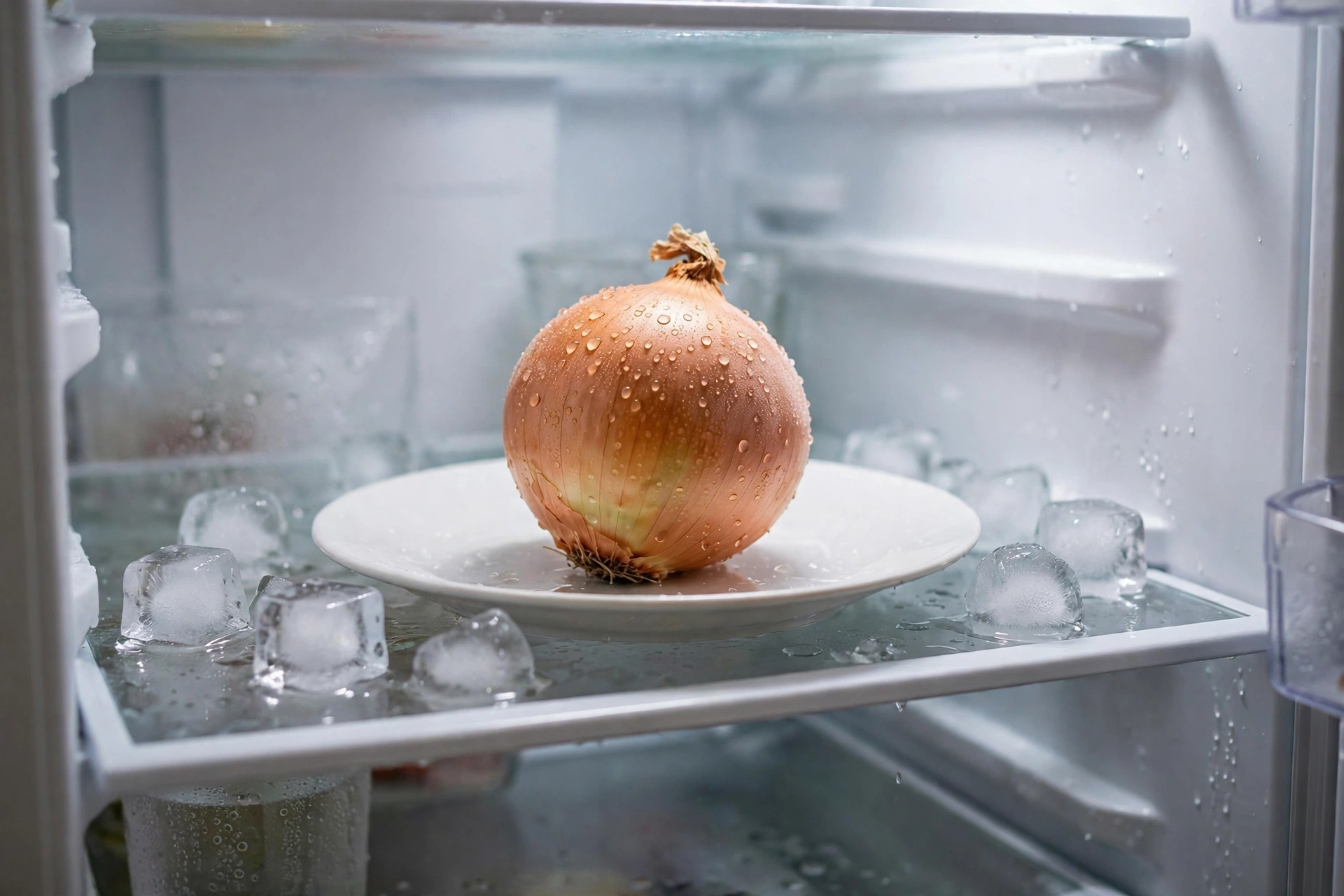
- Chill the onion first. Put the onion in the fridge for 30 minutes before you cut it. Cold slows the tiny helpers. It also slows the gas. The gas moves slower when it is cold. So less gas reaches your eyes. Do not freeze the onion. Freezing can change its taste and feel. Just chill it. A cool onion is enough.
- Use a sharp knife. A sharp knife cuts clean. It breaks fewer cells. A dull knife crushes. It breaks more cells and makes more gas. So keep your knife sharp. Be careful with a sharp knife, of course. Cut slowly and keep your fingers safe.
- Cut near a fan or an open window. A fan blows the gas away from your face. If you cut near a stove fan, turn it on. The fan will pull the gas up and away. An open window can help too. Air flow is your friend.
- Cut the onion under water. Some people cut onions in a bowl of water. The water traps the gas. The gas dissolves in water. That means it mixes into the water and does not float up. This can work well. But it can be a bit tricky. The onion pieces can float. Be careful with the knife in water.
- Wear glasses. Glasses can block some gas from reaching your eyes. Swim goggles work even better, because they seal around your eyes. You may look funny. But you will cry less. Some cooks wear clear safety glasses in the kitchen for this reason.
- Keep your distance. Do not put your face right over the onion. Step back a little. Cut with your arms out. The gas is strongest right above the onion. Farther away, it spreads out in the air. So it is weaker.
- Cut the root last. The root is the bottom part of the onion, where the roots grew. This part has more sulfur and more helpers. If you cut it first, you let out more gas early. If you cut it last, you have less time with the gas. Many cooks cut off the top first, peel the onion, then cut it, and leave the root to the end.
- Use a food processor. A food processor is a machine that cuts food fast in a closed bowl. The bowl traps much of the gas. You still need to open the bowl, so some gas will come out. But you will breathe in less than if you cut by hand. Be careful to follow the machine’s instructions.
Try these tips one at a time. You may find that chilling plus a sharp knife works best for you. Or a fan plus glasses. There is no one perfect trick. But together, they can cut tears a lot.
Why Do We Still Eat Onions If They Make Us Cry?
Onions are in food all over the world. They are in soups, curries, salads, sandwiches, and stews. Why do we love a food that makes us cry?
The answer is taste. Onions give food a deep, rich taste. When you cook them slowly, they turn sweet and soft. They make other foods taste better. They are cheap. They last a long time in storage. They are good for you too. They have fiber, which helps your stomach work well. They have vitamins, which help your body stay strong.
People have eaten onions for thousands of years. Old stories and old cookbooks show onions in many dishes. People learned to deal with the tears because the taste was worth it. Today, cooks still cry a little. But they keep cooking with onions. The tears are short. The taste lasts longer.
Children often ask why adults cry in the kitchen. Now you can tell them. It is not sadness. It is the onion’s gas. And the gas is the onion’s way of protecting itself. That is a fun fact to share at the dinner table.
Frequently Asked Questions
Why do onions make your eyes water?
Onions make your eyes water because cutting them breaks their tiny cells. Tiny helpers in the onion mix sulfur parts and make a gas. The gas floats up to your eyes and stings them. Your eyes make tears to wash the gas out. That is why you cry.
Why do cooked onions not make you cry?
Heat stops the tiny helpers. When you cook an onion, the heat breaks the helpers so they cannot make the gas. The gas also leaves in the steam. So by the time you eat a cooked onion, there is no gas left to sting your eyes.
Is the onion gas bad for your eyes?
No, for most people it is not harmful. It stings for a short time. Then tears wash it out. Your eyes go back to normal. Do not rub your eyes with onion juice on your hands. Wash your hands after cutting onions. If your eyes stay red or sore for a long time, get advice from a doctor.
How can I cut onions without crying?
Chill the onion in the fridge for 30 minutes first. Use a sharp knife. Cut near a fan or an open window. Wear glasses. Keep your face back from the onion. Cut the root last. These tips slow the helpers and blow the gas away from your eyes. They will not stop all tears, but they can cut them a lot.
Do all onions make you cry the same amount?
No. Yellow and white onions often make people cry a lot. Sweet onions often make people cry less because they have less sulfur. Small onions make less gas than big onions. A sharp knife and a chilled onion also make a big difference, no matter what type of onion you use.
Closing: Tears That Mean the Onion Is Working
So, why do onions make your eyes water? It is not because onions are mean. It is because onions are alive, and they protect themselves. Inside an onion, sulfur sits in safe forms. When you cut the onion, you break its tiny cells. Tiny helpers mix the sulfur parts. They make a light gas. The gas floats up. It stings your eyes. Your eyes make tears to wash it out.
That is the whole story, in simple words. No magic. No sadness. Just cells, helpers, sulfur, and gas.
Next time you cut an onion and your eyes water, you will know what is happening. You can chill the onion first. You can use a sharp knife. You can turn on the fan. You can step back a little. And you can smile, because you know your eyes are doing their job. They are keeping you safe.
Then you can cook your meal and enjoy it. The tears will pass in a few minutes. The good taste of the onion will stay much longer. That is a fair trade, and it is why cooks all over the world keep cutting onions, even with watery eyes.