How Do Bees Make Honey?
By Zorium Daily News Desk
SUMMARY OF THIS ARTICLE
- Bees make honey from nectar, the sweet liquid inside flowers, and they make it as food to eat through the winter when no flowers are blooming.
- A forager bee sucks up nectar with her long tongue and carries it home in a special honey stomach, which is separate from the stomach she uses to digest her own food.
- Back in the hive, bees add an enzyme called invertase that breaks the nectar’s main sugar, sucrose, into two simpler sugars, glucose and fructose.
- Worker bees fan their wings to dry the nectar, bringing its water down from about 70 percent to about 17 to 18 percent, which turns the thin liquid into thick, golden honey.
- When the honey is ripe, the bees seal each cell with a thin wax cap, and the low water, the natural acidity, and the enzymes keep honey good for a very long time.
The Golden Spoon on Your Toast
Picture a slow morning. You are sitting at the kitchen table with a piece of warm toast. You pick up a jar of honey, dip in the spoon, and watch a thick golden ribbon pour out and fold itself onto the bread. It smells sweet and a little bit like flowers. You take a bite. It is smooth, rich, and nothing like plain sugar.
Now stop and ask a simple question. Where did that golden stuff come from? It did not come from a factory. No person mixed it in a bowl. It came from a tiny insect, smaller than your thumb, working in a garden full of flowers. That insect is a honeybee, and what she does is one of the cleverest bits of cooking in nature.
A bee does not just find honey lying around. There is no honey in a flower. There is only nectar, a thin, watery, sweet liquid. The bee has to collect that nectar, carry it home, change it with her own body, dry it out, and store it away. It takes thousands of bees, working together like a small town, to fill one jar.
This article follows that journey, step by step, from a flower in the garden to the jar in your kitchen cupboard. Along the way you will meet the queen, the workers, and the drones, and you will learn why honey almost never goes bad. By the end, that spoonful on your toast will taste a little bit like a small miracle.
What Honey Really Is
Let us start with the simplest fact of all. Honey is flower nectar that bees have changed. That is the whole secret in one line. Nectar is thin and watery, and it would go bad in a day or two if you left it out. Honey is thick and golden, and it can sit in a cupboard for years and still be good to eat.
Why is there such a big difference? Because bees do two things to nectar. First, they change its sugars with enzymes from their own bodies. Second, they dry out most of its water. Those two changes turn a weak, watery juice into a strong, long-lasting food.
Think of it like making jam at home. You start with soft fruit and sugar and water. You cook it slowly, the water steams away, and the mixture turns thick. It keeps far longer than fresh fruit would. Bees do something like that, but they do it without a stove, without a pot, and without hands. They use their tongues, their wings, and wax cells the size of your little fingernail.
Honey is not just sweet. It is food with a job to do. Bees do not make it for us. They make it for themselves, to eat when they cannot go out and find fresh flowers. A jar of honey on your shelf is really a bee family’s winter pantry, borrowed by a beekeeper and shared with us.
Why Bees Make Honey at All
Bees make honey because winter is coming, even in the middle of summer. That sounds strange, but it is how a hive thinks. In spring and summer, flowers are everywhere. Bees can fly out every sunny day and bring home more nectar than they need. In winter, though, the flowers are gone. It is cold, and the bees stay inside the hive. They still need to eat, and they still need to keep warm, so they need food stored away.
Honey is that stored food. It is packed with energy, because sugar is energy, and a bee needs a lot of energy to keep its body warm and to keep the hive alive through the cold months. Without a store of honey, a hive would starve before spring.
That is also why bees make far more honey than one small family could ever eat in a day. They are planners. All summer long they work as if winter were already on its way. A good summer means full honeycomb cells and a safe winter. A bad summer, with rain and few flowers, means a hard winter and a hungry hive.
People have learned to work with this habit. A beekeeper looks after the hive, keeps it healthy, and at the end of the season takes some of the extra honey, always leaving enough behind for the bees themselves. The bees do the making. The beekeeper just helps them and shares the surplus.
There is one more reason honey matters so much. A hive is not one bee living alone. It is a whole family living together, and honey is the food that holds the family through the hardest part of the year. Every drop in the comb was carried home by a bee that flew out into the world and came back.
Meet the Hive: One Queen, Thousands of Workers
A honeybee hive is like a small town where everyone has a job, and nobody works alone. There are three kinds of bees in a hive, and each kind does different work.
First, there is the queen. There is only one queen in a hive, and she is the mother of nearly every bee in it. Her job is to lay eggs. That is her whole work, day after day, and the hive depends on her for its future. She is a little larger than the other bees, and the workers look after her and feed her. She does not collect nectar. She does not make honey. But without her, there would be no new bees, and the hive would slowly fade away.
Second, there are the worker bees. These are the bees you see in the garden, and they do almost all the work in the hive. Every worker is female, and she changes jobs as she grows older. When she is young, she stays inside and cleans the hive, feeds the baby bees, and builds wax comb. When she is older, she becomes a forager and flies out to find flowers. Workers also guard the hive entrance, fan the air, and care for the queen. A worker in summer lives only a few weeks, and she works hard for every one of those days.
Third, there are the drones. Drones are male bees, and they are bigger and rounder than workers, with large eyes. They do not sting, and they do not collect nectar or make honey. Their only job is to mate with a new queen, so that a new hive can begin. In autumn, when their work is done, the workers push them out, because there is no food to spare for bees that do not work.
What is striking is how well these three kinds of bees work together. No single bee knows how to make a jar of honey on her own. The foragers find the flowers. The young workers take the nectar and process it. Other workers fan it dry and seal it away. The queen keeps the family growing. It is teamwork on a scale that would make any human factory proud, and it all happens in a dark wooden box in a garden, with no boss shouting orders.
Step One: Collecting Nectar from Flowers
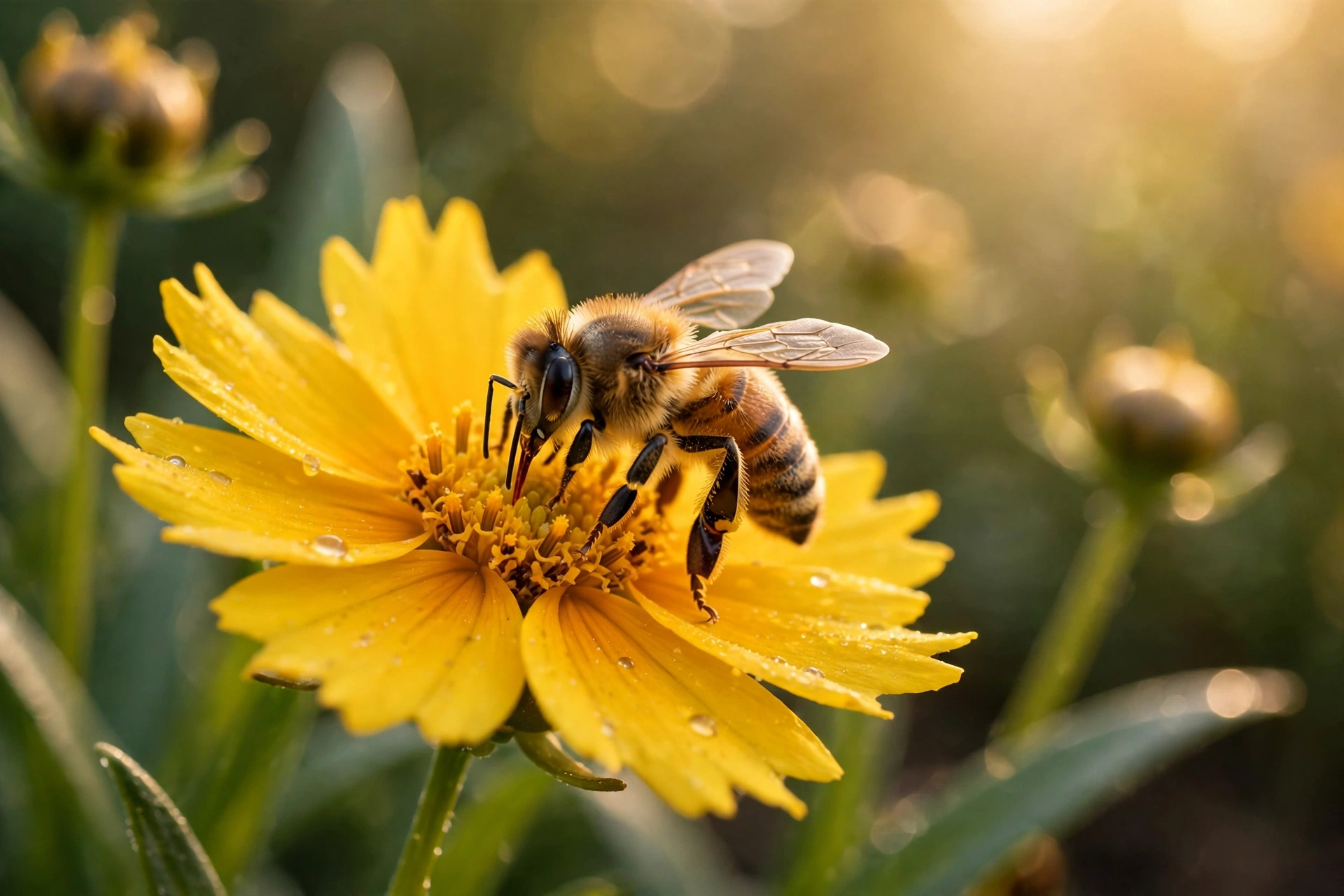
The journey begins in a garden full of flowers. On a warm, sunny day, a forager bee leaves the hive and flies out to look for food. She can smell flowers from a long way off and can see colours we cannot see. She is looking for nectar, the sweet liquid that flowers make deep inside their petals.
Why do flowers make nectar at all? They are not being kind for no reason. Nectar is a bribe. A flower needs pollen, the fine yellow dust that carries its seeds, to travel from one flower to another. It offers nectar as a reward, and the bee, busy drinking, picks up pollen on her body and carries it to the next flower. Both sides win. The flower gets its pollen moved, and the bee gets food.
When the bee lands on a flower, she pushes her long tongue, called a proboscis, deep into the blossom and sucks up the nectar. It is a bit like drinking through a very thin straw. She stores the nectar in a special pouch inside her body called the honey stomach. This is not the stomach she uses to digest her own food. It is a separate storage tank, just for carrying nectar home. That is an important detail, because the nectar she carries is not her lunch. It is cargo for the hive.
A forager may visit many flowers on a single trip, moving from bloom to bloom until her honey stomach is full. Then she flies home, heavy and slow, back to the hive. She has done the first and hardest part of the work: she has found the raw material. But what she carries is not honey yet. It is still thin, watery nectar, about 70 percent water, and if you left it in a cup on the table it would spoil quickly. The real change starts once she is home.
Step Two: The Enzyme That Changes the Sugar
While the forager is still flying home, something quiet and clever is already happening inside her honey stomach. Her body is adding enzymes to the nectar. An enzyme is a helper substance that speeds up a chemical change. It does not get used up in the process. It just makes the change happen faster.
The most important enzyme here is called invertase. Nectar’s main sugar is sucrose, the same kind of sugar you stir into tea. Sucrose is a double sugar, made of two smaller sugars joined together. Invertase breaks that join. It splits each sucrose molecule into two simpler sugars: glucose and fructose. Those two simple sugars are the main sugars in finished honey.
Why does that matter? For one thing, glucose and fructose taste sweeter and are easier for a bee’s body to use for energy. For another, the change helps keep the honey stable. The nectar is being rebuilt, piece by piece, into something new.
The forager is not the only bee adding enzymes. When she gets home, she passes the nectar to a younger worker bee inside the hive, and that bee adds more enzymes of her own. Bees also add a second enzyme, called glucose oxidase, which helps make the honey slightly acidic and helps protect it from germs. You do not need to remember the names. What matters is the idea: the bees are not just carrying nectar, they are cooking it with their own bodies, changing it from the inside out before it ever reaches a wax cell.
Step Three: Passing the Nectar from Bee to Bee
When the forager returns to the hive, she does not pour the nectar into a cell herself. Instead, she finds a younger worker, a house bee, and passes the nectar mouth to mouth. The forager brings up a tiny drop of nectar, and the house bee takes it with her own tongue and draws it into her honey stomach. Scientists call this food-sharing trophallaxis, but you can just think of it as a careful handover.
Sometimes the nectar is passed from one house bee to another, several times, before it is stored. Each bee chews and works the drop for a while, mixing in more enzymes and spreading it thin so that water can escape. It is slow, fiddly work, and it is also the first stage of drying. By the time the nectar has been passed around, its water has already dropped from about 70 percent to roughly half.
Why bother with all this passing around? Because a single bee cannot do everything, and because each handover adds more enzymes and more drying. It is the same idea as a relay race. One runner alone would get tired. A team, passing the baton from hand to hand, goes much further. The hive is a relay team, and the nectar is the baton.
Step Four: Fanning Away the Water
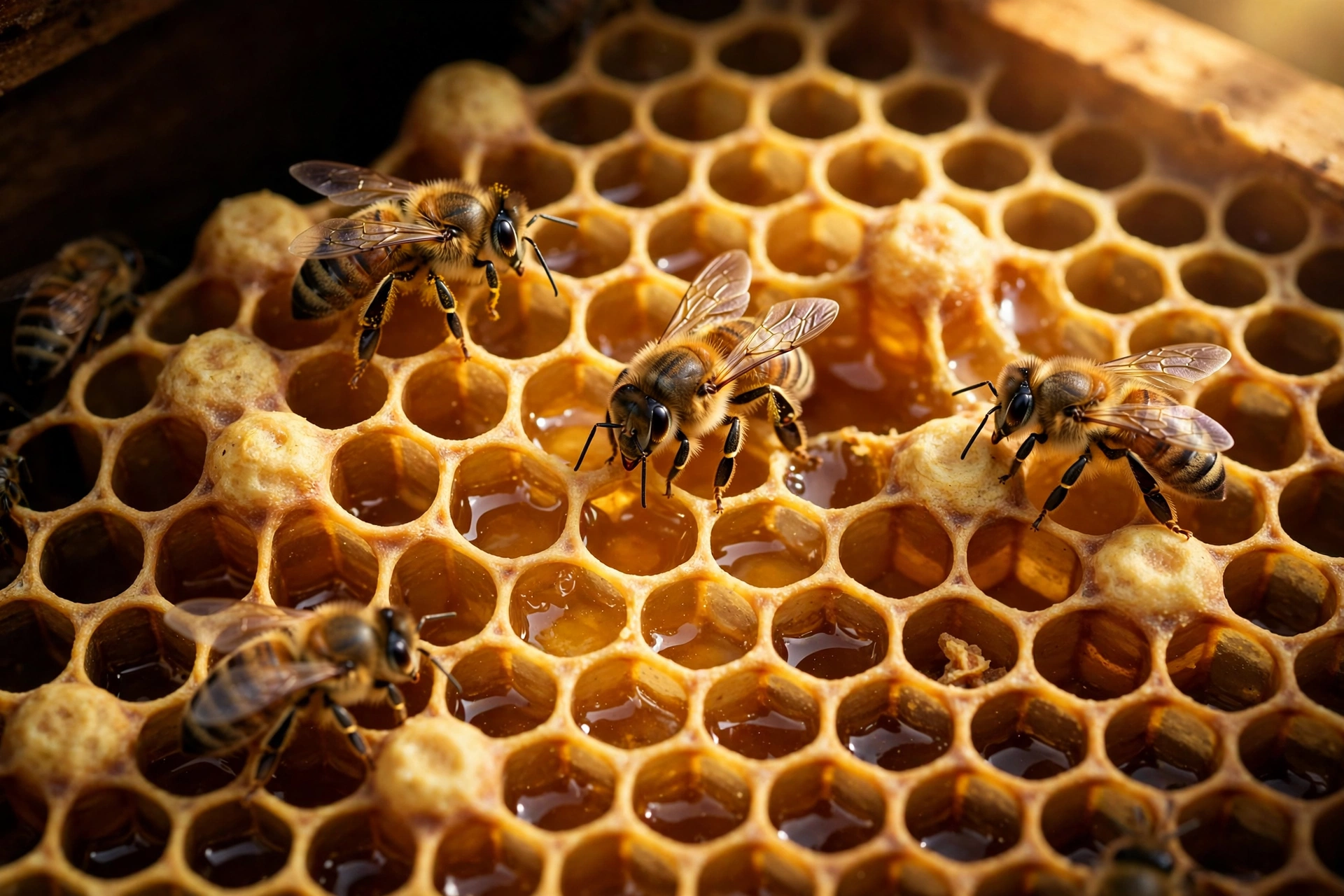
Now the nectar is ready to be stored, but it is still far too wet to be called honey. The house bees place it into the small six-sided wax cells of the honeycomb. These little hexagons fit together perfectly, with no wasted space, and they are the hive’s pantry shelves.
Then comes the drying, and this is the most wonderful part. Hundreds of worker bees stand near the comb and beat their wings fast, fanning air through the hive. You can sometimes see them at the hive entrance on a warm day, lined up like tiny fans. Inside the hive, other bees fan in the same way, sending a steady breeze over the open cells.
This fanning works like a clothesline on a windy day. Wet washing dries faster when air moves over it, and the same is true of nectar. The moving air carries water away, drop by drop, hour by hour. The bees keep at it, day and night, until the water falls from about 70 percent to about 17 to 18 percent. That is the moment when thin nectar becomes thick honey.
It is worth pausing to feel how clever this is. The bees have no heater, no oven, and no machine. They have wings. By beating those wings together, thousands of tiny fans turn a watery juice into a food so thick it pours slowly off a spoon. The whole hive hums with the work, and the smell inside turns sweet and warm.
Step Five: Sealing the Cell with Wax
When the honey in a cell is finally dry enough, the bees know it is ready. How do they know? They can taste it and test it, and they check the thickness. When the water is down to about 17 to 18 percent, the honey is ripe, and it is time to seal it away.
A worker bee makes a thin lid of fresh wax and presses it over the top of the cell. This wax cap is like the lid on a jam jar. It keeps the honey clean, keeps moisture from creeping back in, and keeps the store safe until the hive needs it. A comb full of capped cells is a comb full of finished honey, ready for winter.
The wax itself is made by the bees too. Young worker bees have special glands on their bodies that produce tiny flakes of wax, which they chew and shape into comb. So the bees build the shelves, fill them, dry the food, and put the lids on, all with materials from their own bodies. Nothing is bought. Nothing is brought in from outside, except the nectar itself.
When a beekeeper opens a hive and sees row after row of capped cells, that is the sign of a job well done. The bees have finished their summer work, and the pantry is full.
Why Honey Almost Never Goes Bad
Here is the part that surprises most people. Honey almost never goes bad. Pots of honey found in ancient Egyptian tombs were still good to eat after thousands of years. A jar in your kitchen cupboard can sit there for years and still be fine. Very few foods can say that. Why is honey so different?
The first reason is the water, or rather, the lack of it. Most germs and moulds need water to live and grow. Honey has so little water left, about 17 to 18 percent, that germs cannot get the water they need. It is like trying to grow a plant in a desert. The plant simply cannot get a drink.
The second reason is that honey is naturally acidic. Acids make life hard for many germs, and the enzymes the bees added, including glucose oxidase, help make the honey slightly acidic and can produce tiny amounts of hydrogen peroxide, a substance that kills germs, when the honey is mixed with water. It just means the honey itself is a hard place for germs to live.
The third reason is the wax cap and the thick, sugary nature of honey. Sugar pulls water out of anything that tries to grow in it. That is the same reason jam keeps so well. A germ landing in honey finds itself dried out and starved.
Honey can still change in the cupboard. It may turn cloudy and thick, with tiny crystals, especially in cold weather. That is called crystallising, and it is perfectly normal. It does not mean the honey has gone bad. If you stand the jar in warm water for a while, the crystals melt and the honey turns clear and runny again. Real honey does not need to be thrown away just because it looks cloudy.
So keep your honey in a closed jar, in a cool, dry cupboard, and use a clean, dry spoon each time. If you leave the lid off in a damp kitchen, the honey can slowly soak up water from the air, and then germs could grow. Look after the jar, and the jar will look after itself.
From the Hive to Your Kitchen
Beekeepers have worked with honeybees for thousands of years. A modern beekeeper wears a white suit and a veil, uses a little smoke to calm the bees, and opens the hive with care. The smoke does not hurt the bees. It just makes them think there may be a fire, so they drink some honey and become calm and busy instead of defensive.
The beekeeper lifts out the frames of capped honeycomb, takes them away, and spins the honey out in a machine called an extractor. The honey is then strained and poured into jars. Some of the honey is always left in the hive, because the bees need their winter food. A good beekeeper never takes it all.
That is how the jar on your shelf began its life as nectar in a flower, was carried home in a bee’s honey stomach, was changed by enzymes, passed from bee to bee, dried by thousands of beating wings, and sealed under wax. Fireflies do a different kind of chemistry in the dark, as you can read in how fireflies make light without heat, but the bee’s chemistry happens in daylight, in gardens and fields, and ends on your toast.
Next time you spread honey on warm bread, or stir it into tea, or drizzle it over yoghurt, remember the journey. A tiny insect flew out into the world, found a flower, and brought back a gift. Thousands of her sisters helped turn that gift into gold. It took a whole hive, a whole summer, and a lot of patient wing-work to fill one small jar.
Frequently Asked Questions
How do bees make honey in simple words?
Bees collect nectar from flowers, add enzymes that change its sugars, fan away most of its water, and seal the thick honey in wax cells.
What is nectar, and is it the same as honey?
No. Nectar is the thin, watery, sweet liquid inside flowers. Honey is nectar that bees have changed with enzymes and dried out.
Why do bees make honey?
Bees make honey as food for winter, when flowers are gone and they must stay inside the hive and keep warm.
What does the enzyme invertase do?
Invertase breaks sucrose, the main sugar in nectar, into two simpler sugars, glucose and fructose, which are the main sugars in honey.
How much water is in nectar and in honey?
Nectar is about 70 percent water. Finished honey has only about 17 to 18 percent water, which is why it is so thick.
Why does honey almost never go bad?
Honey has very little water, is naturally acidic, and contains enzymes that fight germs, so most germs cannot live or grow in it.
More from Zorium Daily
- Why Do Cats Purr?
- Why Do We Dream?
- How Do Fireflies Make Light Without Heat?
- Why Do We Get Goosebumps?
The next time you open a jar of honey, take a slow look at it before you dip in the spoon. That gold in the jar was once thin nectar in a flower, carried home by a tiny bee, changed by enzymes, dried by a thousand wings, and sealed under wax for winter. It is a small jar, but it holds a whole summer of work.