Who Invented the Printing Press? Explained Simply
SUMMARY OF THIS ARTICLE
- Johannes Gutenberg of Mainz, Germany, built the first successful printing press with movable metal type around 1440 to 1450, but he did not invent printing itself.
- Movable type came first in China, where Bi Sheng made clay type around 1040, and metal type was already in use in Korea by the 1230s.
- Gutenberg’s breakthrough was putting the pieces together: identical metal letters, thick oil-based ink, and a screw press, so hundreds of copies of a page could be printed fast and cheap.
- His most famous book was the Gutenberg Bible, printed around 1455.
- Before the press, books were copied by hand, so they were slow, costly, and rare. After it, books spread, more people learned to read, and ideas travelled fast.
The Book That Cost as Much as a House
Picture a young student in a town in Germany, about six hundred years ago. He wants just one book, a Bible, to read at home. He asks the price, and his heart sinks. The book costs as much as a house.
That was real life. Every book had to be written out by hand, letter by letter, by a person at a desk with a pen. A single Bible could take a team of writers three years to finish, so books lived in churches, universities, and rich homes.
Then, in the middle of the 1400s, a craftsman in Mainz found a better way. His name was Johannes Gutenberg, and his machine could print hundreds of copies of the same page in the time it took a writer to copy one. He was not the first person to print, but his press changed the world.
The Short Answer: Gutenberg, in Germany, Around 1440
If you need the quick answer, here it is. Johannes Gutenberg, a goldsmith from Mainz in Germany, built the first printing press with movable metal type in Europe around 1440 to 1450. Movable type means small, separate letters that can be arranged to make words and used again.
But be careful with the short answer. Gutenberg did not invent printing. People in China and Korea had printed with movable type long before he was born. What Gutenberg did was take ideas that already existed, add a few of his own, and put them together into one machine that could print books by the hundred. He made printing practical.
Before the Press: Books Written Out by Hand
For most of human history, the only way to make a book was to copy it by hand. A writer, often called a scribe, sat at a desk with a pen made from a feather, a pot of ink, and a pile of paper or parchment, which is animal skin prepared for writing. He read a few words, wrote them down, and went on for months.
It was slow work. A good scribe could copy about three or four pages a day, and a Bible has more than a thousand pages. That is why a team of scribes needed about three years to finish one Bible. And every copy was different, because people make mistakes.
Books were costly for another reason. Parchment came from animal skins, and a big book could take the skins of a whole flock of sheep. Paper was cheaper, but it still cost money, and so did the ink and the scribe’s time. Put it all together, and a book was a luxury, like a car is today. Churches, universities, and kings owned books. A farmer did not.
This shaped everyday life. With no books, learning depended on listening. A priest read the Bible aloud in church. A teacher read lessons aloud, and children tried to remember them. Stories and news travelled by word of mouth. Knowledge was locked up in a small number of books, in few hands.
Printing Started in China, Hundreds of Years Earlier
The first printing in the world happened in China, hundreds of years before Gutenberg was born. The Chinese printed using woodblocks. A worker carved a whole page of words, backwards, into a flat block of wood, brushed ink over it, laid paper on top, and pressed it down. When he lifted the paper, the words were there.
But woodblock printing had a weakness. Carving a whole page took a long time, and once carved, that block could only print that one page. If you found a mistake, you had to carve the whole block again.
Then, around the year 1040, a Chinese craftsman called Bi Sheng had a new idea. Instead of carving a whole page into one block, why not make each character as a separate little piece? Then you could arrange the pieces to make any page, print it, and use them again. That is movable type, and Bi Sheng invented it.
Bi Sheng made his type from clay. He shaped each character into a small clay block, baked it hard, and set the blocks in a frame with a sticky mixture to hold them. After printing, he heated the frame and the pieces came free. It was clever, and it worked. But clay type was fragile, and Chinese writing uses thousands of characters. His invention never quite took over from woodblocks.
The next big step happened in Korea. Korean printers made the pieces from metal instead of clay. Metal type was stronger, lasted longer, and printed more clearly. By the 1230s, Korean craftsmen were casting metal type and printing books with it. The oldest surviving book printed with movable metal type is a Korean book called Jikji, from 1377.
So by Gutenberg’s time, movable type was already an old idea in Asia. The knowledge had simply not travelled to Europe. An idea in Korea could take hundreds of years to reach Germany, if it ever did. Gutenberg almost certainly did not know about Bi Sheng or the Korean printers. He came to a similar idea on his own.
Who Was Johannes Gutenberg?
Johannes Gutenberg was born around the year 1400, in Mainz, a town on the River Rhine in Germany. His father worked with the town’s mint, where coins were made. Growing up around coins meant growing up around metalwork, the skill that would make his press possible.
Gutenberg trained as a goldsmith, making jewellery and small, fine things, and cutting stamps and moulds. It is careful, exact work, needing steady hands and patience. He learned to shape metal, cast it in moulds, and make many copies of the same small shape, exactly alike. Years later, that training was exactly what he needed for hundreds of tiny metal letters.
We know little about his early life. He left Mainz for a while, lived in Strasbourg, and worked on different projects, including small metal mirrors for pilgrims. He borrowed money and kept working on his secret project. By around 1440 he was back in Mainz, and by around 1450 he had a working press, paid for by a loan from a businessman called Johann Fust.
Gutenberg was not a writer or a scholar, and he never wrote a book about his invention. We know about his press from the books it printed and from court records about his debts. He died in 1468, in Mainz, without much money or fame. The world only understood what he had done after he was gone.
The Breakthrough: Three Old Ideas Put Together
Gutenberg’s press was not one invention. It was three ideas, joined together so well that the whole thing worked better than any of them had worked alone. Each idea solved a problem that had stopped earlier printers.
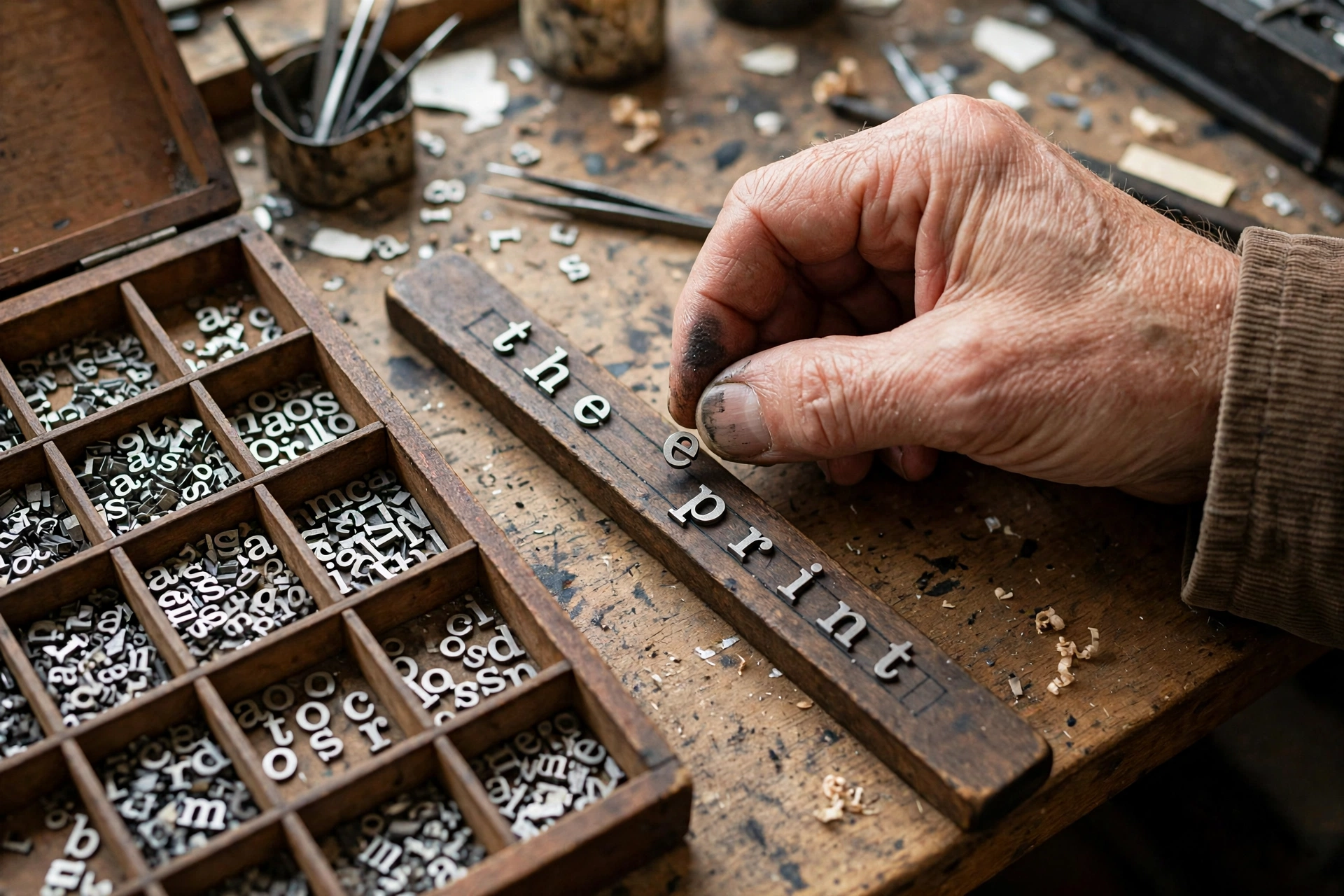
The first idea was movable type made from metal. Clay type broke and wooden type wore out, so Gutenberg made his letters from a mixture of metals, mostly lead, with tin and a little antimony. The mixture melted easily and hardened quickly. Each letter was cast on its own little block, all the blocks exactly the same height, so their tops made one flat surface.
The second idea was the ink. Earlier printers used watery ink, the kind scribes used with a pen. That ink was too thin for a metal press. It ran off the metal, or soaked into the paper and smudged. Gutenberg made a thick, oil-based ink, more like the ink used by painters. It clung to the metal letters and dried without spreading.
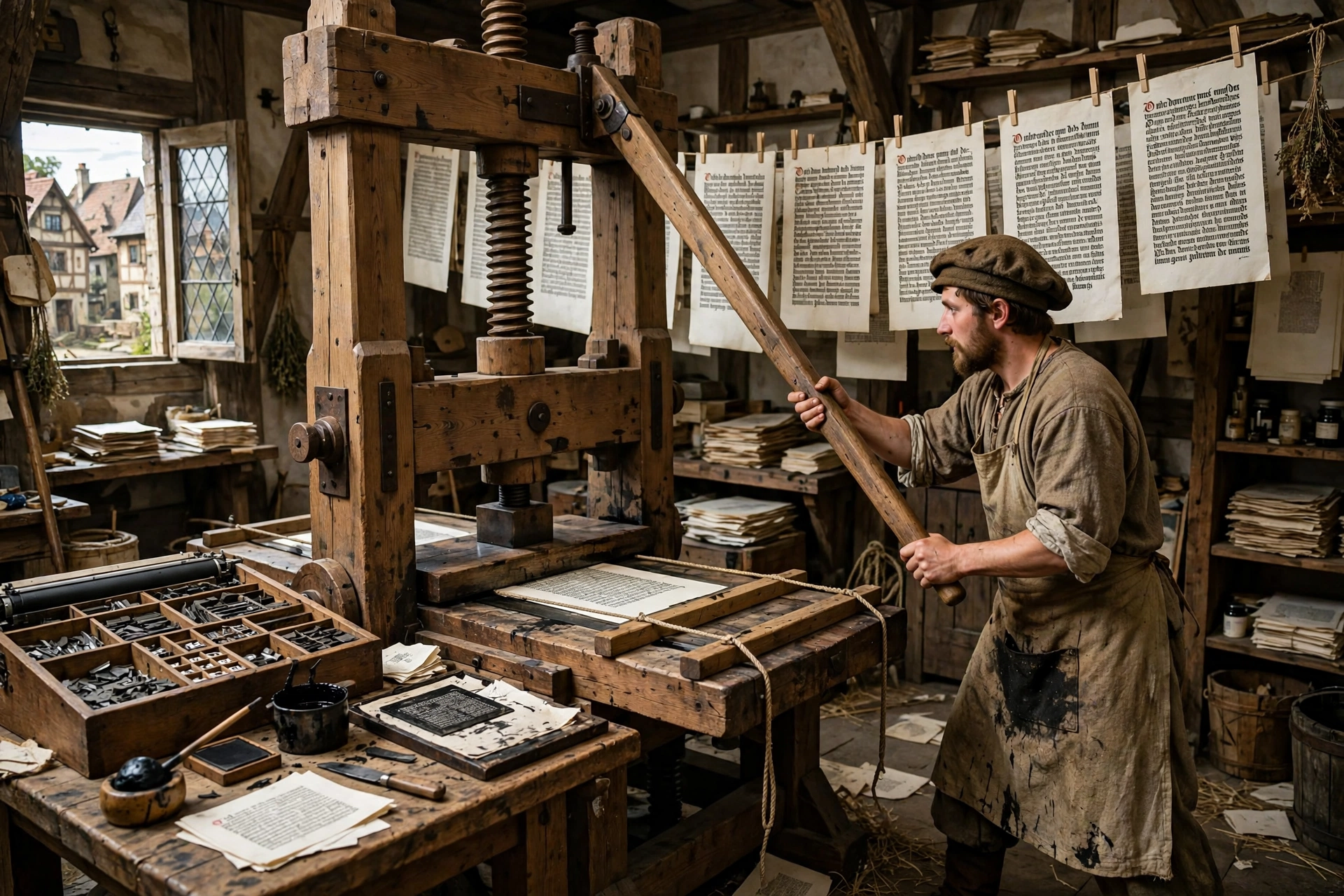
The third idea was the press itself. Gutenberg borrowed the design from a wine press, the big screw machine farmers used to squeeze juice from grapes. He built a frame with a flat plate, called a platen, that could be screwed down onto the paper lying on the inked type. One pull on a long handle turned the screw and printed the page. A worker could print about 250 pages a day.
Each idea was simple on its own. Metal letters, thick ink, a screw press. But together, they made a machine that could print the same page hundreds of times, every copy exactly the same. That combination was Gutenberg’s real invention.
How the Press Worked, Step by Step
First came the type-setting. A worker called a compositor stood at a slanted tray divided into small boxes, each holding one letter. He picked up letters one at a time, reading from a handwritten page, and placed them in a small metal stick, upside down and backwards, so they would print the right way round.
Next came the locking up. The frame was wedged tight with small pieces of wood and metal, so the letters could not move. If a letter slipped, even a little, the page would print badly. The locked frame was carried to the press and fixed in place.
Then came the inking. A worker dabbed two leather balls, stuffed with horsehair and covered in ink, onto the type, pressing gently so the ink covered every letter evenly. Too little ink, and the print would be faint. Too much, and the letters would blob.
Then came the paper. A sheet, dampened slightly so it would take the ink better, was laid over the inked type. The worker turned the screw, the plate came down, and the page was printed. The plate was lifted, the sheet taken out, and a fresh sheet put in its place.
The printed sheets were hung up to dry, like washing on a line. A printed page is wet with ink, and if you stack the sheets too soon, they smudge. So the workshop had lines strung across the room, with pages pegged up to dry.
Once one side of a sheet was printed, it was turned over and the other side was printed. Then the sheets were folded, gathered in order, and sewn into a book. A single press, with a small team, could print about 250 sheets a day, and every copy was identical. That had never been possible before.
The Gutenberg Bible: The Book That Showed the World
Gutenberg’s most famous book was the Bible. He started printing it around 1452, and it was finished around 1455. It is usually called the Gutenberg Bible. It is a big book, two volumes, with about 1,282 pages, printed in Latin, the language of scholars in Europe at that time.
About 180 copies were printed, most on paper, and about 30 on parchment, which was much more expensive. Scribes would have needed years to make 180 copies of a Bible. Gutenberg’s workshop made them in about three years, and each copy was nearly identical to the others.
The Gutenberg Bible was also beautiful. Gutenberg wanted his printed book to look as good as the best handwritten books, so he copied the style of the finest scribes. The pages had wide margins, and spaces were left for artists to paint large coloured letters at the start of each chapter. He was showing off: a printed book was not a cheap copy, but a real book.
Today, about 49 copies of the Gutenberg Bible still survive, in whole or in part, in libraries and museums around the world. They are among the most valuable books on earth, but their real value is not money. They are the first great books of the printed age, when books stopped being rare treasures.
How Printing Spread Across Europe
Gutenberg’s press did not stay in Mainz. Within twenty years of the Gutenberg Bible, printing shops had opened across Germany, Italy, France, and the Netherlands. By 1500, only fifty years after the Bible, there were print shops in more than 200 towns in Europe, and they had printed about 20 million books.
One reason printing spread so fast was that printers were businessmen. They printed what people wanted to buy: Bibles and prayer books, but also schoolbooks, law books, medical books, and calendars. A printer in Venice printed in Greek and Latin. A printer in London printed in English.
Another reason was that the skill was easy to carry. A printer needed only a press, some type, some ink, some paper, and a few trained workers. A young man could learn the trade in a few years, then pack up his tools and set up a shop in another town. That is how printing reached England in 1476.
Printers also learned from each other. They improved the type, making letters clearer. They started numbering pages. They added title pages, so you could tell at a glance what a book was. They printed in smaller sizes, so a book could fit in a pocket.
There was a darker side too. Because books could be printed fast, new ideas could spread fast, including ideas that rulers and church leaders did not like. A pamphlet printed in one town could be carried to another in a day. Governments tried to control printing, but once people knew how to print, the knowledge could not be taken back.
What Changed When Books Became Cheap
Before the press, a school needed a teacher, and the teacher needed books, and books were rare. After the press, a school could buy a set of textbooks, one for each child. A child could take a book home and learn at his own pace. Learning stopped depending on memory alone, because the words were there on the page.
Reading itself spread. When books were rare, few people bothered to learn to read, because there was little to read. When books became common, reading became useful, and more people learned. By the 1600s, reading was common in many parts of Europe, in a way it had never been before.
Ideas travelled faster too. Before the press, a new idea in science spread slowly, from teacher to student, by word of mouth. After the press, a scientist could print his book and send copies to scholars in a dozen countries, and they could all read the same words. That is how modern science grew.
Religion changed as well. In 1517, a German monk called Martin Luther wrote down his complaints about the church, and his words were printed as pamphlets. Those pamphlets spread across Germany in weeks, and then across Europe. People who had never met Luther could read his ideas and decide for themselves.
Everyday life changed in small ways we still live with. Printed calendars told farmers when to plant. Printed maps helped sailors find their way. Printed plays and poems gave people something to read for fun. Printed news sheets told people what was happening in other towns.
What the Press Could Not Do on Its Own
It is easy to tell this story as if the press fixed everything at once. It did not. A printed Bible still cost perhaps a month’s wages for a skilled worker, and in villages with no school, children still worked in the fields instead of learning to read. The press made reading possible for more people, but it did not make it happen by itself. The press printed mistakes too, and it could spread lies as well as truth. The machine did not care what was printed on it. That is still true of every new way of sharing information, from the press to the phone in your pocket.
Why the Printing Press Still Matters to You
You read on a screen, not on paper, so why does a machine from the 1400s still matter? Because almost everything you do with information today follows the pattern Gutenberg started.
When you search for something on your phone and find the answer in seconds, you are doing what a reader in 1500 did when he opened a printed book: finding words that someone else wrote, copied exactly, and shared widely. When you send a message to a friend, you are using the same idea: one message, many identical copies, travelling fast.
Even the book on your shelf owes its shape to Gutenberg. Page numbers, the title page, the chapters, the index at the back, all of these were made common by early printers, because they made books easier to use. Your school textbook and your favourite novel follow the pattern that started in Mainz.
There is a personal lesson in Gutenberg’s story too. He was not a king, or a rich man, or a famous scholar. He was a craftsman who knew metal, who noticed a problem, and who kept working on it, quietly, for years, even when he was in debt. He took ideas from others, added his own, and made them work together.
The next time you pick up a book, spare a thought for the man in Mainz, and for Bi Sheng in China, and for the Korean printers who cast metal type before either of them. They never met, but together they gave the world the printed word.

Frequently Asked Questions
Who invented the printing press?
Johannes Gutenberg of Mainz, Germany, built the first successful printing press with movable metal type in Europe, around 1440 to 1450. But he did not invent printing itself. Movable type was invented earlier in China by Bi Sheng, around 1040, and metal type was used in Korea by the 1230s. Gutenberg put metal type, oil-based ink, and a screw press together into one machine that could print books fast and cheap.
Did Gutenberg invent printing?
No, not by himself. Printing with woodblocks was already old in China by Gutenberg’s time, and movable type had been invented there about four hundred years earlier. What Gutenberg did was new for Europe. He made identical, reusable metal letters, used a thick ink that worked on metal, and used a screw press to print clearly. That combination made printing practical for books.
What was the first book printed by Gutenberg?
His most famous book was the Gutenberg Bible, printed around 1455. It was printed in Latin, in two volumes, with about 1,282 pages. About 180 copies were made. The Bible proved his press could make a fine, full-size book. About 49 copies still survive today, in libraries and museums around the world.
How did the printing press work?
A worker set small metal letters into a frame to make a page, locked the frame tight, and brushed thick ink over the letters. A sheet of paper was laid on top, and a screw press pushed a flat plate down onto the paper, printing the page. The sheet was taken out, hung up to dry, and the next sheet was printed. A team could print about 250 sheets in a day.
Why was the printing press so important?
It made books cheap and identical. Before the press, books were copied by hand, so they were slow, costly, and rare, and every copy was a little different. After the press, hundreds of copies of the same book could be made quickly, and they all said exactly the same thing. More people could own books, and new ideas spread across Europe in months instead of generations.
What came before the printing press in Europe?
Before the press, books in Europe were written out by hand by scribes, on parchment or paper, using a feather pen and ink. A single Bible could take a team of scribes about three years to finish, and it cost as much as a house. There was also woodblock printing, but it was slow to set up. The press replaced both methods, because it was faster, cheaper, and every copy came out the same.
More from Zorium Daily
- Who Invented Paper? Explained Simply
- Who Invented Paper Money?
- Who Invented the First Train?
- Who Invented the First Car?
The printing press began as a craftsman’s answer to a simple problem: books took too long to copy, and too few people could afford them. Gutenberg did not invent printing from nothing. He stood on the work of Bi Sheng in China and the metal-type printers of Korea, and he added his own craft, his metal letters, his thick ink, and his screw press. The result put books into the hands of ordinary people, spread new ideas across a continent, and opened the door to the world we live in now, where words travel in seconds.