What Makes the Wind Blow? Explained Simply
SUMMARY OF THIS ARTICLE
- Wind is simply air on the move, and the Sun is the engine that starts it moving, because the Sun heats the Earth unevenly and warm air behaves very differently from cool air.
- When air warms up it rises, and that leaves a patch of low pressure behind, so cooler, heavier air rushes in to fill the gap, and that rush of air is what we feel as wind.
- The bigger the difference in pressure between two places, the stronger the wind blows, which is why a gentle summer breeze and a wild storm are really the same thing at different strengths.
- A sea breeze happens on sunny days because the land warms faster than the sea, so cool air from the water flows in over the beach to take the warm air’s place.
- Wind also bends as the Earth spins, and the great planet-wide winds, the trade winds and the jet streams, follow the same simple rules of warm air rising and cool air rushing in.
The Kite That Would Not Stay Down
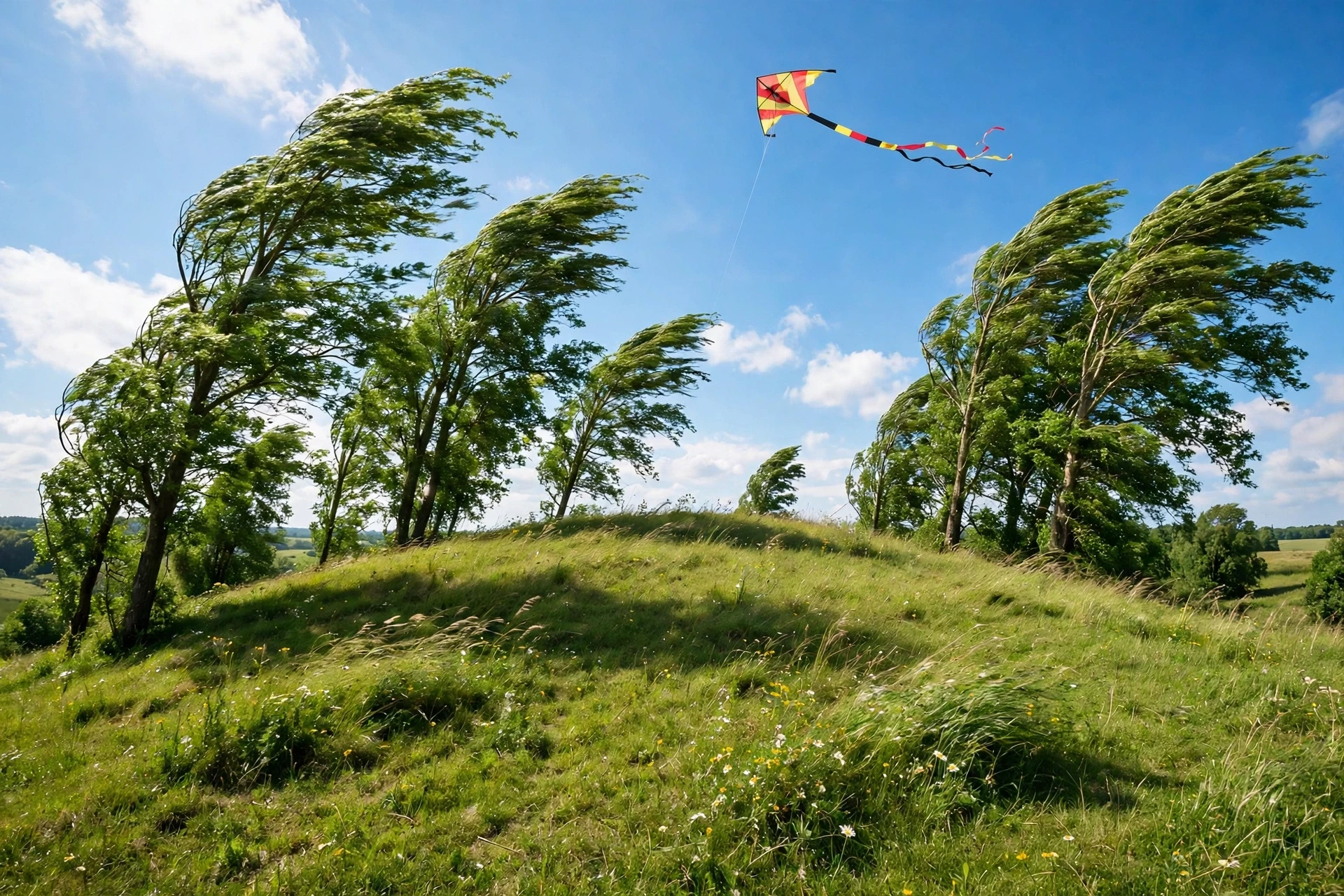
It was a bright Saturday afternoon, and eleven-year-old Maya was standing at the top of a grassy hill with a red kite in her hands. She had tried to fly it three times already that morning, and three times it had flopped to the ground like a tired bird. Her little brother Sam sat on the grass, watching.
“There is no wind,” Maya said, winding the string back around the spool. “The kite needs wind, and today there is none.”
Just then, a soft breeze brushed past her cheek, lifting a few strands of her hair. Maya looked up. The tops of the trees were swaying, just a little. She gave the kite a small tug and let out some string. This time, the kite rose. It wobbled, dipped, then caught the breeze and climbed higher and higher, until it was dancing far above the hill.
“What changed?” Sam asked, squinting up at the sky.
Maya grinned. “The wind woke up.”
Sam frowned. “But where does wind come from? It is not like someone switches it on.”
Maya did not know the answer, and neither do most grown-ups, if you ask them on the spot. We all feel the wind every day. It ruffles our hair, pushes our umbrellas inside out, and dries our washing on the line. But the reason it blows is one of the cleverest tricks in nature, and once you see it, you will notice it everywhere.
So What Is Wind, Really?
Wind is air on the move. That is the whole secret in one short sentence, but it is worth stopping on, because it sounds too simple to be true.
The air around you is not empty. It is a sea of tiny bits of gas that you cannot see, and you are standing at the bottom of it right now, like a fish standing on the sea floor. When that air sits still, you feel nothing. When it starts to move, you feel it as wind. A gentle breeze is air moving slowly. A strong gust is the same air moving fast. A storm is air moving very fast indeed.
Here is the question that matters. What makes the air start moving in the first place? Air does not just decide to go for a walk. Something has to push it, and that something is heat from the Sun. The Sun is the engine of every breeze you have ever felt, from the softest whisper on a summer evening to the wildest storm at sea.
To understand wind, you only need to remember two facts about air. Warm air is light, so it rises. Cool air is heavy, so it sinks. Everything else in this article follows from those two facts, like a chain of falling dominoes.
The Sun Is the Engine
The Sun does not heat the Earth evenly. That one unevenness is where all wind begins.
Think about a sunny day at the beach. You step off the sand onto a rock, and the rock feels hot under your feet. Then you step into the sea, and the water feels cool. Same sunshine, same day, but the land and the water feel completely different. Land warms up quickly, and water warms up slowly. That is the first piece of the puzzle.
The same thing happens on a much bigger scale. The middle of the Earth, near the equator, gets far more sunshine than the cold lands near the North and South Poles. The Earth is a patchwork of warm spots and cool spots, and it changes all day long.
Now remember our two facts. Warm air rises, and cool air sinks. Where the Sun has heated the ground, the air above that ground warms up too. Warm air is light, so it floats upward, like a hot air balloon rising into the sky. And where the ground is cool, the air above it stays cool and heavy, and it hugs the ground.
So the Sun is always making some air rise and some air stay low, all over the planet, all day and all night. And that rising and staying is what sets the air in motion.
Warm Air Rises, Cool Air Rushes In
Here is the part that turns rising air into wind, and it is simpler than it sounds.
Imagine a room full of people, all standing shoulder to shoulder. Now imagine that a group of people in the middle of the room suddenly floats up to the ceiling. What happens on the floor? There is an empty space in the middle, and the people standing around it get pushed and pulled toward that gap. Nature hates an empty space, and air is no different.
When warm air rises, it leaves a gap behind, a patch where there is less air than before. Scientists call this low pressure. It is not a hole you can see, but it is a place where the air is thinner and lighter, and it pulls other air toward it.
Cool air is heavy, and heavy things fall and spread. The cool air nearby slides along the ground toward that low-pressure gap, rushing in to fill it. And that rush of air along the ground is wind. You feel it on your face, it lifts Maya’s kite, and it bends the trees on the hill.
Then the cool air that rushed in gets warmed up by the ground in its turn, and it rises too, and more cool air rushes in behind it. It is a loop, a circle of air going up and along and around, and as long as the Sun keeps heating the ground unevenly, the loop keeps going. Wind is not a one-off push. It is a cycle that never really stops.
Why Some Winds Are Gentle and Some Are Wild
If wind is just cool air rushing in to fill a gap, why is it sometimes a soft breeze and sometimes a storm that knocks over fences? The answer is the size of the gap.
Think about water in a bath. If you lift one end of a tray of water just a little, the water slides gently to the low end. If you tip the tray steeply, the water rushes. Air behaves in a similar way. When the pressure difference between two places is small, the air moves slowly, and you get a breeze. When the pressure difference is big, the air rushes fast, and you get a strong wind or a storm.
On a calm summer evening, the warm and cool patches of ground are not very different from each other, so the air drifts along gently. It is enough to dry the washing and flutter the curtains, but not enough to lift a kite very high. On a stormy day, a huge patch of very warm air sits next to a huge patch of very cold air, and the difference is enormous. The air rushes in fast and hard, and that is when trees bend, bins roll down the street, and the rain comes in sideways.
Listen to the wind, too. A gentle breeze hums softly through the trees, while a storm howls and rattles the windows, and a simple guide to What Is Sound and How Does It Travel? Explained Simply explains how those sounds travel through the air to your ears.
Weather forecasters watch these pressure differences all the time. On a weather map, the lines that join places with the same pressure are packed tightly together where the wind is strong, and spread far apart where the wind is gentle.
The Sea Breeze: Nature’s Own Air Conditioning
One of the loveliest examples of wind is the sea breeze, and if you have ever spent a day at the beach, you have felt it.
By late morning on a sunny day, the sand and the land behind the beach have warmed up quickly. The sea, meanwhile, is still cool, because water takes far longer to warm. The air over the hot land rises, leaving low pressure behind. The cool, heavy air over the sea slides in across the beach to fill the gap. That is the sea breeze, a soft, fresh wind that blows from the sea toward the land, and it feels wonderful on a hot day.
It is nature’s own air conditioning, and it is free. People who live near the coast know it well. The morning may be still and sticky, but by the afternoon the sea breeze arrives, right on time, and the whole beach breathes a sigh of relief.
At night, the whole thing turns around. After sunset, the land cools down fast, but the sea stays warm for much longer, because water also cools down slowly. Now the air over the warm sea rises, and the cool air from the land flows out toward the sea. This is called a land breeze, and fishermen have used it for hundreds of years, sailing out to sea in the evening on the gentle land breeze and coming home in the morning on the sea breeze.
The sea breeze is also part of a bigger story. Wind pushes clouds across the sky, and those clouds carry water from the sea to the land, where it falls as rain. A simple guide to What Is the Water Cycle and How Does It Work? Explained Simply shows how that water keeps moving around the planet, and wind is the delivery driver that carries it from place to place.

Why Wind Bends: A Light Touch of Coriolis
So far, wind sounds simple. Warm air rises, cool air rushes in, and the air travels in a straight line from high pressure to low pressure. But there is one more twist, and it comes from the fact that the Earth is spinning.
The Earth turns once every day, and it carries everything on it, you, your house, the air, around with it. Now imagine you are standing at the North Pole and you roll a ball straight toward the equator. While the ball is rolling, the ground underneath it is turning, so the ball seems to curve away from its straight path. It is not really bending on its own. The ground is moving beneath it.
Air does the same thing. As it rushes from high pressure to low pressure, the spinning Earth gently bends its path. In the northern half of the world, the wind bends to the right. In the southern half, it bends to the left. Scientists call this the Coriolis effect, named after a French scientist who worked it out.
Here is the important part, and it is one that surprises many people. The Coriolis effect is very gentle, and you will never feel it in your garden. It does not bend the water in your bath, and it does not decide which way the water swirls when you pull the plug. That is a story people tell at parties, but it is not true. The effect only matters over huge distances, like the hundreds of kilometres that a great storm travels. So remember it lightly, as a gentle nudge that steers the big winds, not as a force that rules your everyday life.
The Big Planet-Wide Winds: Trade Winds and Jet Streams
The same simple rules that make a sea breeze also make the biggest winds on the planet, and sailors have known about them for hundreds of years.
Near the equator, the Sun beats down harder than anywhere else. The air there gets very warm and rises high into the sky, leaving a band of low pressure around the middle of the Earth. Cool air from the north and south rushes in to fill it, and as it rushes, the spinning Earth bends it. The result is a pair of steady, reliable winds called the trade winds. In the northern half of the world they blow from the north-east, and in the southern half they blow from the south-east, and they blow toward the equator all year round.
Hundreds of years ago, sailing ships depended on these winds to cross the oceans. They were called trade winds because they helped traders carry goods from one side of the world to the other, and a good captain knew exactly where to find them. They are still there today, steady as ever, blowing ships and clouds across the warm seas.
High above our heads, there is another kind of wind, and it is even faster. The jet streams are narrow rivers of air that race around the planet, ten kilometres or more above the ground, at speeds that can reach 300 kilometres per hour or more. They form where very warm air meets very cold air high in the sky, and the huge pressure difference makes the air rush along at astonishing speed.
Pilots know the jet streams well. A plane flying with a jet stream behind it can arrive much earlier than planned, and a plane flying against one can take far longer. Weather forecasters watch them too, because they steer storms and carry weather from one country to another, like a fast lane in the sky.
A Worked Example: Breeze, Gust, and Storm
Numbers make wind much easier to picture, so here is a simple worked example with round, made-up numbers to show how different winds compare. Imagine you are standing on the same hill where Maya flies her kite, and you have a little wind gauge in your hand.
On a calm morning, the air moves at about 5 kilometres per hour. That is a light breeze. It is slower than a person walking, and you can barely feel it on your face. The leaves on the trees rustle softly, and a feather dropped from your hand would drift gently to the ground. A kite would struggle to stay up in this wind, which is why Maya’s kite flopped down on her first three tries.
By the afternoon, the Sun has warmed the land, the pressure difference has grown, and the wind picks up to about 20 kilometres per hour. That is a fresh breeze. It is about as fast as a bicycle rider pedalling along a flat road. Now the kite flies beautifully. The trees sway, the washing on the line flaps, and you can feel the air pushing against your jacket as you walk.
Then a storm rolls in. The pressure difference is now huge, and the wind races at about 90 kilometres per hour. That is as fast as a car on a motorway, and you would have to lean into it just to stay standing. Umbrellas turn inside out, bins roll down the street, and the trees bend hard. The same air, the same simple rules, but the gap between high and low pressure is far bigger, so the rush is far stronger.
The numbers in this example are round and made up, but the idea is real. Wind is always the same thing, air rushing from high pressure to low pressure, and the only thing that changes is how big the difference is.
What Wind Does for Us
Wind is not just weather. It is one of the most useful forces in our lives, and people have been putting it to work for thousands of years.
Sailors were the first to use it. Long before engines, ships crossed whole oceans on wind alone, carried by the trade winds and the sea breezes. Even today, a sailing boat is a beautiful sight, a piece of cloth catching the moving air and turning it into a journey.
Farmers and millers used wind too. A windmill is a simple machine, a set of great sails that turn when the wind pushes them, and that turning can grind grain into flour or pump water from a well. The old windmills you see on postcards are still working in some places, and their modern cousins, the tall white wind turbines, do the same job on a far bigger scale, turning wind into electricity for homes and schools.
Wind also does quiet jobs that we rarely notice. It carries seeds from one place to another, so new plants can grow far from their parents. A dandelion clock is a perfect example. Blow on it, and a hundred tiny parachutes float away on the breeze, each one carrying a seed to a new home. Wind carries the smell of rain before a storm, it dries the washing on the line, and it brings fresh air into stuffy rooms when you open a window.
Can You Catch the Wind Yourself?
You do not need a laboratory to see how wind works. You can try it at home, today, with things you already have.
On the next breezy day, hold a thin ribbon out of your window and watch it. The ribbon points in the direction the wind is blowing toward, and when the wind is strong, the ribbon streams out straight and flat. When the wind is gentle, it droops and flutters. You have just built a wind gauge, and sailors have used ribbons and flags in exactly this way for centuries.
Try a second experiment with a piece of paper. Hold it flat above your head on a warm day and let go. It does not fall straight down. It floats and drifts, because the warm air rising from the ground is pushing it up. You are watching the same rising and rushing that makes the wind.
And on a hot afternoon, try standing with one foot on sunny pavement and the other on cool grass. You can feel the difference in temperature with your own skin, and that difference, tiny as it is, is the same uneven heating that drives the great trade winds and the jet streams.
Frequently Asked Questions
What is wind in simple words?
Wind is air on the move. When air moves from one place to another, you feel it as wind. A slow movement feels like a breeze, and a fast movement feels like a strong wind or a storm.
What makes the wind blow?
The Sun heats the Earth unevenly, so some air gets warm and rises, leaving low pressure behind. Cool, heavy air rushes in along the ground to fill the gap, and that rush is the wind. The bigger the pressure difference, the stronger the wind blows.
Why is there more wind at the seaside?
At the seaside, the land warms up faster than the sea during the day, so cool air from the water flows in over the beach to take the warm air’s place. This is called a sea breeze, and it often arrives in the afternoon, just when the beach is at its hottest.
What is the Coriolis effect?
The Coriolis effect is the gentle bending of wind caused by the spinning Earth. In the northern half of the world, wind bends to the right, and in the southern half it bends to the left. It only matters over huge distances, like a storm travelling hundreds of kilometres, and it does not affect the water in your bath.
What are the trade winds?
The trade winds are steady winds that blow toward the equator all year round. Warm air rises at the equator, cool air rushes in from the north and south, and the spinning Earth bends that air into a steady flow. Sailing ships used them for hundreds of years to cross the oceans.
How fast can the wind blow?
A gentle breeze moves at about 5 kilometres per hour, while a fresh breeze moves at about 20 kilometres per hour. A storm can reach 90 kilometres per hour or more, and the jet streams high in the sky can race along at 300 kilometres per hour or even faster.
More from Zorium Daily
- How Do Rainbows Form? Explained Simply
- Why Do Tides Go In and Out? Explained Simply
- Why Is the Ocean Salty?
- What Causes Thunder and Lightning?
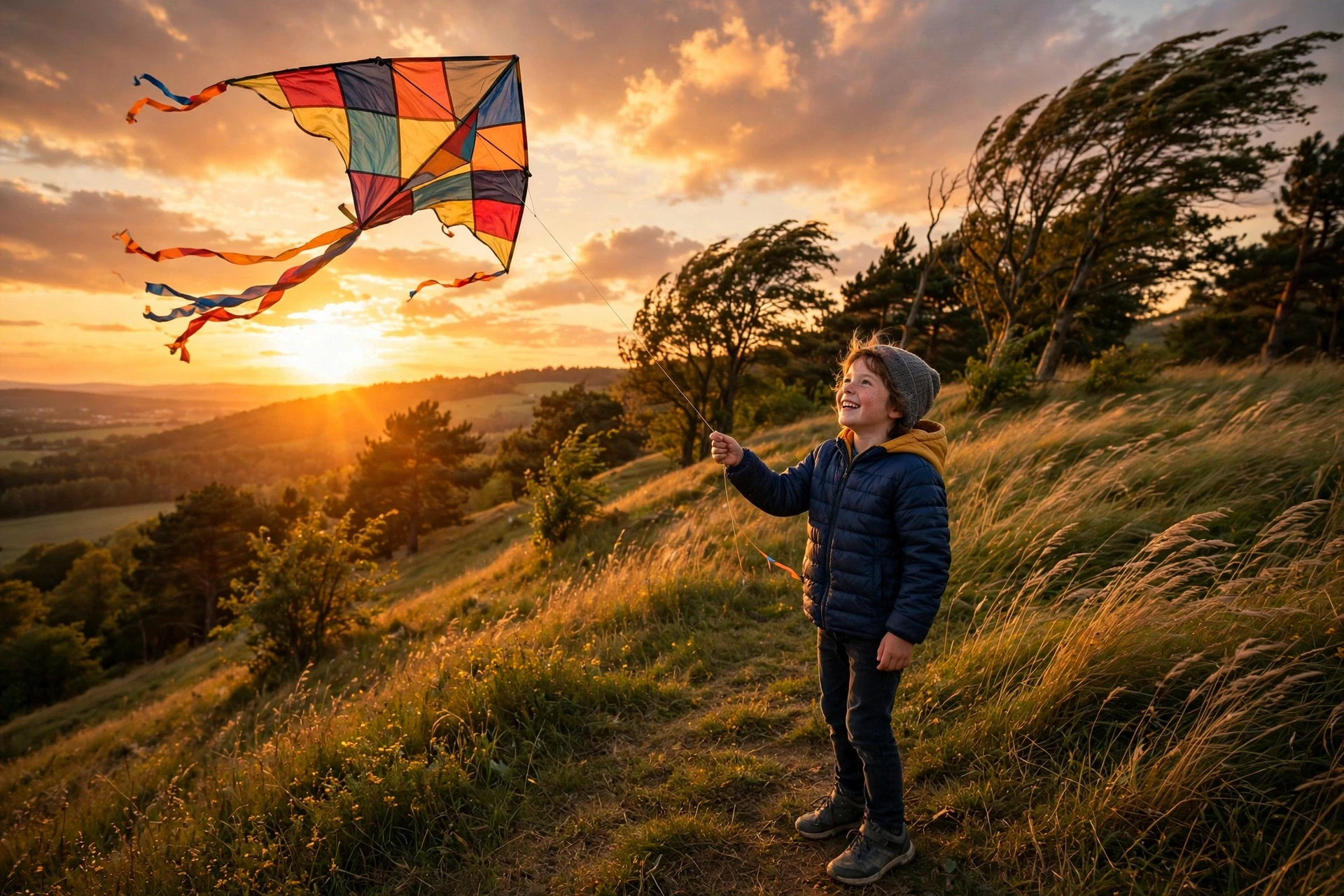
Maya’s kite is still flying high above the hill, and now you know the secret that lifts it: the Sun warms the ground, the warm air rises, and the cool air rushes in to take its place.