Why Does the Moon Look Orange Near the Horizon?
SUMMARY OF THIS ARTICLE
- The Moon does not change colour by itself. It looks orange near the horizon because of Earth’s air.
- Moonlight travels through more air when the Moon is low, and air scatters blue light away.
- What is left is mostly red and orange light, so the Moon looks orange or red.
- The same effect makes the Sun look orange at sunrise and sunset.
- Dust, smoke, and pollution in the air can make the orange colour even stronger.
A Familiar and Beautiful Mystery
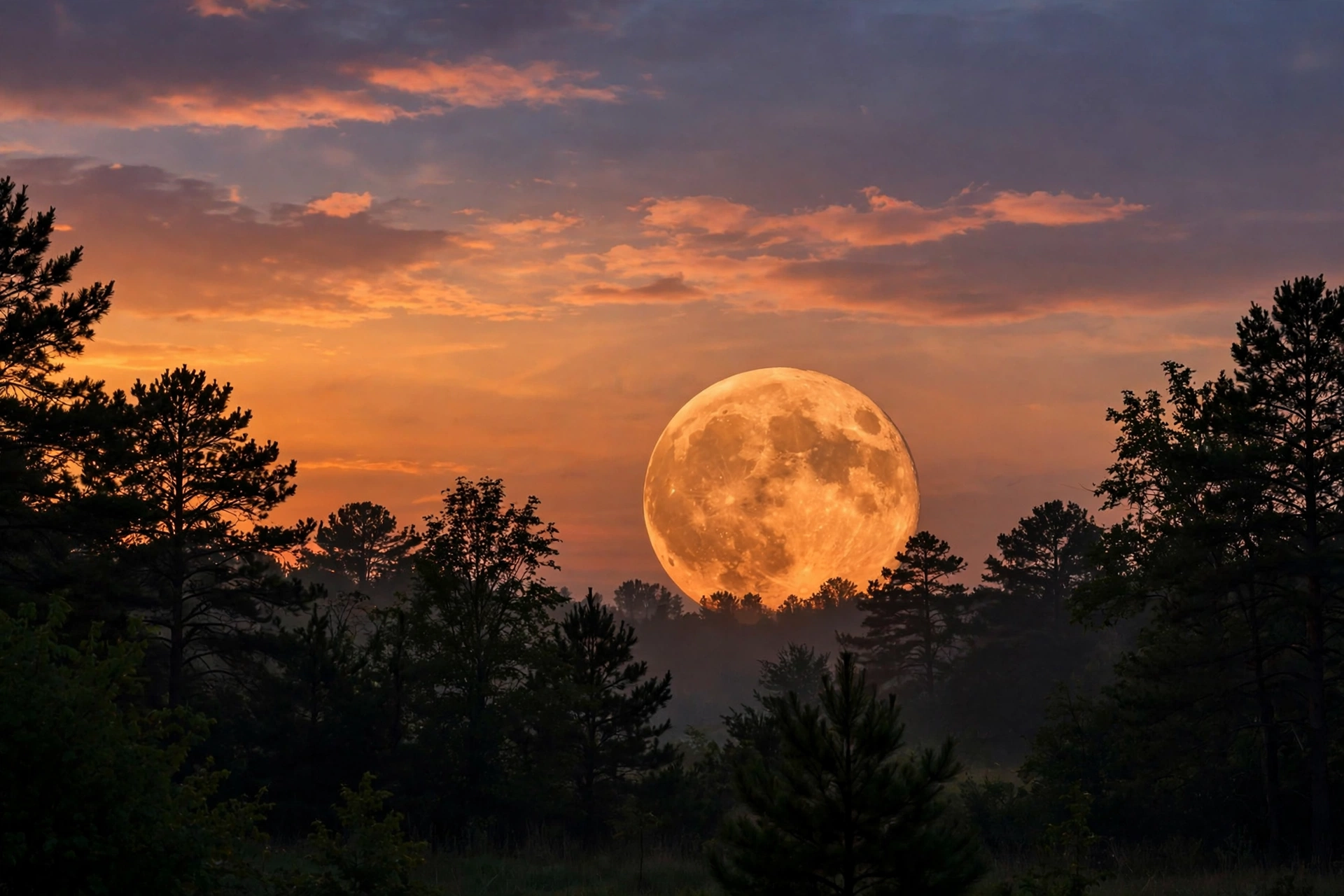
Have you ever seen the Moon rise, big and orange, just above the trees or the rooftops? It looks huge, warm, and almost unreal. Then, a few hours later, the same Moon is high in the sky, and it looks small and white again. What happened? Did the Moon change? Did your eyes play a trick?
The Moon did not change. What changed was the air between you and the Moon. When the Moon is low, near the horizon, its light must travel through a lot more air to reach your eyes. That air acts like a filter. It takes away blue light and leaves red and orange light behind. That is why the low Moon looks orange, and the high Moon looks white.
This is the same reason the Sun looks orange at sunrise and sunset, and white at noon. It is a simple piece of science, and once you understand it, you will see it everywhere: in sunsets, in moonrises, and even in the colour of the sky on a dusty day.
In this article, we will explain the orange Moon in very simple words. You will learn how light works, what air does to light, why the horizon makes a difference, and why the Moon also looks bigger near the horizon, even though it is not. You will also learn about blood Moons, harvest Moons, and other special Moons, and how to enjoy the next orange moonrise safely and simply.
Light Is Made of Colours
White light, like sunlight and moonlight, is not just one colour. It is a mix of many colours: red, orange, yellow, green, blue, and violet. You can see this mix when light passes through a prism, or when you see a rainbow after rain. A rainbow shows the colours hidden inside white light, spread out in order.
Each colour has a different wavelength. Think of wavelength as the distance between waves. Blue light has short waves. Red light has long waves. Orange light is in between, closer to red. This difference matters, because air treats short waves and long waves differently.
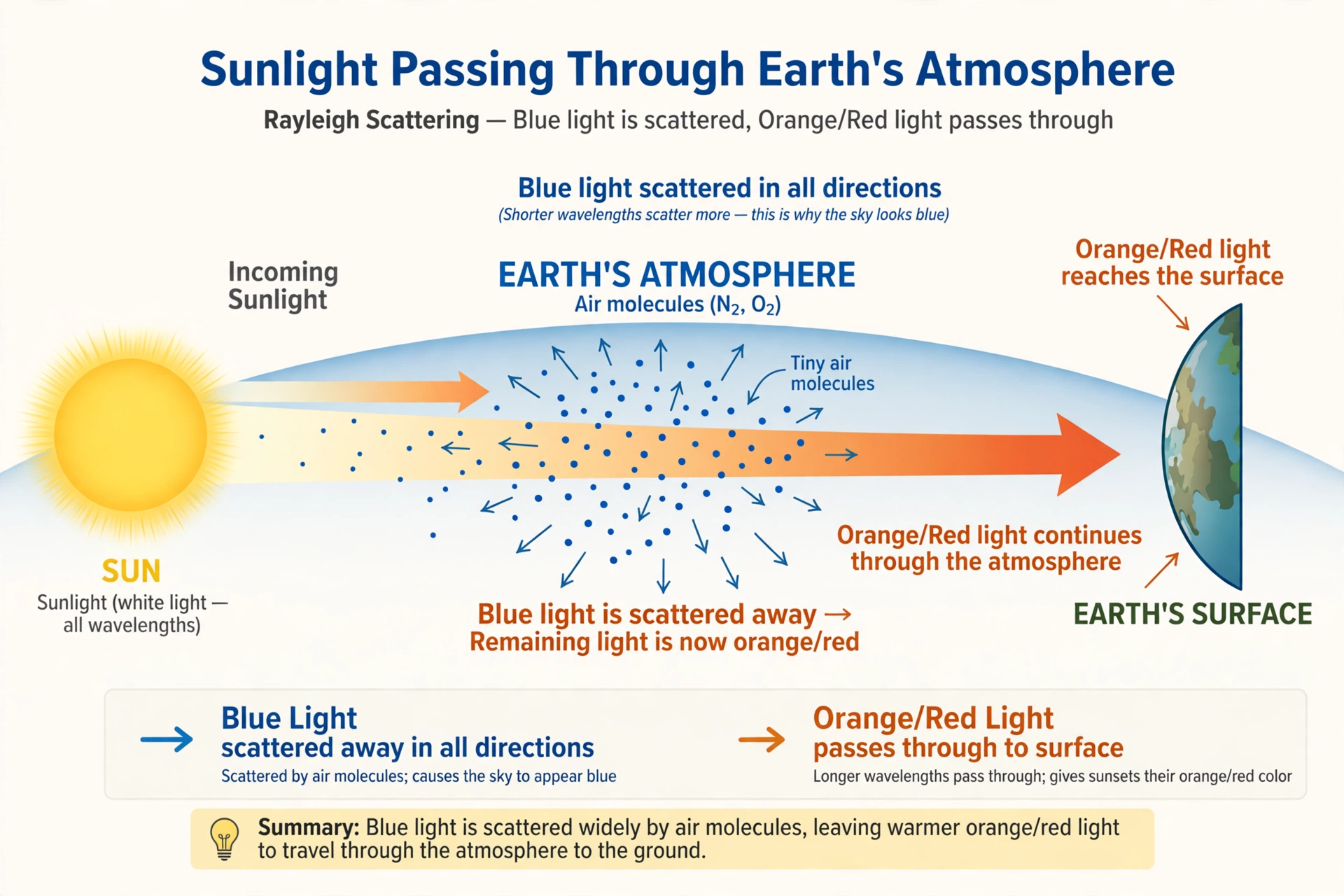
When light travels through air, it hits tiny particles: air molecules, dust, water drops, and smoke. Short blue waves hit these particles more often and scatter in all directions. Long red waves pass through more easily, with less scattering. Scientists call this Rayleigh scattering, named after Lord Rayleigh, who explained it in the 1800s. But you do not need the name to understand the idea: blue scatters easily, red travels far.
That is why the sky is blue in the daytime. Sunlight enters the air, blue light scatters all over the sky, and your eyes see blue from every direction. At the same time, the Sun itself looks a little less blue, because some blue has been scattered away. The same scattering, in a stronger form, makes the low Moon orange.
Why the Horizon Makes a Difference
When the Moon is high in the sky, its light travels through a thin layer of air, straight down to you. The path is short. Only a little blue light is scattered away. Most colours still reach your eyes, so the Moon looks white, or pale yellow-white.
When the Moon is near the horizon, its light travels a much longer path. It comes at a low angle, almost sideways through the air, instead of straight down. Imagine walking across a field. Walking straight across is short. Walking diagonally across is much longer. Moonlight near the horizon takes the long diagonal path.
On that long path, the light meets far more air, dust, and water. Almost all the blue light is scattered away before it reaches you. Green and yellow are also partly scattered. What survives the long journey is mostly red and orange light. So your eyes see an orange Moon.
The effect is strongest when the air is dusty or smoky. After a volcanic eruption, or during a season of forest fires, the air has more particles. Those particles scatter even more blue light, and the Moon can look deep red, almost like blood. On a very clear, clean night, the low Moon may look only pale gold, not deep orange, because there is less dust to scatter light.
Pollution can also change the colour. In a city with a lot of smoke and dust, sunsets and moonrises often look more orange and red. In a clean countryside, they may look softer. That is why photographers love to watch the Moon in different places. The same Moon can look different, just because the air is different.
Why the Moon Also Looks Bigger Near the Horizon
Many people notice something else: the low Moon looks much bigger than the high Moon. It looks like a giant coin, while the high Moon looks like a small coin. Is the Moon really closer when it is low? No. The Moon is about the same distance from Earth all night. The size change is an illusion, a trick of the brain.
Scientists call this the Moon illusion. It has been studied for thousands of years, and there is still debate about exactly why it happens, but the main idea is simple. When the Moon is near the horizon, your brain sees it next to trees, houses, and hills. Your brain compares the Moon to those familiar objects and thinks, “That Moon is huge.” When the Moon is high, with only empty sky around it, there is nothing to compare it to, so it looks smaller.
You can test this yourself. Next time the Moon looks huge near the horizon, hold your thumb up at arm’s length and cover the Moon with it. Then, later in the night, do the same when the Moon is high. Your thumb will cover the Moon in both cases, in about the same way. That shows the Moon’s size in the sky has not really changed. Only your brain’s judgement has changed.
Photographers sometimes make the low Moon look even bigger by using a long lens and standing far from a building or a tree. The lens compresses the scene, making the Moon and the building look close together, and the Moon looks enormous in the photo. That is a camera trick, not a real change in the Moon.
The Sun Does the Same Thing
The orange Moon and the orange Sun share the same science. At noon, the Sun is high, its light takes a short path through air, and it looks white and bright. At sunset, the Sun is low, its light takes a long path, blue light scatters away, and the Sun looks orange and red. That is why sunsets are so colourful.
Moonlight is really sunlight, reflected. The Moon does not make its own light. It reflects light from the Sun. So moonlight starts as sunlight, bounces off the Moon’s grey surface, then travels through Earth’s air to your eyes. The air filters it in the same way, whether it is direct sunlight or reflected moonlight. That is why a low Moon and a low Sun can both glow orange on the same evening.
This also explains why the sky changes colour at sunset. As the Sun goes low, blue light scatters away from the direct beam, but it scatters across the sky, making the sky blue in one part, pink and orange in another. Clouds catch the remaining red and orange light and glow pink, gold, and purple. It is all the same scattering, seen from different angles.
If you love sunsets, you will love moonrises too. They are the same science, in a quieter, cooler form. A moonrise does not hurt your eyes like a sunset can, so you can watch it for a long time, safely, with no special glasses.
Special Moons: Harvest Moon, Blood Moon, and More
You may have heard names like Harvest Moon, Hunter’s Moon, or Blood Moon. These names do not mean the Moon changes colour on its own. They are old names, or names for special events, that happen to involve colour.
The Harvest Moon is the full Moon closest to the autumn equinox, in September or October. It rises soon after sunset for several nights in a row, giving farmers extra light to harvest crops in the evening, before electric lights existed. Because it rises low, it often looks orange, which adds to its beauty. But any full Moon near the horizon can look orange. The Harvest Moon is special because of its timing, not because of a unique colour.
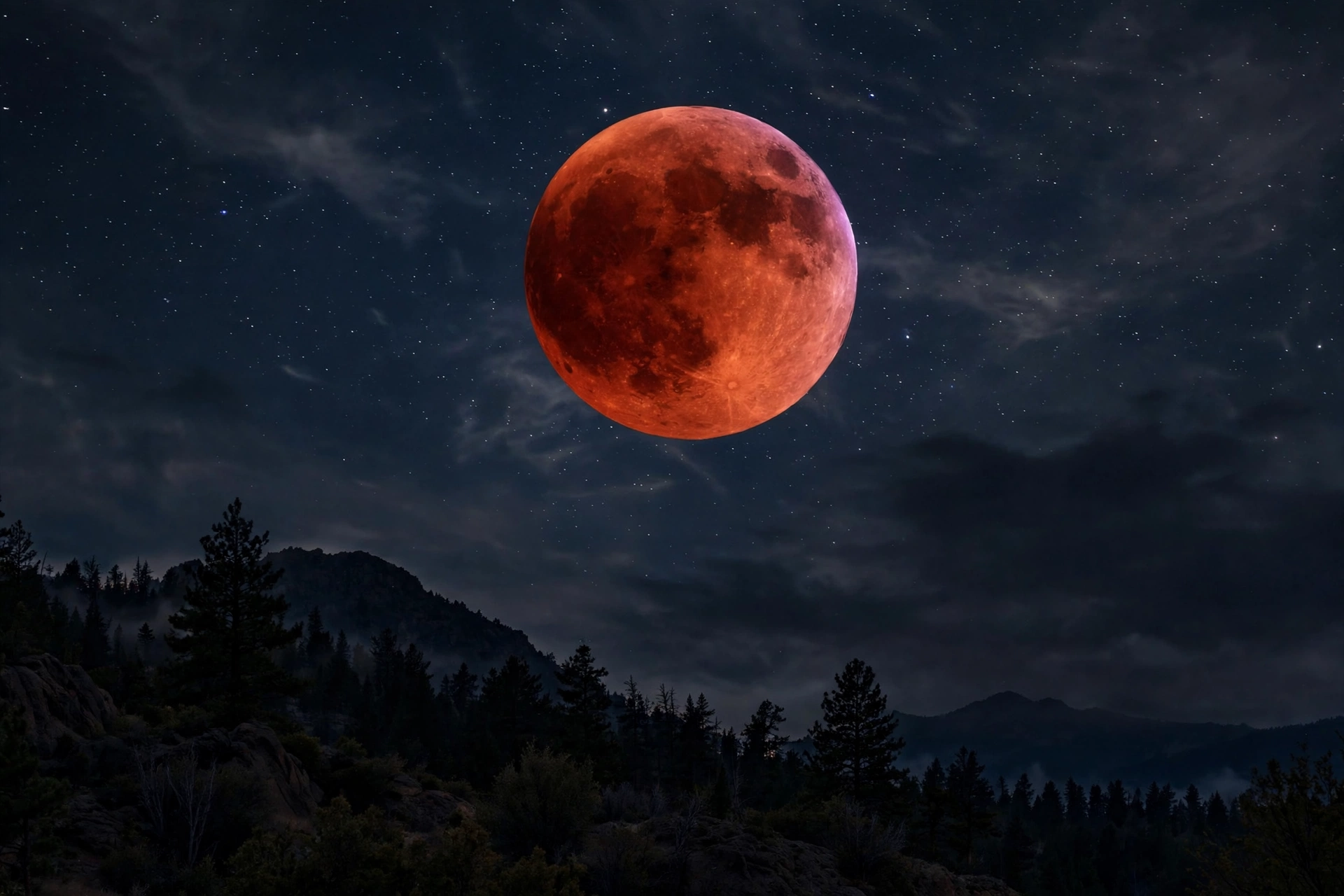
A Blood Moon happens during a total lunar eclipse. During an eclipse, Earth passes between the Sun and the Moon, and Earth’s shadow falls on the Moon. But Earth also has air. Sunlight passes through Earth’s air, blue light scatters away, and red light bends into the shadow and falls on the Moon. So the eclipsed Moon glows deep red, like blood. That is a real colour change, caused by Earth’s air, not just by the horizon. A Blood Moon is rare and beautiful, and it can last for an hour or more.
A Supermoon is a full Moon that happens when the Moon is closest to Earth in its orbit. The Moon’s orbit is not a perfect circle. Sometimes it is closer, sometimes farther. When it is closest and full, it looks a little bigger and brighter, about 14 percent bigger and 30 percent brighter than a far full Moon. That difference is hard to notice with the naked eye, but photographers love it. A Supermoon near the horizon can look especially large and orange, combining both the Moon illusion and the scattering effect.
A Blue Moon is not blue at all. It is a name for the second full Moon in one calendar month, which happens about once every two or three years. The phrase “once in a blue moon” means rarely, because a second full Moon in a month is rare. A real blue-coloured Moon can happen after a volcanic eruption, when ash particles scatter red light and leave blue, but that is very rare and not what most people mean by Blue Moon.
How to Enjoy the Next Orange Moonrise
You do not need special equipment to enjoy an orange Moon. You just need to know when and where to look. A full Moon rises around sunset, so the best time to see an orange Moon is in the evening, just as the Sun goes down and the Moon comes up in the opposite direction. Look east, toward the horizon, where the Moon rises.
Find a place with a clear view of the eastern horizon, like a field, a beach, a rooftop, or a hill. Trees and buildings can add to the beauty, because they give your brain something to compare the Moon to, making it look bigger. But if they block the Moon, move to a clearer spot. Arrive a few minutes early, so you do not miss the first glow.
Bring a friend or family member. Watching a moonrise together is more fun, and you can talk about the science while you watch. Ask children what colour they see, and why they think it changes later. That is a wonderful science lesson, taught by the sky itself, with no textbook needed.
You can take a photo with your phone, but do not expect it to look as big as it does with your eyes. Phone cameras have wide lenses that make the Moon look small. That is normal. Enjoy the view with your eyes first, then take a photo as a memory, not as a perfect copy. If you want a big Moon photo, use a camera with a long zoom lens, or simply enjoy the moment without a photo at all.
Check the weather and the air. A clear evening after a dusty day often gives the deepest orange. A hazy evening can also give strong colour. A cloudy evening may hide the Moon completely. If you miss one moonrise, do not worry. The Moon rises every night, a little later each night, and you will have many more chances. A full Moon comes about once a month, so there is always a next time.
The Moon, the Air, and the Colours of History
People have watched the orange Moon for thousands of years, long before they knew about scattering. Ancient farmers, sailors, and storytellers gave it meanings. In many cultures, a red or orange Moon was seen as a warning, a sign of change, or a time for a festival. Today we know the science, but the beauty and the wonder remain.
Sailors used the Moon to navigate and to tell time at night. A low orange Moon told them evening had come, and a high white Moon told them midnight was near. Farmers used the Moon to plan planting and harvesting, because the Moon’s cycle matched the months better than any clock they had. The Harvest Moon, which we talked about earlier, is a good example. It gave light for harvesting after sunset, and its orange colour made it easy to spot.
Artists have painted orange Moons for centuries. In Japanese art, in Indian art, and in European paintings, the low Moon is often shown large and golden, rising over water, mountains, or temples. Those paintings capture the feeling of a moonrise, even if they make the Moon larger than it really is. That feeling is real, even if the size is an illusion. Art and science can both be true in their own way: science explains the light, art explains the feeling.
Modern science also uses the orange Moon. When scientists study Earth’s air, they can learn about dust, smoke, and pollution by watching how much blue light is scattered. After a volcanic eruption, the colour of sunsets and moonrises around the world can tell scientists how much ash is in the air, and where it is travelling. That is a simple, global measurement, made by millions of eyes, not just by satellites.
Astronauts on the Moon see something different. From the Moon, Earth has no thick air to scatter light in the same way, so the sky is black, even in daytime. The Sun looks white, not orange, because there is no air to filter it. When astronauts look back at Earth, they see a blue marble, because Earth’s air scatters blue light out into space. That blue Earth, seen from the Moon, is the same scattering that makes our sky blue and our low Moon orange. It is one science, seen from two worlds.
Children often ask the best questions about the Moon. “Why is the Moon following me?” “Why does the Moon change shape?” “Why is it orange tonight?” Those questions are the start of science. The answer to the orange Moon is a good first step: light, air, and a long path. From there, a child can learn about rainbows, sunsets, stars, and planets, all from looking up at night.
If you want to teach a child, try a simple experiment at home. Shine a torch through a glass of water with a little milk in it. The milk particles scatter blue light, just like air does. From the side, the water looks blue. From the end, looking through the water toward the torch, the light looks orange and red. That is the orange Moon in a glass. It is a small, safe experiment, and it shows the same scattering in your kitchen.
The Moon Through the Year
The orange Moon is not the same every month. In winter, the full Moon rises higher in the sky in the northern hemisphere, because the Sun is low and the Moon takes the opposite path. In summer, the full Moon rises lower, and stays lower for longer, so it can look orange for more of the evening. That is why summer moonrises often feel warmer and more golden.
Your location also matters. Near the equator, the Moon rises almost straight up, so it leaves the horizon quickly and turns white soon. Far north or far south, the Moon rises at a low angle, hugging the horizon for a long time, so it stays orange longer. That is one reason moonrises in Scotland, Canada, or southern Australia can look especially dramatic.
The season, the air, and your place all work together. A dusty summer evening in a dry place can give a deep orange Moon that lasts for an hour. A clear winter night in a clean place may give only a pale gold Moon for a few minutes. Both are the same science, just with different amounts of air and dust in the way.
Keep a simple moon diary if you like. Note the date, the time, the colour, and the weather. After a few months, you will see a pattern. You will learn which evenings give the best orange Moons in your area, and you will start to predict them, just like old farmers and sailors did. Science, in the end, is careful watching, written down, over time.
Light, Heat, and Colour in Everyday Science
The orange Moon is one example of how light and air work together, but the same kind of simple science explains many everyday wonders. For example, how fireflies make light without heat shows a completely different way to make light, using chemistry inside a living insect instead of the Sun. Together, these stories show that light is never just light. It is always shaped by air, by chemistry, and by the world it travels through.
Frequently Asked Questions
1. Why does the Moon look orange near the horizon?
Because its light travels through more air when it is low. Air scatters blue light away, leaving mostly red and orange light to reach your eyes. High in the sky, the path through air is short, so the Moon looks white.
2. Does the Moon really change colour?
No. The Moon itself stays grey. The colour change is caused by Earth’s air filtering moonlight. Dust, smoke, and pollution can make the orange or red colour stronger.
3. Why does the Moon look bigger near the horizon?
That is the Moon illusion, a trick of the brain. Near the horizon, your brain compares the Moon to trees and houses and judges it as huge. High in the sky, with no objects to compare, it looks smaller, even though its real size in the sky has not changed.
4. What is a Blood Moon?
A Blood Moon happens during a total lunar eclipse, when Earth blocks direct sunlight from the Moon. Sunlight passing through Earth’s air loses its blue light, and red light bends into Earth’s shadow and lights the Moon red.
5. Is it safe to look at an orange Moon?
Yes. Moonlight is reflected sunlight, but it is far dimmer than direct sunlight. You can look at the Moon with your naked eyes safely, for as long as you like, with no special glasses needed.
Closing
So, why does the Moon look orange near the horizon? Because of air. When the Moon is low, its light takes a long journey through Earth’s air. That air scatters blue light away and leaves red and orange light behind. When the Moon climbs high, the journey is short, the filtering is weak, and the Moon looks white again.
It is the same science that makes sunsets orange, the sky blue, and Blood Moons red. It is simple, beautiful, and happening above us every clear night. The Moon does not change. Our air changes what we see.
Next time you see a big orange Moon rising, stop for a minute and enjoy it. Remember the long path its light took, through miles of air, dust, and sky, just to reach your eyes. Then watch as it climbs, turns white, and shrinks in your view, even though it never really changed at all. That is science, written across the night sky, for anyone who looks up.