Why Do We Celebrate Birthdays?
SUMMARY OF THIS ARTICLE
- Birthdays began thousands of years ago in ancient Egypt, where a pharaoh’s crowning day was celebrated as his “birth” as a god — not the day he was born.
- The Greeks honoured the moon goddess Artemis with round cakes, and the Romans were the first to celebrate birthdays for ordinary people, though at first only for men.
- The modern children’s birthday party comes from 18th-century Germany, from a festival called Kinderfest, with a cake in the morning and candles for each year of life.
- The song “Happy Birthday to You” started as a simple classroom greeting song in 1893, written by two sisters in Kentucky in the United States.
- Birthdays spread around the world as sugar and cake became cheap, but the reason we keep them is simple: a birthday says, “You matter, and we are glad you are here.”
Your Birthday Morning
Think about your last birthday. Maybe you woke up to someone singing in the kitchen. Maybe there was a cake on the table, with candles standing in a row. Maybe your phone buzzed all day with messages from people you had not heard from in months.
It feels normal. It feels like something people have always done. But have you ever stopped to ask why? Why do we pick one day a year and say, “This is your day”? Why cake? Why a song? Why gifts wrapped in bright paper?
Nobody sat down one day and invented the birthday party. It grew, slowly, over about 5,000 years. It passed through Egypt, Greece, and Rome. It almost disappeared for a while. Then a group of German families in the 1700s put the pieces back together, and their version is the one we still use today.
This is the story of that long journey — about kings who thought they were gods, a goddess of the moon, Roman men who loved a good feast, and German children who woke up to a cake by their bed.
The Short Answer
If you want the quick answer, here it is. People did not always celebrate the day they were born. At first, birthdays belonged to gods and kings. The Egyptians celebrated the day a pharaoh was crowned, because they believed that was the day he became a god. The Greeks celebrated the birthdays of their gods, with round cakes for Artemis, the goddess of the moon. The Romans took the idea and made it personal: they were the first people to throw birthday parties for ordinary men, with feasts and gifts.
Then the custom faded. For hundreds of years in Europe, most people did not celebrate birthdays at all. The early Christians thought birthdays came from old pagan religions, so they avoided them. Birthdays came back in Germany in the 1700s, as a party for children. A child woke up to a cake with candles, one for each year of life, and blew them out in the evening while making a wish.
From Germany, the party travelled to America and then around the world, until a custom that started with pharaohs ended up in your kitchen.
A birthday marks one more trip around the Sun. A year is a long time, and how we count it has its own long story. You can read about it in our article about why we have 12 months in a year. But the birthday itself is not about the calendar. It is about the person. So let us start at the beginning, in Egypt, about 5,000 years ago.
Egypt: Birthdays for Gods and Kings
The oldest birthday story we know comes from Egypt, around 3,000 BCE. That is about 5,000 years ago. But here is the strange part: the Egyptians were not celebrating the day someone was born.
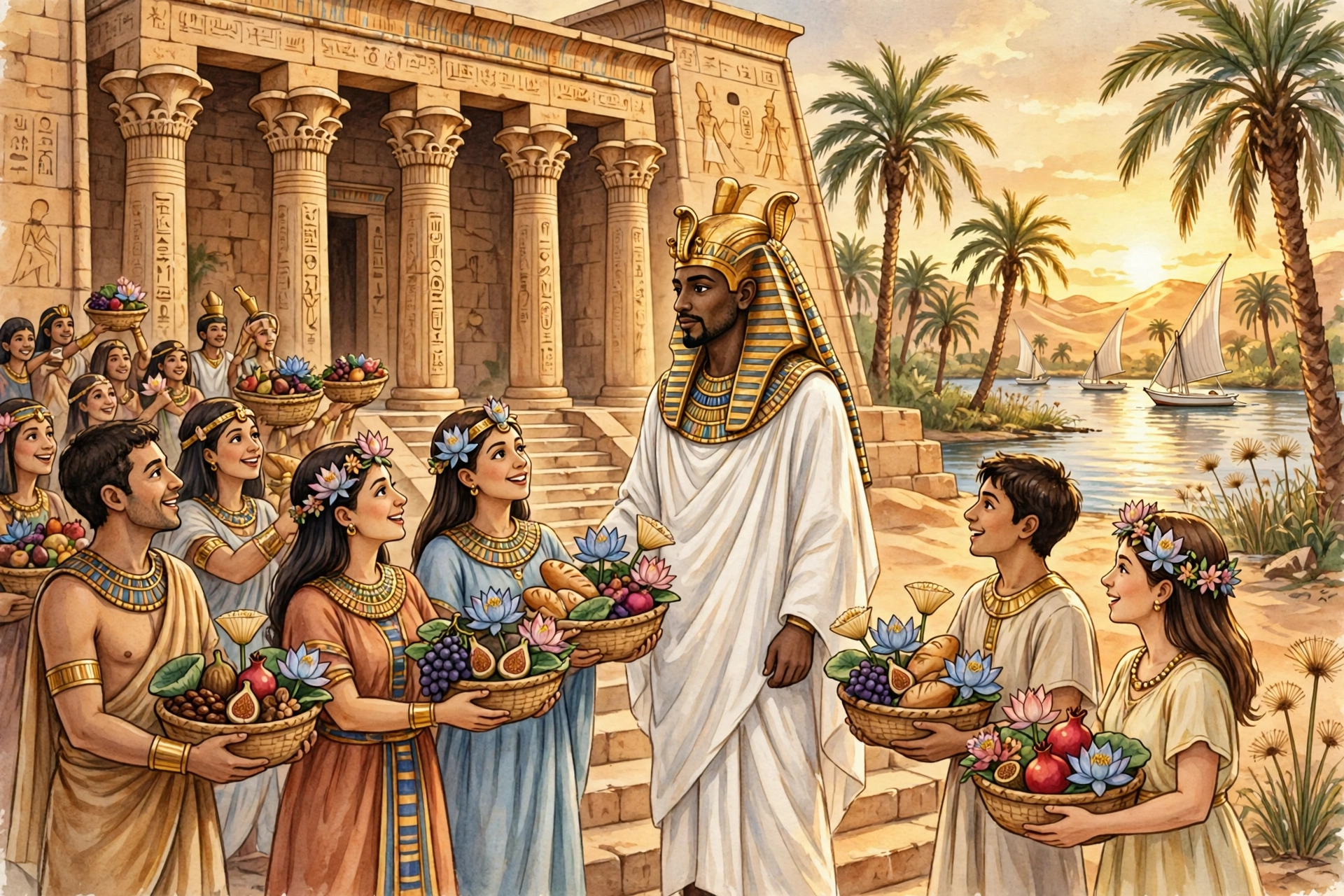
In Egypt, the pharaoh was not just a king. People believed he was a god on Earth, or at least the link between the gods and ordinary people. When a new pharaoh was crowned and took the throne, the Egyptians believed he was “born” as a god that day. His crowning day mattered more than the day he came into the world as a baby. So the day they celebrated was the coronation, the day he became a god-king.
One of the oldest written mentions of a birthday anywhere comes from the Bible, in the book of Genesis. It tells of a pharaoh in Egypt holding a great feast on his birthday, with all his officials invited. Scholars say the “birthday” was most likely the pharaoh’s coronation day, his birth as a god, rather than the day of his actual birth.
Picture the scene: a great hall, full of light and music, servants carrying trays of bread, figs, and roasted meat, and the pharaoh in the place of honour, wearing a crown of gold and blue. It is a party, but it is also a show of power. The message is simple: this man is special.
Ordinary Egyptians did not get this. A farmer did not have a birthday party. A builder working on a pyramid did not get a cake. Birthdays belonged to the top of society, to the pharaoh and the gods. For everyone else, the day they were born passed without a song or a gift. The birthday started as something rare and grand, for kings only. It took thousands of years before it became something for everyone. The next step on that road came from Greece.
Greece: Cakes for the Moon
The Greeks took the Egyptian idea and gave it a sweet twist. Like the Egyptians, they celebrated the birthdays of their gods. And their favourite birthday belonged to Artemis, the goddess of the moon and the hunt.
Artemis was one of the most loved goddesses in Greece. She was the daughter of Zeus, the king of the gods, and she was linked to the moon, which is round and bright in the night sky. To honour her, the Greeks baked round cakes. The round shape stood for the full moon. The story goes that they placed lit candles on the cakes, so the cakes glowed like the moon, and carried them to her temple.
It is a lovely story, and you will find it in many books and on many websites. But here we must be honest with you, because the truth is a little less neat. There is no direct proof that the Greeks put candles on cakes for Artemis and blew them out to make a wish. Archaeologists have found round cakes at the temple of Artemis at Ephesus, in what is now Turkey. The Greeks did offer honey cakes to her. But no old Greek book says clearly, “We put lit candles on a round cake for Artemis.” Historians say the candle part may be a later guess, a story that grew up around the real cakes.
What do we know for sure? The Greeks honoured Artemis with round cakes, and they believed smoke could carry prayers up to the gods. The rest — the candles, the wish, the blowing out — is a popular story, not a proven fact.
Still, the Greek story matters, because it gave us the link between birthdays and cake. Before Greece, a birthday was a feast for a king. After Greece, a birthday had a cake in it. That cake would come back, again and again, in every century after.
The Greeks also believed birthdays needed protection. They thought evil spirits came close on your birthday, and that loud noise and bright light would scare them away. That may be one reason birthday parties are still noisy and bright today, with singing, clapping, and candles — your friends gathered close to keep you safe.
Rome: Birthdays for Ordinary People
If Egypt gave birthdays to kings and Greece gave birthdays to gods, Rome gave birthdays to people. That was the big change. And it is the reason we have birthday parties today.
The Romans were the first people in history to celebrate the birthdays of ordinary men — not gods, not kings, but men. A rich Roman man would invite his friends to his house for his birthday. They would eat a feast, drink wine, give him gifts, and make speeches to toast his health. It was a social event, a chance to show friendship and enjoy good food together.
Roman birthday cakes were sweet, made with honey and nuts, and sometimes with cheese. The emperor Hadrian, who ruled from 117 to 138 CE, is said to have sent birthday cakes to guests who could not come to his party. Roman men who reached the age of 50 got something special: a cake made of wheat flour, grated cheese, honey, and olive oil. Fifty was a grand age in a world where many people died young.
The Romans also set public holidays for the birthdays of famous people. The birthday of an emperor was a day off, a day for the whole city to celebrate. It is a bit like the public holidays we have today for kings, queens, and presidents. The idea is the same: a birthday can belong to a whole country, not just one person.
But there was a catch, and it was a big one. Roman birthdays were for men only. Women did not get birthday parties. A Roman wife, mother, or daughter could attend a party, but the party was not for her. Women had to wait a very long time — until around the 12th century, hundreds of years later — before their birthdays were celebrated too. That is a strange thought today, when we celebrate everyone’s birthday. But in Rome, the birthday was a man’s honour.
The Romans also loved the circle as a sign of life that goes on and on. You can read about that old idea in our article about why wedding rings go on the left hand. A round cake carries the same message: a circle has no end.
So by the time Rome fell, the birthday had come a long way. It had moved from kings to gods to ordinary men. It had cake, gifts, feasts, and songs. It looked, in many ways, like a modern birthday party. And then, almost overnight, it vanished.
The Long Quiet: When Birthdays Went Away
When the Roman Empire fell apart, Europe changed. New kingdoms grew up, the Christian Church became very strong, and the Church did not like birthdays. The early Christians believed birthdays came from pagan religions, the old religions of Greece and Rome. The Bible mentions only two birthday parties, and both end badly: one is the pharaoh’s feast, and the other is the birthday of King Herod, at which John the Baptist was killed. To early Christians, that was proof enough. Birthdays belonged to the old world, not to their faith.
So Christians celebrated other days instead. They celebrated the day a saint died, which they believed was the day the saint went to heaven. They celebrated Christmas, the birth of Jesus. But they did not celebrate their own birthdays. For hundreds of years, in much of Europe, a birthday passed like any other day. No cake. No song. No gifts.
Kings and rich families still marked birthdays quietly, but for ordinary people the party slept for about a thousand years. Slowly, things changed. In the 1100s and 1200s, women’s birthdays began to be celebrated too, and churches kept baptism books, so families knew the date a child was born. Still, the birthday party as we know it did not come back in England or France. It came back in Germany, as a party for children.
Germany: The Children’s Party That Changed Everything
In the 1700s, in Germany, families began a new tradition. They called it Kinderfest. Kinder means children in German. Fest means festival or party. So Kinderfest means children’s festival. It was the first birthday party made just for a child, and it is the direct ancestor of the birthday party in your home today.
Here is how it worked. On the morning of a child’s birthday, the child woke up to a wonderful sight: a cake on the table, covered in lit candles. One candle stood for each year of the child’s life. A child turning seven would have seven candles. But there was always one extra candle, taller than the rest, standing in the middle. That extra candle was called the Lebenslicht, which means “light of life.” It stood for the year ahead, and for the hope that the child would live to see another birthday.
The candles burned all day — if one burned down, it was replaced, and the flame was never allowed to go out. In the evening, the family gathered around the cake. The child made a silent wish, which nobody was allowed to know, and blew out all the candles in one breath. If every flame went out, the wish would come true. Then the cake was cut and shared.
We have good records for Kinderfest. One of the earliest comes from 1691, when a German scholar wrote about children’s birthday cakes in Nuremberg. Later, the writer Johann Wolfgang von Goethe described a large cake with many candles at his 52nd birthday, in the early 1800s — proof that by then, adults enjoyed the custom too.
The candles are the one part of this story we will only touch lightly here, because our article about why we put candles on a birthday cake tells the full candle story, from the Greek moon cakes to the German Kinderfest and the secret wish. What matters for this story is that the Germans took the candle, the cake, and the wish, and put them together into a party for a child. That party is the birthday party we know.
Why Do We Sing “Happy Birthday to You”?
Every birthday party has a moment when the room goes quiet, the cake comes out, and everyone starts to sing. The tune is the same in almost every English-speaking country. But where did that song come from? It is younger than you might think.
The melody was written by two sisters in Louisville, Kentucky, in the United States. Their names were Mildred and Patty Hill. Mildred wrote the music, and Patty wrote the words. In 1893, they published it as a little greeting song for children in a kindergarten, a school for small children. It was called “Good Morning to All.” The teacher sang “Good morning to you” in the morning, and the children sang it back. It was a warm, simple way to start the school day.
Over time, people changed the words. “Good morning to you” became “Happy birthday to you.” Nobody knows exactly who made the change, or when. The new words fit the same tune perfectly. The song spread from school to school, from family to family, and by the early 1900s it was being sung at birthday parties across America. From there it travelled the world. Today it is one of the most sung songs in the English language — and it started as a way to say good morning to a class of small children.
Singing matters because it is something everyone can do together, even if they cannot cook or buy a gift. When a whole room sings to one person, that person feels noticed. It costs nothing, it needs no skill, and it is almost impossible to sing it without smiling.
Why Do We Give Gifts?
Gifts are the oldest part of the birthday, older even than the cake. The Romans gave gifts at birthdays, and German children at a Kinderfest received presents. A gift says, “I thought about you before today. I noticed what you like.” In Rome, gifts were often practical: food, wine, a piece of clothing. Today, gifts can be anything, from a pair of socks to a phone. The price does not matter much. A small gift chosen with care beats a costly gift bought in a hurry, every time. Time is the one gift we can never buy more of, and on a birthday, giving your time is often the best present of all.
How Birthdays Spread Around the World
For a long time, birthday cake was a luxury. In the 1700s, sugar was costly, because it came from far away. Only rich families could afford a sweet cake. That changed in the 1800s, when farmers in Europe learned to make sugar from sugar beet, a root vegetable that grows in cold weather. Flour got cheaper too, and baking powder, which helps cake rise, was made by a British chemist named Alfred Bird in 1843. Suddenly, an ordinary family could bake a birthday cake in their own kitchen.
At the same time, German families were moving to America. In the 1800s, many Germans crossed the sea to start new lives in the United States, and they brought their Kinderfest with them. Their American neighbours saw the custom, liked it, and copied it. By the early 1900s, birthday parties with cake and candles were common in the United States, Britain, and other English-speaking countries. Shops sold birthday candles, and cookbooks printed birthday cake recipes.
Trade and travel carried the custom everywhere. Today you can find birthday cake in Asia, Africa, South America, and Australia. The cake, the flavour, and the song may all be different — but the idea is the same: one day a year belongs to one person.
Why Birthdays Still Matter
So why do we keep doing this, after 5,000 years? The kings are gone, the gods are stories now, and the sugar is cheap. Why do we still stop, once a year, and make a fuss over one person?
The first reason is simple: a birthday is a pause. Life moves fast, and a birthday says, “Stop. This day is different.” It gives us a reason to gather the people we love in one room, eat together, and talk.
The second reason is that a birthday is a mark in time — a small New Year, just for you. Like New Year’s Day on 1 January, it is a moment to look back and forward. You can read about how 1 January became the world’s New Year in our article about why we celebrate New Year’s Day on 1 January. A birthday asks the same questions on a personal scale: what went well this year? What do I want next year?
The third reason is the deepest one. A birthday tells a person they are loved. Many people go through the year feeling unseen. They work, they cook, they drive, they help others, and nobody says thank you. Then their birthday comes. The phone rings. A card arrives. A cake appears. For one day, the message is clear: you are not invisible. We noticed you. We are glad you were born.
That is the real gift of the birthday — not the cake, not the candles, not the presents, but the feeling of being seen. The Egyptians gave it to their kings, the Romans to their friends, the Germans to their children. And today, we give it to each other, one birthday at a time.

Frequently Asked Questions
Who celebrated the first birthdays?
The ancient Egyptians, around 3,000 BCE. They celebrated the day a pharaoh was crowned, believed to be the day he was “born” as a god.
Did the Greeks really put candles on cakes for Artemis?
That is a popular story, but there is no direct proof. The Greeks did offer round honey cakes to Artemis, the moon goddess, yet no old record says they put lit candles on them.
Why did the Romans celebrate birthdays?
The Romans were the first to celebrate birthdays for ordinary people, with feasts and gifts. At first, though, only men had birthday parties. Women’s birthdays were not celebrated until around the 12th century.
What is Kinderfest?
Kinderfest was a German children’s birthday festival from the 1700s. The child woke to a cake with one candle for each year of life, plus one extra candle, the “light of life,” and blew them out in the evening while making a wish.
Where did “Happy Birthday to You” come from?
The tune was written by two sisters, Mildred and Patty Hill, in Louisville, Kentucky. They published it in 1893 as a school greeting song called “Good Morning to All.” People later changed the words.
Why do we give gifts on birthdays?
Gifts are the oldest part of the birthday. The Romans gave them, and German children received them too. A gift says, “I thought about you,” and the best gift of all is often your time.
More from Zorium Daily
- Why Do We Put Candles on a Birthday Cake?
- Why Do We Have Weekends?
- Why Do We Celebrate New Year’s Day on 1 January?
- Why Do We Have Seven Days in a Week?
The next time a birthday comes around — yours, or someone you love — think of the long road that party travelled. It started with a pharaoh in Egypt, passed through Greece and Rome, slept for a thousand years, and woke up in a German child’s bedroom. Five thousand years later, it still ends the same way: with people you love, gathered close, singing your name.