Why Do We Get Dizzy When We Spin Around? Explained Simply
SUMMARY OF THIS ARTICLE
- Spinning makes you dizzy because of the tiny balance system inside your ears.
- Three small curved tubes in each inner ear are filled with liquid that moves when you turn.
- When you spin, the liquid keeps moving after you stop, and your brain thinks you are still turning.
- Your eyes and your ears send different messages, and that mix-up makes the room seem to spin.
- The feeling fades in a minute or two as the liquid settles, and sitting down helps.
Spin Around and See What Happens
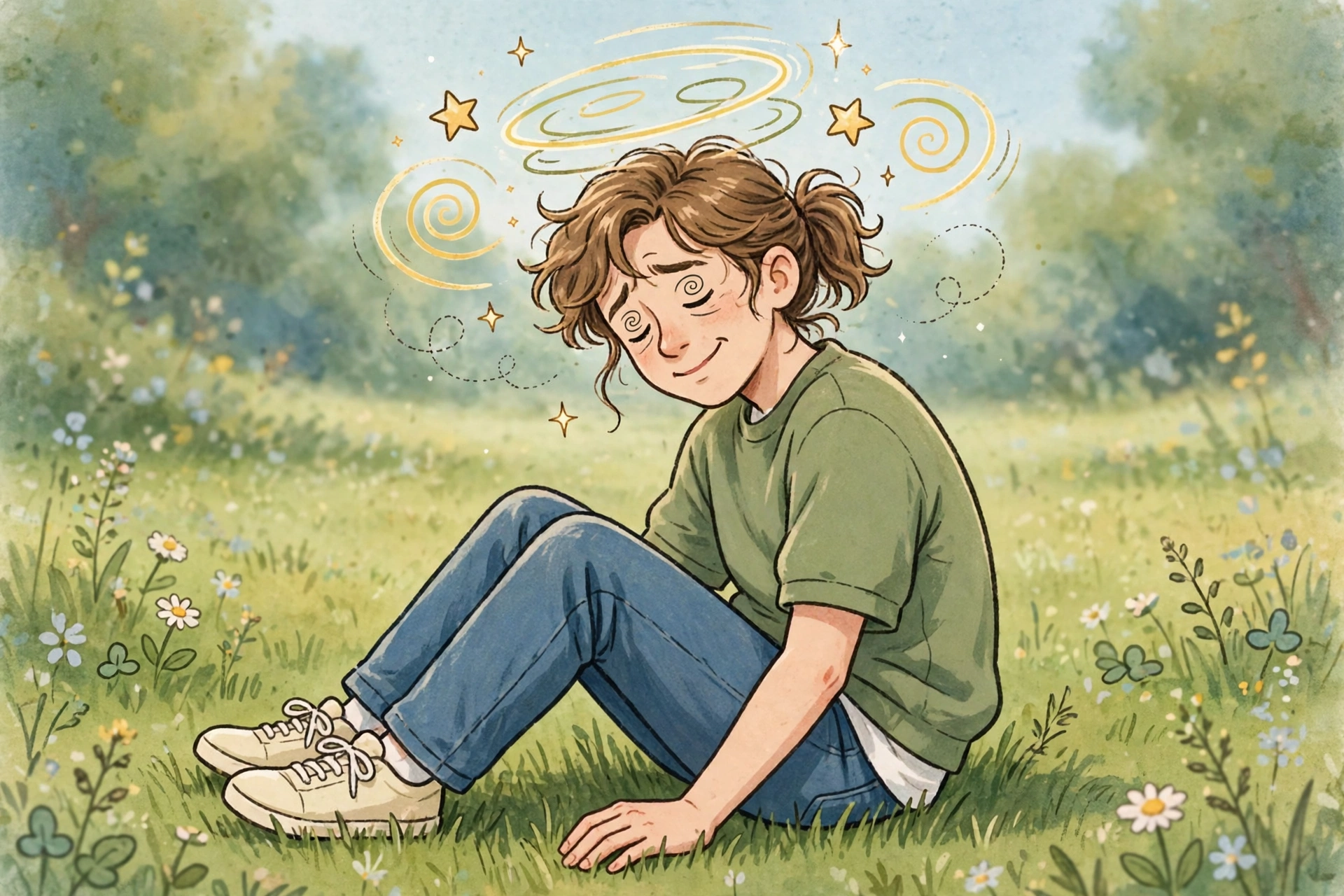
You have done it as a child, and maybe you still do it now. Arms out, round and round, faster and faster, until the world turns into a blur. Then you stop, and the world does not stop with you. It keeps spinning. The trees lean. The ground tilts. Your legs wobble. You laugh, you fall over, and you feel wonderfully, gloriously dizzy.
It is fun. But it is also strange. Why does the room keep spinning after you have stopped? Why do your eyes dart from side to side? And why does it sometimes make you feel sick?
The answer is hidden in a tiny place you cannot see: deep inside your ears. There is a small balance system in there, no bigger than a pea, and it is one of the cleverest things in your body. When you spin, you confuse it. And when it is confused, it tells your brain a story that is not true. Let us look inside and see how it works.
The Tiny Gyroscope Inside Your Ear
Your ear does two jobs, not one. The outer part hears sounds. The inner part, hidden deep in your head, helps you balance. It is called the inner ear, and it is a small, bony maze filled with liquid.
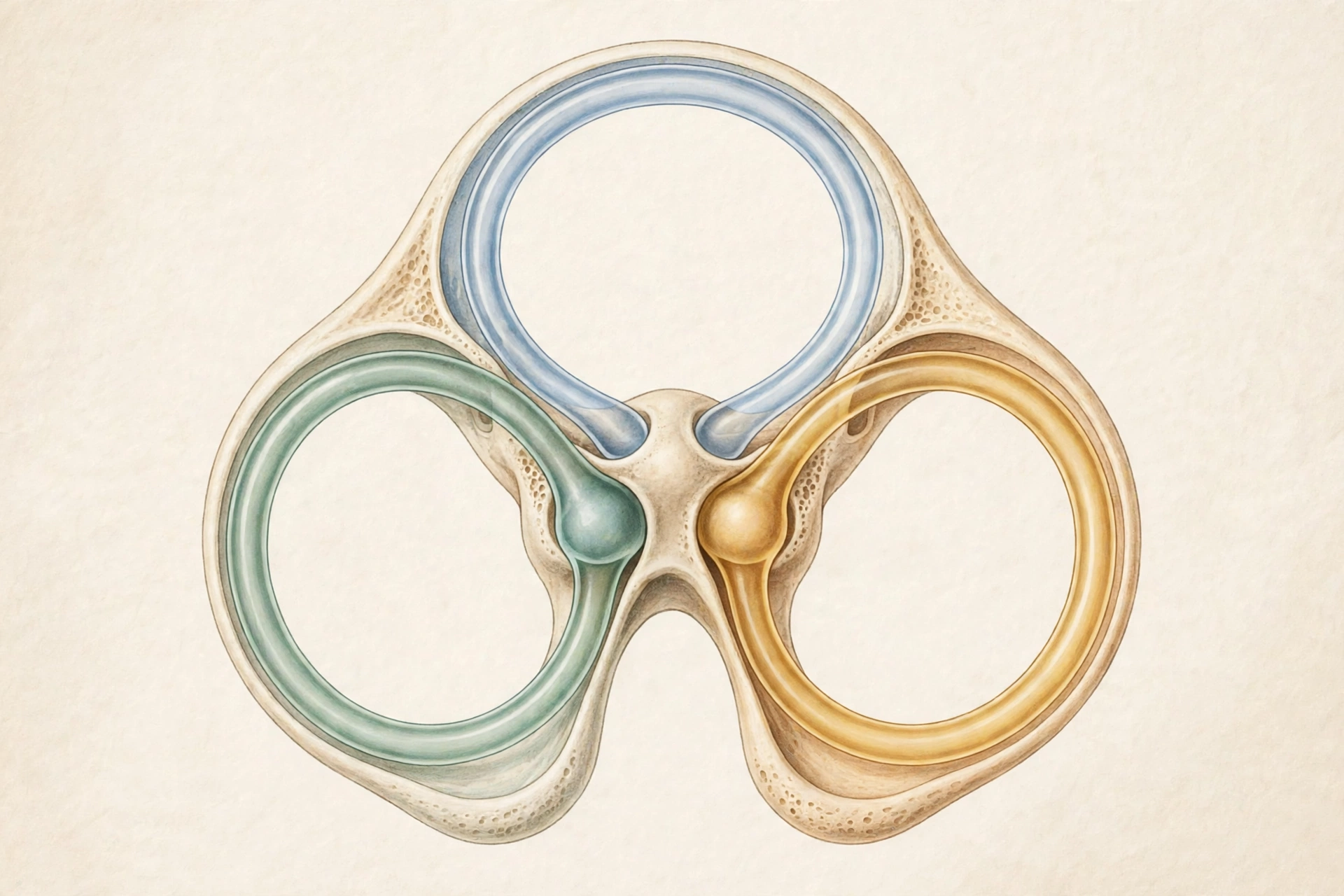
Inside the inner ear are three little tubes, shaped like loops, set at different angles — one for up and down, one for side to side, and one for tilting. Scientists call them the semicircular canals. Semicircular means half-circle, and canals are just small tubes. Together, the three loops can sense movement in every direction: turning your head left, nodding up and down, tilting to the side. It is a bit like a gyroscope, a spinning toy that knows which way is up, only made of liquid and tiny hairs instead of metal.
Here is how it works. Each loop is filled with a thick liquid, a bit like jelly, and at the base of each loop sits a tiny clump of hair-like sensors, called hair cells. When you turn your head, the liquid in the loop sloshes a little, like water in a bucket when you swing it round. The sloshing liquid bends the tiny hairs. The bent hairs send a signal to your brain: “We are turning left!” Or, “We are nodding down!” Your brain reads these signals, combines them with what your eyes see and what your feet feel, and works out where you are and which way you are moving.
It is a beautiful system, and it works so well that you never notice it. You walk, you run, you jump, you dance, and your balance system keeps you upright without you thinking about it. It only shows itself when you confuse it. And spinning is the best way to confuse it.
What Happens When You Spin
Now, let us spin. You turn round and round, and the liquid in those little loops starts to move. At first, the liquid lags behind — the tube turns, but the liquid takes a moment to catch up. That lag bends the hairs, and your brain gets the message: “We are spinning!”
After a few seconds of spinning at a steady speed, the liquid catches up with the tube. It is moving at the same speed as your head now, so the hairs straighten out again, and the signal fades. Your brain starts to think you have stopped spinning, even though you are still turning. That is why, if you spin for a long time at the same speed, the dizzy feeling can ease off a little while you are still spinning. Your balance system has adjusted.
Then you stop. Suddenly. And here is the problem. Your head has stopped, but the liquid inside the loops has not. It keeps swirling round, like water in a bucket after you stop swinging it. The moving liquid bends the hairs again, but this time in the opposite direction. Your brain gets a loud, clear, and completely wrong message: “We are spinning the other way!”
That is why the world seems to spin after you stop. Your eyes tell your brain, “We are standing still. The trees are not moving.” Your ears tell your brain, “No, we are spinning fast!” Your brain does not know who to believe, and the mix-up makes you feel dizzy. It is a disagreement between two trusted messengers, and you are caught in the middle.
Why Your Eyes Dart From Side to Side
If you watch someone who has just stopped spinning, you will see something funny: their eyes flick from side to side, quickly, without them meaning to. It looks like their eyes are dancing. This has a name: nystagmus. Nystagmus is the word for fast, uncontrolled eye movements, and it is a direct result of the confused balance system.
Here is why it happens. Your brain tries to keep your eyes steady on the world while your head moves. When you turn your head to the left, your eyes automatically move to the right, to stay fixed on what you were looking at. It is a reflex, an automatic response you do not have to think about. It is called the vestibulo-ocular reflex, but you do not need to remember that name. Just think of it as your eyes trying to stay still while your head moves.
When you stop spinning, your confused inner ear tells your brain that your head is still turning. So your brain moves your eyes to compensate, to stay fixed on the world. Then it snaps them back, and moves them again, and snaps them back, over and over. That is the darting you see. It is your brain trying to fix a problem that is not really there, because the liquid in your ears is still sloshing.
The darting usually lasts a minute or two, until the liquid settles and the signals calm down. Then your eyes go back to normal, and the world stops spinning. It is a neat little window into how your brain and ears work together, and it is one of the reasons doctors check eye movements when they want to know if someone’s balance system is working properly.
Why the Room Keeps Spinning After You Stop
We have talked about the liquid, but there is another part to the story: your brain needs time to catch up.
When you spin, your brain builds a picture of the world from three sources: your eyes, your inner ears, and the sensors in your muscles and joints, which tell your brain where your arms and legs are. Normally, all three agree. You are walking forward, your eyes see the path moving past, your ears feel the movement, your feet feel the ground. All three say the same thing, and you feel steady.
When you spin and stop, the three sources disagree. Your eyes say, “We are still.” Your feet say, “We are standing on solid ground.” Your ears say, “We are spinning fast!” Your brain cannot make sense of three different stories at once, and the result is dizziness. The world seems to tilt and turn, even though you know, in your thinking mind, that you are standing still.
This is also why closing your eyes can make dizziness worse. If you shut your eyes, you lose one of the three sources. Now your brain has only your ears, which are lying, and your feet, which are telling the truth. The argument gets worse, not better. Opening your eyes and fixing them on one steady point — a tree, a door, a spot on the wall — gives your brain a strong, true message to hold on to. That is why dancers and skaters are taught to spot: to pick one point and look at it each time they turn, so their brain stays anchored.
Why Spinning Can Make You Feel Sick
For most people, dizziness after spinning is fun and fades in a minute. For some people, it brings a queasy feeling in the stomach, and sometimes even nausea, which is the feeling that you might be sick. Why would spinning make your stomach upset?
The answer is that your balance system is wired to your stomach, through a part of the brain that handles sickness. Scientists think this wiring is an old safety system. Long ago, if your balance system sent strange signals, it might have meant you had eaten something poisonous. Poison can upset the inner ear and make you dizzy, and the body’s response was to feel sick and throw up, to get rid of the poison. It is a clever system, but it can misfire. Spinning is not poison, but your brain cannot tell the difference. It feels the strange signals and thinks, “Something is wrong. Better feel sick, just in case.”
That is why fairground rides make some people feel ill. A roller coaster, a spinning teacup, a ride that whirls you round — all of them confuse the balance system in the same way. Some people are more sensitive than others. Children often love spinning and feel fine. Adults often feel sicker, because their balance system is more set in its ways. And some people get motion sickness in cars and boats for the same reason: the eyes and the ears disagree, and the stomach pays the price.
If spinning makes you feel sick, sit down, fix your eyes on a steady point, and breathe slowly. The feeling usually passes in a few minutes. And if you often feel dizzy without spinning, or the dizziness lasts a long time, it is worth talking to a doctor, because there are ear conditions that can cause dizziness, and they are worth checking.
How Dancers and Skaters Beat the Spin
If spinning makes everyone dizzy, how do dancers spin round and round on stage and finish standing still, smiling? How do ice skaters spin so fast they become a blur, and then glide away gracefully? The answer is practice, and a clever trick called spotting.
Spotting is simple. A dancer picks one spot on the wall — a mark, a light, a face in the crowd — and keeps their eyes fixed on it for as long as possible while they turn. As the body turns, the head stays facing the spot until the very last moment, then the head whips round quickly to find the spot again. The eyes stay anchored, the brain gets a steady message from the eyes, and the dizziness stays small.
It takes a lot of practice. Young dancers feel dizzy at first, just like everyone else. But with time, their brains learn to ignore the confusing signals from the ears and trust the eyes instead. Their balance system adapts. It is a bit like learning to ride a bike: wobbly at first, then smooth, then second nature.
Ice skaters do the same thing, and so do gymnasts. Astronauts, the people who travel into space, train in spinning machines to get used to strange balance signals, because in space there is no up or down, and the inner ear sends very confusing messages. Their training is long and hard, but it shows how adaptable the human balance system is. Given time and practice, the brain can learn to handle almost any spin.
You can try a little version of spotting yourself. Next time you spin, pick a tree or a door and try to keep your eyes on it as long as you can. It will not make you a ballet dancer, but you will feel the difference. Your brain will thank you for giving it something steady to hold on to.
Animals Get Dizzy Too
Humans are not the only ones with a balance system in their ears. Almost all animals with a backbone have one, and they get dizzy too.
Dogs that chase their tails in circles sometimes stop and wobble, looking confused. Cats that fall from a height twist in the air to land on their feet, using their inner ear to tell which way is up. It is a remarkable reflex, and it works in a fraction of a second. Birds use their balance system to fly steady in the wind. Fish use a similar system to stay upright in water, even when the current pushes them around.
Even animals without a backbone have ways of sensing balance. A jellyfish has tiny stones in its body that shift with gravity, telling it which way is up. It is a simple system, but it works. Balance is one of the oldest jobs in the animal kingdom, and every creature that moves needs a way to do it.
It is a lovely thought: the same tiny tubes that make you dizzy after spinning are cousins of the balance systems in dogs, cats, birds, and fish. We are all, in our own way, trying to stay upright in a world that keeps moving.
Our bodies are full of these small automatic systems, working quietly without us noticing. A hiccup is another one — a sudden, funny reflex that takes over without warning. If you have ever wondered what causes that strange little jump in your chest, our piece on why we get hiccups explains it in simple words. Like dizziness, hiccups are a reminder that the body has a mind of its own, and sometimes it does things we did not ask for.
How to Stop the Spinning Feeling Fast
The good news is that dizziness after spinning fades on its own, usually in a minute or two. But if you want to feel better faster, here are a few simple tricks.
Sit down. Standing up while dizzy is a wobbly business, and sitting gives your body a stable base. If you can, sit on the ground or on a low step, where a fall would not hurt.
Fix your eyes on one steady point. Pick a tree, a door, a lamppost, anything that is not moving, and look at it. Do not move your eyes around. Let your brain use that steady picture to argue against the lying signals from your ears.
Keep your head still. Do not shake your head or look around quickly. Every head movement sloshes the liquid in your ears a little more. Stillness helps the liquid settle.
Breathe slowly. Take a few slow, deep breaths. It will not fix the liquid in your ears, but it calms your stomach and helps the queasy feeling pass. If you feel sick, fresh air helps too. Step outside, or open a window.
Drink a little water when you feel steady again. Spinning does not dehydrate you, but a sip of water is soothing, and it gives you a moment to sit and recover.
And here is what not to do: do not spin again right away, do not close your eyes and hope it goes away faster, and do not try to walk a straight line to prove you are fine. Give your ears a minute. They have been working hard, and they need a moment to catch up.
When Dizziness Is More Than Fun
Most dizziness after spinning is harmless and fades quickly. But dizziness can sometimes be a sign of something else, and it is worth knowing when to pay attention.
If you feel dizzy often, without spinning, or if the dizziness lasts a long time, or if it comes with other symptoms — like hearing loss, ringing in the ears, a bad headache, or trouble walking — it is worth talking to a doctor. There are conditions of the inner ear that can cause dizziness, and a doctor can check them. This article is a simple explainer, not medical advice, and it cannot diagnose anything. It can only tell you how the normal system works, and when it might be wise to get a professional opinion.
Ear infections can also cause dizziness, because the infection can reach the inner ear and upset the balance system. A cold can do it too, because the tubes that link the ear to the nose can get blocked, changing the pressure in the ear. If you have a cold and the room feels like it is spinning, that is often why. It usually fades as the cold clears.
Dehydration, which means not having enough water in your body, can make you feel light-headed too, especially on a hot day. So can standing up too fast, skipping a meal, or being very tired. The body is a connected system, and dizziness can come from many places, not just the ears.
The rule is simple: fun dizziness after spinning is normal and short. Dizziness that keeps coming back, lasts a long time, or comes with other worries is worth a chat with a doctor. Trust your body. If something feels wrong, it is always better to ask.
Frequently Asked Questions
Why do we get dizzy when we spin around?
Because of the balance system in your inner ears. Three small curved tubes filled with liquid sense when you turn. When you spin and stop, the liquid keeps moving, and it tells your brain you are still spinning, even though you have stopped. Your eyes say you are still, your ears say you are moving, and the mix-up makes you feel dizzy.
How long does dizziness after spinning last?
Usually a minute or two. The liquid in your inner ear needs a little time to settle and stop moving. Once it settles, the signals to your brain calm down, and the world stops spinning. If the dizziness lasts much longer, or happens often without spinning, it is worth talking to a doctor.
Why do my eyes move from side to side when I am dizzy?
That is called nystagmus, and it is your brain trying to keep your eyes steady. Your confused inner ear tells your brain your head is still turning, so your brain moves your eyes to compensate, then snaps them back, over and over. It usually stops once the liquid in your ears settles down.
Why does spinning sometimes make me feel sick?
Because your balance system is wired to the part of your brain that handles sickness. Long ago, strange balance signals could mean you had eaten something poisonous, so the body learned to feel sick and throw up to get rid of it. Spinning is not poison, but your brain cannot tell the difference, so it can make you feel queasy just in case.
How do dancers spin without getting dizzy?
They use a trick called spotting: they pick one point and keep their eyes fixed on it for as long as possible while they turn, whipping their head round quickly to find it again. With practice, their brains learn to trust the eyes and ignore the confusing signals from the ears. It takes a lot of training, and even dancers feel dizzy when they start learning.
Can animals get dizzy from spinning?
Yes. Dogs, cats, birds, and fish all have balance systems in their ears, and they can get dizzy too. A dog that chases its tail in circles may stop and wobble. Cats use their inner ear to twist in the air and land on their feet. Balance is a job every moving animal needs to do, and the systems are surprisingly similar across species.
The World Will Stop Spinning
Here is the loveliest part of this story. The dizziness always fades. The liquid settles. The hairs straighten. The brain and the eyes agree again. The world stops spinning, and you are left standing on solid ground, a little wobbly, a little laughing, and completely fine.
It is a small reminder of how much work your body does without you noticing. A tiny maze of tubes, no bigger than a pea, filled with liquid, keeping you upright every time you walk, run, dance, or spin. You never think about it until you confuse it. And when you do, it tells you a story that is not true, just for a minute, until it sorts itself out.
So the next time you spin around in a park, or on a dance floor, or on a playground roundabout, enjoy it. Feel the world blur. Laugh when you wobble. And when you stop, sit down, pick a steady point to look at, and wait for the room to catch up with you. It will. It always does. Your ears just need a moment to remember that you have stopped, and that the world was never really spinning at all.