
Why Do Cats Purr?
SUMMARY OF THIS ARTICLE
- A purr is a soft, low sound a cat makes when air moves past parts in its throat, and the sound can go on while the cat breathes in and out.
- Cats do not purr only when they are happy. They also purr when they are calm, when they want care, and when they want to calm themselves down.
- Kittens are born blind and deaf, and they purr in their first days of life to stay close to their mother and to find food.
- A cat may also purr when it is hurt, sick, or scared, as a way to soothe itself, and some scientists think the gentle shake of purring may help the body heal, though this is not yet proven.
- To know what a purr means, look at the whole cat: its ears, eyes, tail, and body. A soft, loose body often means calm, while a stiff body or flat ears can mean stress or pain.
Have you ever sat with a cat on your lap and felt a soft shake in its body? You hear a low, steady sound. It is not a meow. It is not a growl. It is a purr. Many people think a purr always means, “I am happy.” That is true some of the time. But it is not the full story. Cats purr for many reasons. Some are sweet. Some are about need. Some are about fear or pain. In this article, we will look at all of them in simple words.
A purr is one of the first sounds a cat learns. It is also one of the sounds people love most. It can feel warm and calm. But a cat cannot tell us in words how it feels. So we must read its whole body, not just one sound. That is the key to this article. A purr is a clue. It is not the full answer on its own.
What Is a Purr?
A purr is a soft sound that goes on and on, like a small motor. It is low and gentle. You can often feel it more than you hear it. Put your hand on a purring cat, and you may feel a light shake under your hand. That shake is called a vibration. A vibration is a fast, tiny shake.
Cats can purr while they breathe in. They can also purr while they breathe out. That is why a purr can go on for a long time without a break. A meow stops when the cat needs a breath. A purr does not need to stop in the same way.
People ask many simple questions about nature. On Curiosity, you can find many such questions in plain words. For example, people ask how fireflies make light without heat. That is a small wonder of nature, just like a purr. People also ask why we yawn, and if a yawn can spread from one person to the next. Our bodies do many things on their own, and a purr is one of them.
How Does a Cat Make That Sound?
Inside a cat’s throat, there is a part called the voice box. In simple words, it is the place where sound is made. Near the voice box, there are soft folds of skin. You can think of them like two small doors that can open and close. When a cat purrs, its brain sends a fast signal to the muscles near those folds. The muscles move the folds open and closed, very fast, about 25 times each second. You cannot see it happen. You can only hear and feel the result.
As the cat breathes, air moves past those moving folds. The air makes the folds shake. That shake makes the soft purr sound. Because the folds move when the cat breathes in and when it breathes out, the sound does not stop. It just keeps going, like a soft hum.
The First Purrs: Mother Cats and Kittens
A kitten is born blind. That means it cannot see. A kitten is also born deaf. That means it cannot hear at first. So how does a tiny kitten find its mother? How does it find food? It uses touch, smell, and the feel of a purr.
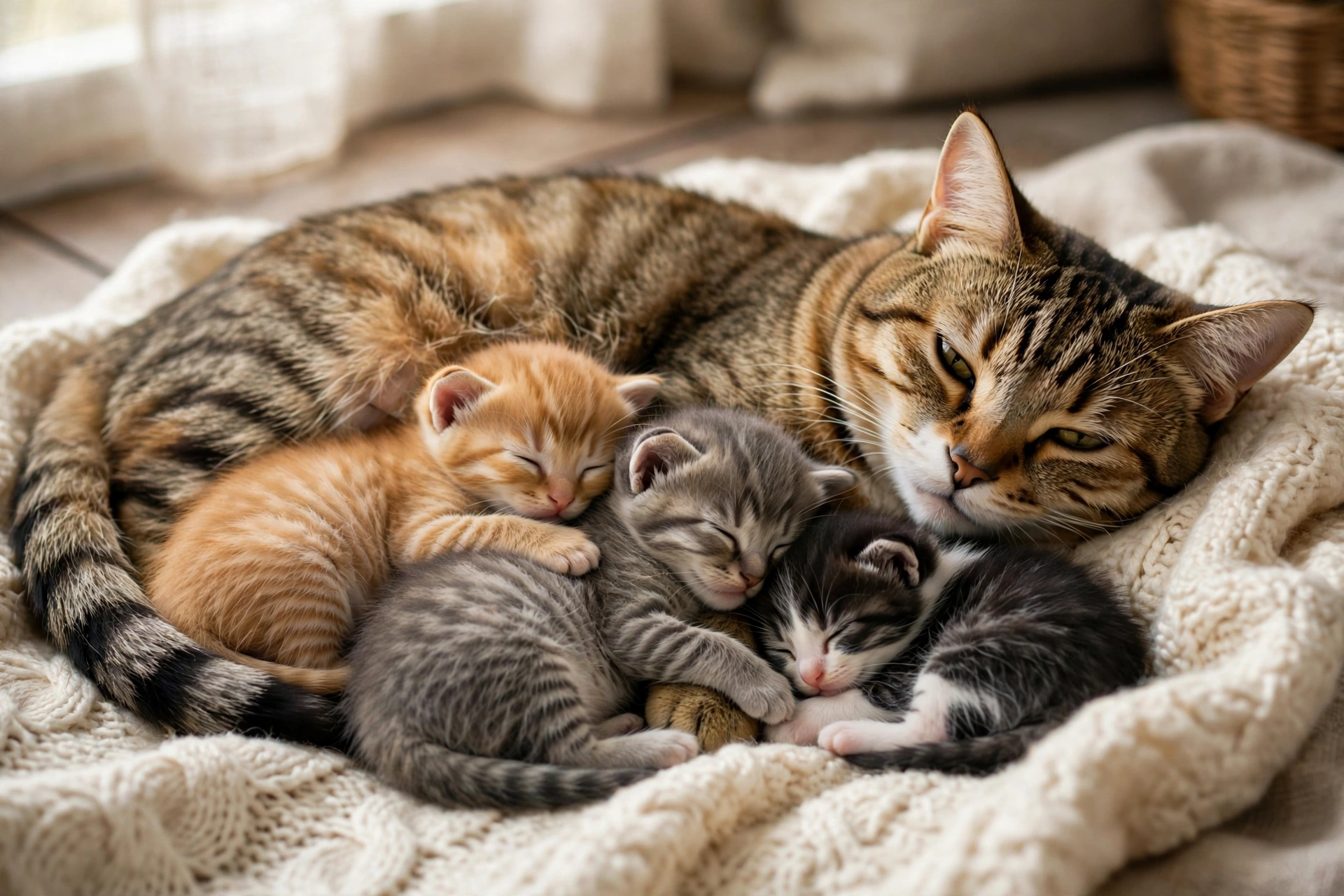
A mother cat purrs to her kittens. The kittens feel the shake of her body. That shake is like a sign that says, “I am here. Come close. You are safe.” The kittens move toward that shake. They find her body. They find food. They stay warm.
Kittens start to purr when they are only a few days old. At first, their purrs are very soft. They purr while they feed. In this way, mother and kittens talk without words. The mother purrs, and the kittens purr back. It is a quiet, close talk. It says, “We are together. All is well.”
This early purr is a big clue. It shows that purring is not only about joy. It is about bond. A bond is a close tie between two beings. For a kitten, a purr is a tie to its mother. It is a way to stay near her when it cannot see or hear well. Later in life, cats keep this habit. When a cat sits on your lap and purrs, it may be saying, in cat language, “You are like family to me. I feel safe near you.”
Long ago, people also had to find ways to do things without the tools we have now. For example, people had to tell the hour without clocks, and you can read how ancient people did that. In the same way, a kitten finds its way without sight or hearing. It uses what it has. Nature often finds a simple way to solve a hard problem.
The Happy Purr
Yes, cats do purr when they are happy. When a cat is calm, safe, and pleased, it may purr. You may see this when you stroke a cat gently. The cat may close its eyes part way. Its ears may be soft and forward. Its body may be loose, not stiff. Its tail may be still or move slowly. Then you hear the purr.
A happy purr often comes with other calm signs. The cat may knead with its paws. Kneading is when a cat pushes its front paws in and out, like it is making bread dough. Kittens do this when they feed from their mother. Adult cats may do it when they feel safe and pleased.
A happy cat may also rub its head on you. It may roll on its side and show its belly. But take care here. A belly shown is not always a call to rub it. Some cats like a belly rub. Some cats do not. Watch the cat. If it stays soft and still, it is likely calm. If it grabs your hand or moves fast, stop and give it space.
The Calm-Down Purr: Purring to Soothe Itself
One of the most important things to know is this: cats also purr to calm themselves down. This is called self-soothing. Self-soothing means doing something to make yourself feel less scared or less stressed. People do this too. You may hum a tune when you are nervous. You may take a slow breath. You may hold a soft blanket. A cat may purr.
A cat may purr at the vet. The vet’s office is new. It smells strange. There are loud sounds. The cat may be scared. Yet it may purr. That does not mean it loves the vet visit. It may mean it is trying to calm its own body down. It is like a child hugging a toy in a strange place.
A cat may also purr when it is in a new home. A move is a big change for a cat. New rooms, new smells, new sounds. The cat may hide under a bed and purr softly. It is not happy yet. It is trying to feel safe. The purr is its own tool for calm.
This is why you must look at the whole cat. If a cat purrs but its body is stiff, its ears are flat, its eyes are wide, and its tail is tucked close, it may be stressed. The purr is not a lie. It is a sign of a need. The cat needs calm, space, and time. Give it that. Do not pick it up and force a cuddle if it wants to hide. Let it come out when it is ready.
This is a bit like other body reactions we do not control. For example, your eyes may water when you cut an onion. That is not a choice. It is a body reaction to a sting in the air. You can read why onions make your eyes water. In the same way, a purr can be a body reaction to stress. It is not always a choice to show joy. It can be a way the body tries to settle itself.
The Asking Purr: Purring to Get Care
Cats are smart. They learn what works with people. If a cat purrs and gets food, it will purr again when it is hungry. If a cat purrs and gets a stroke, it will purr again when it wants a stroke. Over time, cats may learn to use a purr to ask for things.
Some cats have a special kind of purr for asking. In simple words, it is an asking purr. This purr is a bit different. It may be louder. It may have a high sound mixed in with the low purr. That high sound is a bit like a cry. People tend to hear it fast. It can sound urgent, like the cat really needs something.
An asking purr often comes with other signs. The cat may rub against your legs. It may walk to its food bowl and look back at you. It may meow as well. It may sit near you and stare. The message is clear, even without words: “Please help me. I want food, or I want care, or I want to play.” This does not mean the cat is being bad or tricky. It means the cat has learned how to live with people. Cats live in our homes. They depend on us for food, water, and safety. Asking is a smart way to live.
We ask questions about things we use each day too. A phone can get hot when it charges, and people ask why a phone gets hot while charging. A phone can also lose power fast, and people ask why a phone battery drains so fast. Cats do the same with us, in their own way. They ask when they need something. They just ask in cat language.
Purring When Hurt, Sick, or Scared
This is the hardest part to hear, but it is important. Cats may purr when they are hurt. They may purr when they are sick. They may purr when they are in pain. This does not mean they are happy in those moments. It may mean they are trying to soothe themselves.
Vets see this often. A cat that is hurt may purr while the vet checks it. A cat that is ill may purr in its bed at home. An owner may think, “My cat is purring, so it must be fine.” That is a mistake we must avoid. A purr alone does not mean a cat is well.
Why would a cat purr when it is hurt? First, the purr may calm the cat, as we saw above. When the body is in pain, calm can help. Second, the purr may be a signal to others. A soft purr may say to a mother or to a friend, “I am here. I need help. Please do not leave me.” Third, the purr may help the body itself. That idea leads us to the healing question.
If your cat purrs but also hides more than usual, eats less, moves less, or cries when touched, do not just say, “It is purring, so it is fine.” Look for other signs. A change in eating, drinking, play, or toilet habits can be a sign of illness. If you are worried, call a vet. A vet can check the cat and tell you what is wrong. A purr is not a test for health. It is only one clue.
Could Purring Help Healing? What Science Says So Far
Here is a fascinating idea. Some scientists think purring may help a cat’s body heal. This idea is not yet proven. We must be honest about that. It is a theory, not a fact. A theory is an idea that fits some facts but still needs more proof.
The idea goes like this. A cat purrs at a rate of about 25 shakes each second. Some studies of bones and muscles show that gentle shakes at a rate near this can help bones stay strong. They may also help soft tissue, like muscles and tendons, heal a bit faster. Tendons are the strong cords that join muscle to bone. So some scientists ask: could a cat’s own purr help its bones and muscles heal after an injury?
There is another fact that makes this idea interesting. Cats tend to heal from broken bones faster than dogs do, in some cases. Could purring be one reason? It is possible. But it is not proven. Many other things could also explain it. Cats are light. Cats are small. Cats rest a lot after an injury. All of these could help healing too.
How to Read a Purr: Look at the Whole Cat
So how do you know what a purr means? You look at the whole cat. Here is a simple guide.
First, look at the body. Is the body loose and soft? That often means calm. Is the body stiff and low to the ground? That can mean fear or stress.
Second, look at the ears. Soft ears that point forward often mean calm and interest. Ears that are flat back against the head often mean fear or anger.
Third, look at the eyes. Soft, half-closed eyes often mean calm. Wide eyes with big pupils can mean fear, excitement, or pain. Pupils are the dark spots in the middle of the eye. Slow blinks are a good sign. A slow blink is when a cat closes its eyes slowly and opens them slowly. Many cat lovers call this a “cat kiss.” It often means trust.
Fourth, look at the tail. A tail held up with a soft curve can mean a friendly greeting. A tail that lashes fast from side to side can mean anger or excitement. A tail tucked close to the body can mean fear. A tail puffed up big can mean the cat is trying to look bigger because it is scared.
Fifth, look at the situation. Where is the cat? What just happened? Did you just feed it? Did a loud sound just happen? Did a stranger just come in? The situation gives the purr its meaning. A purr on a sunny lap after a meal is likely a happy purr. A purr in a vet cage after a loud noise is likely a calm-down purr. A purr near an empty food bowl at meal time is likely an asking purr.
Put these clues together. Do not use one clue alone. A purr plus a soft body plus slow blinks is a strong sign of calm joy. A purr plus flat ears plus a stiff body is a strong sign of stress. A purr plus hiding plus less eating is a sign to call a vet.
Do All Cats Purr? And What About Big Cats?
Most small cats purr. Your pet cat purrs. Wild small cats, like the cougar and the cheetah, also purr. But big cats are different. Lions, tigers, leopards, and jaguars can roar. They cannot purr in the same way as a pet cat. Why? It is about the bones in their throat. In big roaring cats, a bone in the throat is not fully hard. It is partly soft. That lets them roar loud and far, but it stops them from making a true, steady purr. In small cats, that bone is fully hard. That stops them from roaring, but it lets them purr. So nature gave each kind of cat a different voice. Big cats got the roar. Small cats got the purr. Cheetahs and cougars are exceptions: they purr and do not roar. Size alone does not decide it. The throat bone decides it.
Why Do Cats Purr for People?
Cats did not always live with people. Long ago, wild cats lived on their own. Then, over thousands of years, some cats began to live near people. People stored grain. Grain brought mice. Mice brought cats. Cats ate the mice. People liked the cats. Slowly, cats moved into our homes.
As cats moved in, they learned our ways. They learned that a soft sound gets a soft response. A purr makes people smile. A purr makes people stay. A purr makes people stroke and feed. So cats kept purring for us. In a way, we helped shape the purr. We reward it with care. Cats learn fast what we reward.
People ask many simple questions about daily habits too. For example, people shake hands when they meet, and you can read why we shake hands when we meet. People also wonder why some countries drive on the left side of the road, and you can read why some countries drive on the left instead of the right. These are habits we learn and keep, just as cats keep purring. Habits can start for one reason and stay for many reasons.
When Should You Worry, and How to Live With a Purring Cat?
Most purrs are normal. You do not need to worry about every purr. But call a vet if your cat purrs and also eats much less, hides for a long time, moves less, cries when touched, breathes fast, or stops using its litter box in a normal way. Also call a vet if the purr itself changes a lot. For example, if a quiet cat suddenly purrs all the time, or if a loud purring cat suddenly stops purring, that change can matter. Cats hide pain well. Do not try to diagnose your cat alone from the internet. A vet can check your cat in person. Early care can make a big difference.
Frequently Asked Questions
1. Do cats only purr when they are happy?
No. Cats purr when they are happy, but they also purr when they are calm, when they want food or care, when they are scared or stressed, and when they are hurt or sick. A purr alone does not prove happiness. Look at the whole cat to know more.
2. Why do kittens purr?
Kittens are born blind and deaf. They purr in their first days to stay close to their mother, to find food, and to feel safe. Their mother purrs back. This early purr builds a bond between mother and kittens.
3. How does a cat make a purring sound?
A cat’s brain sends a fast signal to muscles near its voice box. Those muscles move soft folds in the throat open and closed about 25 times each second. Air moves past the folds as the cat breathes in and out. That makes the soft, steady purr sound.
4. Can purring help a cat heal?
Maybe, but it is not proven. Some scientists think the gentle shake of purring, at about 25 shakes each second, may help bones and muscles stay strong and heal. This idea fits some facts, but it still needs more proof. Do not treat it as a fact yet.
5. Do big cats like lions purr?
Lions, tigers, leopards, and jaguars can roar, but they cannot make a true purr like a pet cat. This is because a bone in their throat is partly soft, which lets them roar but stops a steady purr. Cheetahs and cougars are exceptions: they purr and do not roar.
6. Should I worry if my cat purrs at the vet?
Not always. Many cats purr at the vet to calm themselves down, because the vet’s office is new and stressful. But if your cat also hides, eats less, moves less, or cries when touched, call a vet for advice. A purr at the vet can mean stress, not joy.
7. What should I do if my cat purrs but seems unwell?
Look for other signs, like less eating, less play, hiding, or trouble moving. If you see a change from your cat’s normal pattern, call a vet. Do not assume a purr means all is well. A vet can check your cat in person.
More from Zorium Daily
- Learn how AI dreams and if a machine can dream like a human.
- Find out if AI can forget what it learned.
- Read why the Dead Sea is so salty, and why you can float in it.
- Discover how a small business makes money, in simple words.
- Learn how to build an emergency fund on a small income, step by step.
- Read why the moon looks orange near the horizon.
- Read why we have seven days in a week.
- Read why we add an extra day in February.
- Learn what happens when you delete a file, and if it is really gone.
- Learn where photos go when you upload them to the cloud.
- Read why a phone shuts down in the cold, even with battery left.
- Learn how to free up space without deleting your photos.
- Read how Libya built an underground river in the Sahara.